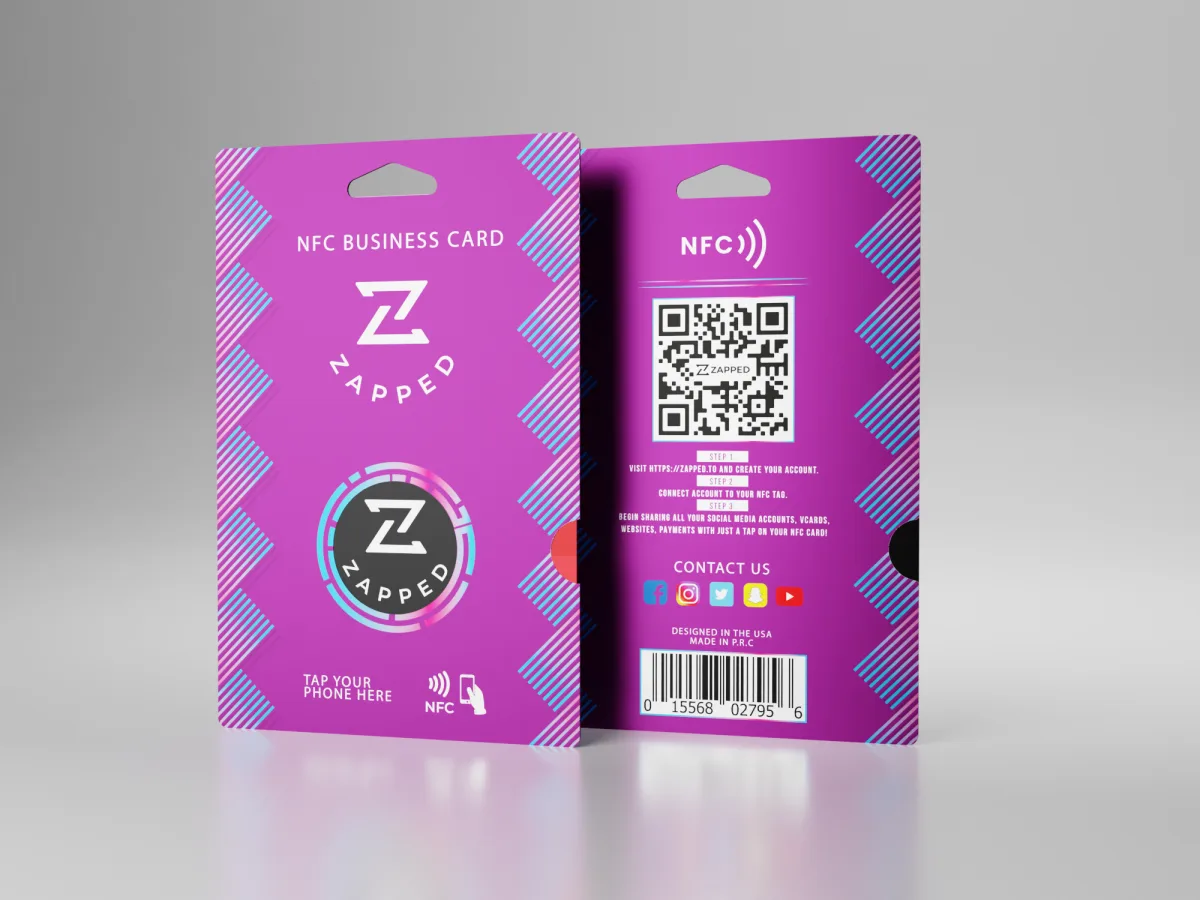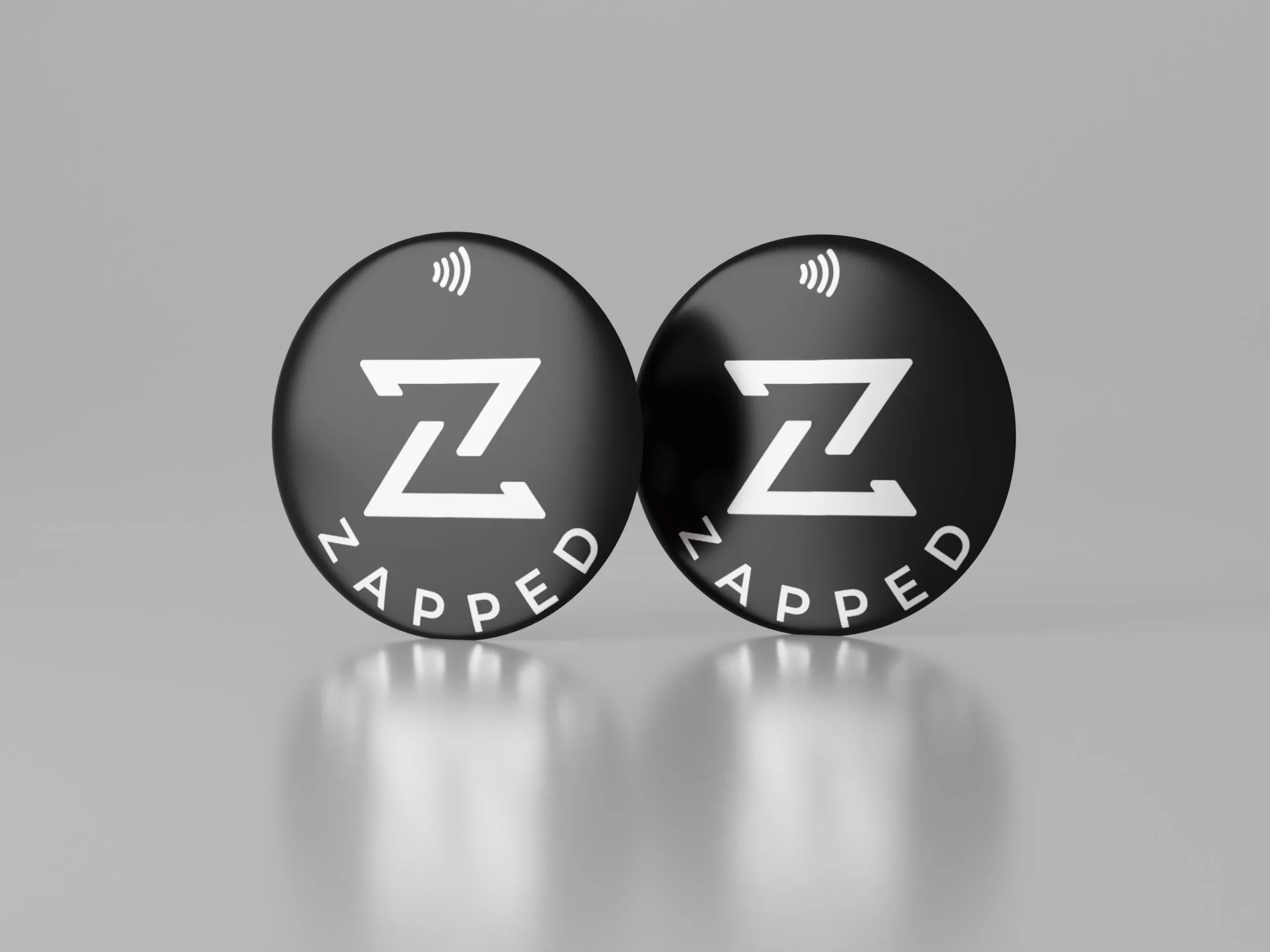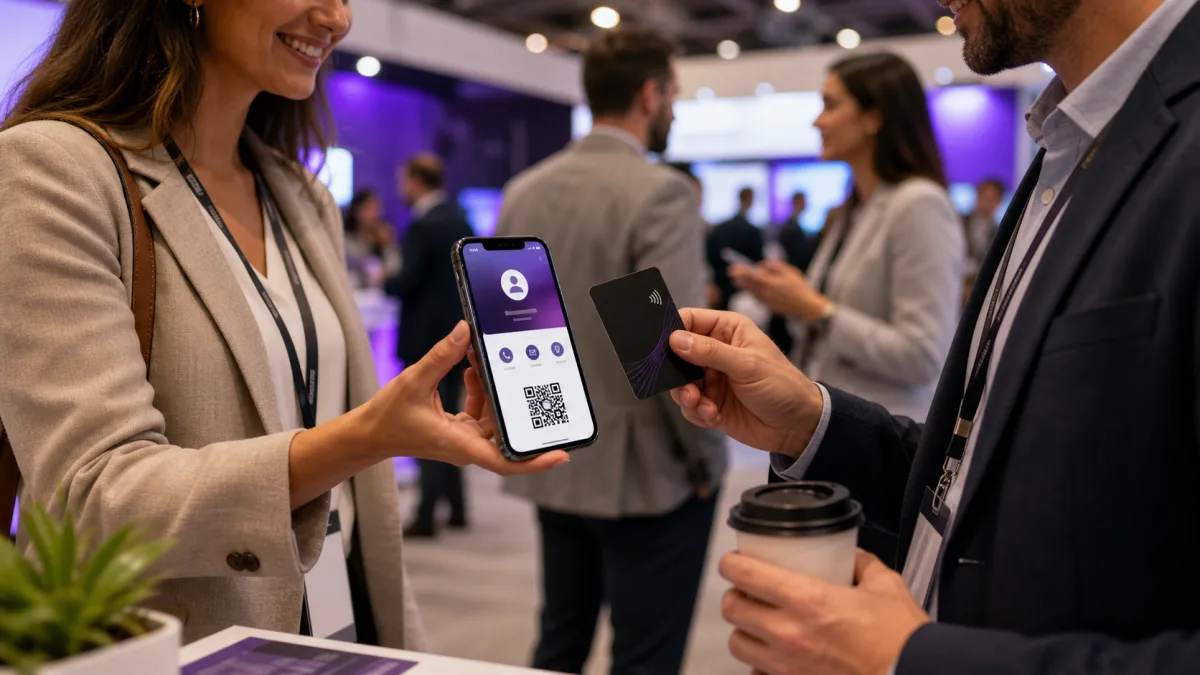
An NFC keychain business card is a small chip and antenna built into a fob you carry on a keyring, tapped against a phone to open a shared profile instead of handing over a paper card.
The two things that decide whether that shrink is worth it, the size of the antenna and who controls the link once you stop paying, are exactly what the shop pages selling these things leave out.
What an NFC keychain business card actually is
The mechanism itself is covered elsewhere. Our guide to how an NFC digital business card works walks through the chip, the tap, and the profile page in full.
We stay on what changes once that mechanism gets squeezed onto a keyring: a smaller antenna, and a maker who may or may not be running a subscription behind the sale price.
Who sells these keychains, and what they actually charge
No maker here is being called the best. The table below lays out the actual spread of prices and terms across the category, so you can compare instead of judging from a single shop page.
Across the makers below, a single keychain runs from about $5 to $25. Buying by the hundreds for a company rollout brings metal and wood keychains down closer to $5 per unit, but only at that volume.
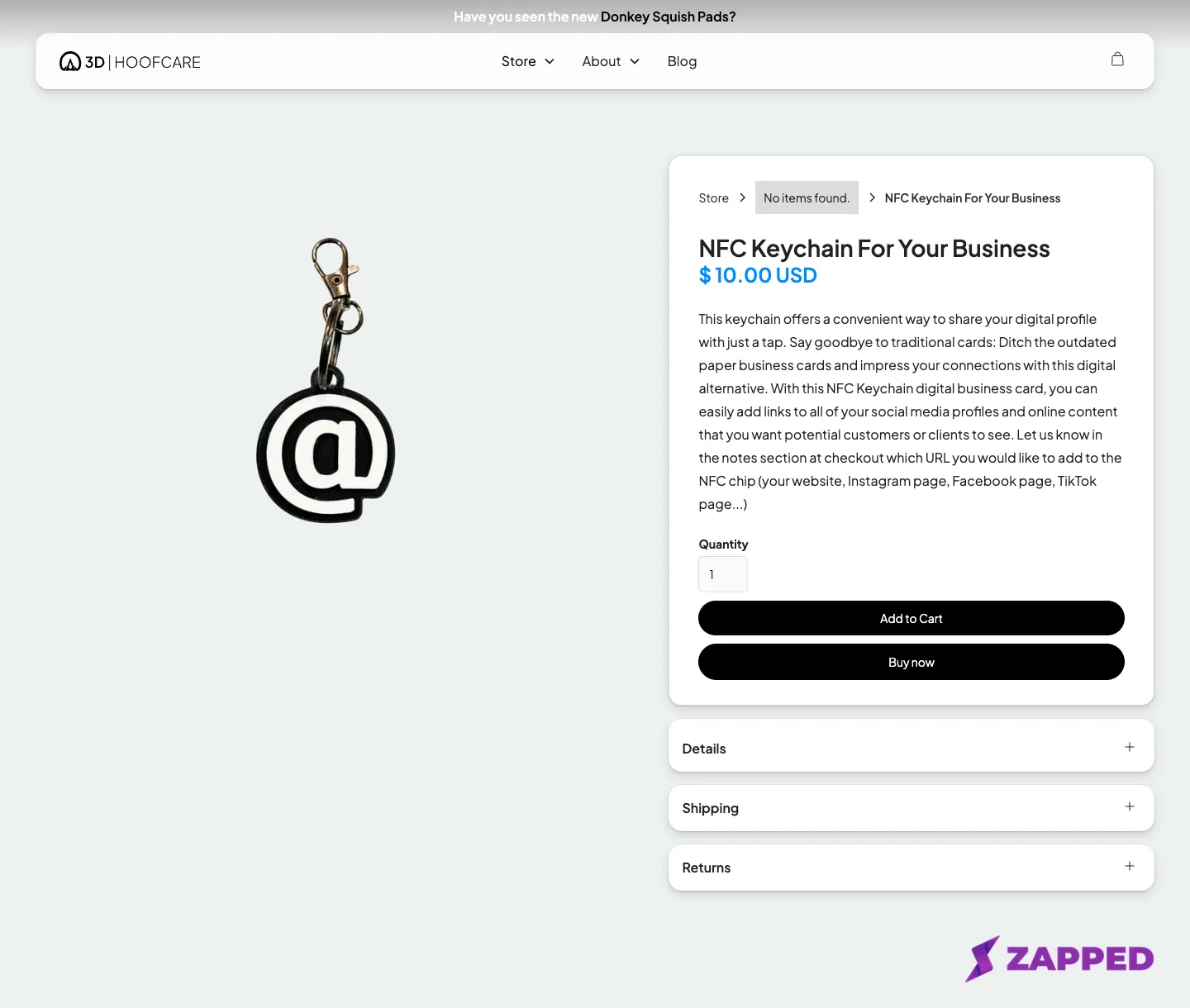
Source: 3dhoofcare, captured in August 2026.
| Maker | Price | Payment | Material | Rewritable |
|---|---|---|---|---|
| Tap Tag, Keychain Lite | $10.95 (sold out at capture) | Pay once, no subscription | Not stated | Not stated |
| Tap Tag, Custom | $23.95 | Pay once, no subscription | PVC with an epoxy bubble finish | Yes, through a dashboard |
| 3dhoofcare | $10.00 | Pay once, no subscription stated | Not stated | You email the URL at checkout instead of editing it yourself |
| TapKeychains | As low as $4.99 per unit at 200-plus units, or $23.95 at low volume | Pay once, no subscription, no app | Metal or wood at bulk pricing | Not stated |
| Contact Co | $24.99 | Pay once, no subscription | Chip called Apex Core; case material not stated | Yes, through an app |
| Etsy top listing | $7.99 (July 30, 2026 search capture) | Not stated | Not stated | Not stated |
Tap Tag's Keychain Lite is marketed as lighter than a dime and built to survive rubbing against other keys. Ordering ten or more of the custom keychain requires a separate bulk quote rather than a published discount.
Tap Tag's own wider collection ranges from $8.95 up to $99.95 for larger signage, none of it carrying a recurring fee, which shows how wide this category's price band really runs.
The Etsy price above is dated to a July 30, 2026 search capture. Etsy blocked every attempt to reconfirm it in early August, so treat it as a snapshot rather than today's price.
Wave Connect does not sell a dedicated keychain at all. Its closest form factor is a $23.00 NFC bracelet, sitting inside a card lineup that runs $23.00 to $75.00.
Popl's own Amazon listing is titled to warn shoppers about "Fake Knockoffs," which tells you how many imitation Popl style keychains are floating around under other names.
gettap.co, Tapt, Mobilo, and Popl each show up in their own sections below, since each raises a bigger question than price alone: a durability claim worth checking against the chip's own spec, what happens once a subscription lapses, or a price that never gets published at all.
Who owns the link once you stop paying
Three makers say this loudly, in their own words. Tap Tag's product page says plainly that it charges "No Subscriptions," just a single purchase, alongside "All Tap Tags come with a COMPLETELY FREE FOREVER software."
TapKeychains matches that promise almost word for word: "One Time Purchase, No Monthly Fees" and "No Subscriptions. No Apps." Contact Co puts it plainer still, describing its keychain as sold with "no subscriptions required."
Two other makers charge on a schedule instead, and they are just as plain about it. Tapt's Foundation tier carries no platform fee below five profiles, then $69 a year for five to nine, $139 a year for ten to twenty four, and a custom quote above that.
Mobilo runs a straight monthly subscription: $3 a month for Pro, $4 a month for Teams, $5 a month for Business, each bundling a physical card with the purchase. A promotional entry price of $5 for a Mobilo branded card, or $10 for a custom design, bundles ninety days of Pro free before billing starts.
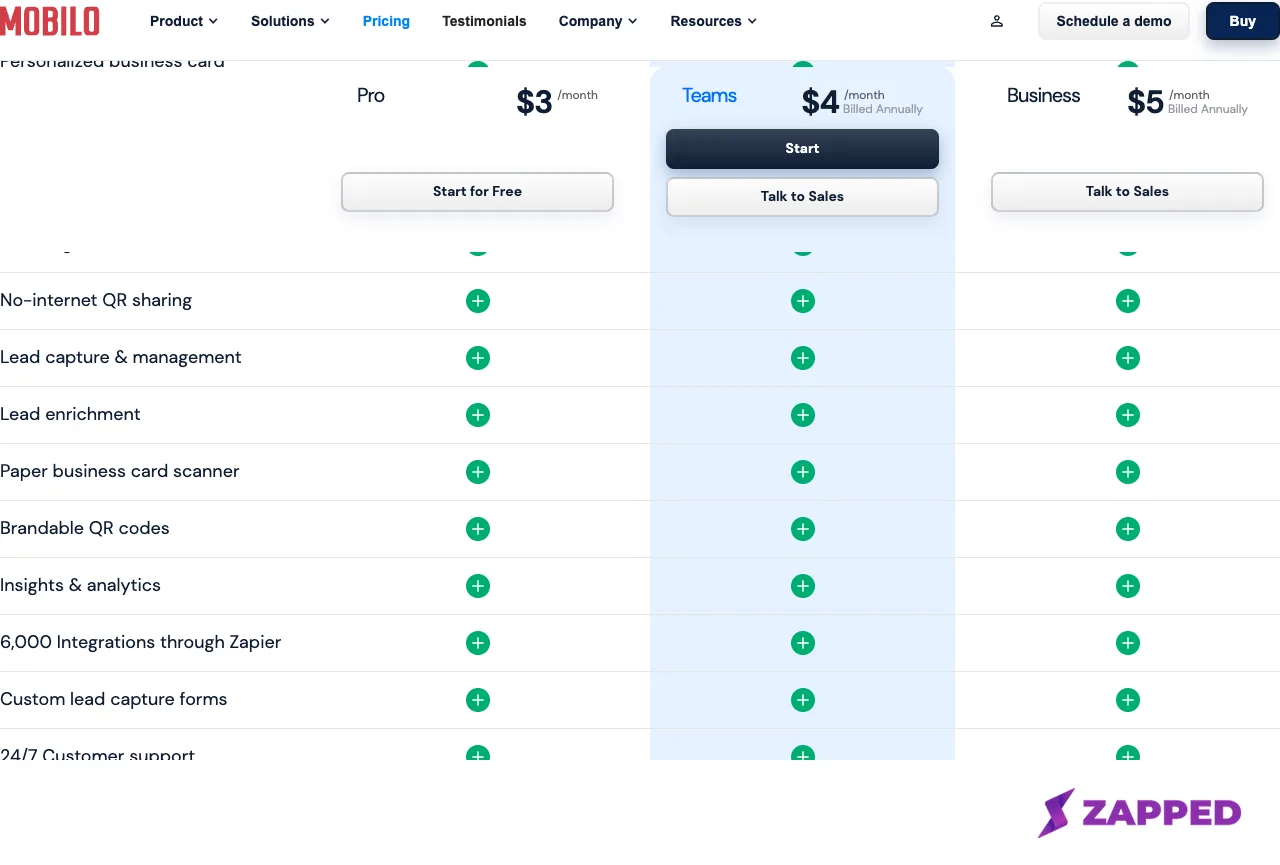
Source: Mobilo, captured in August 2026.
Neither Tapt's nor Mobilo's own pricing page says what happens to the physical fob once the account lapses. That is a silence, not a documented lockout, and it is worth naming as exactly that: two companies precise about their fees say nothing about what a nonpaying customer keeps.
Popl adds a third texture to the same theme. Its own pricing page will not quote a number at all. It says pricing is "customized for your exact needs" and that the company would rather "quote pricing over a meeting" than publish one online.
If the subscription question matters most to you, our full comparison of NFC business cards without a subscription runs the deeper analysis we don't repeat here.
Why a keychain's antenna struggles against your metal keys
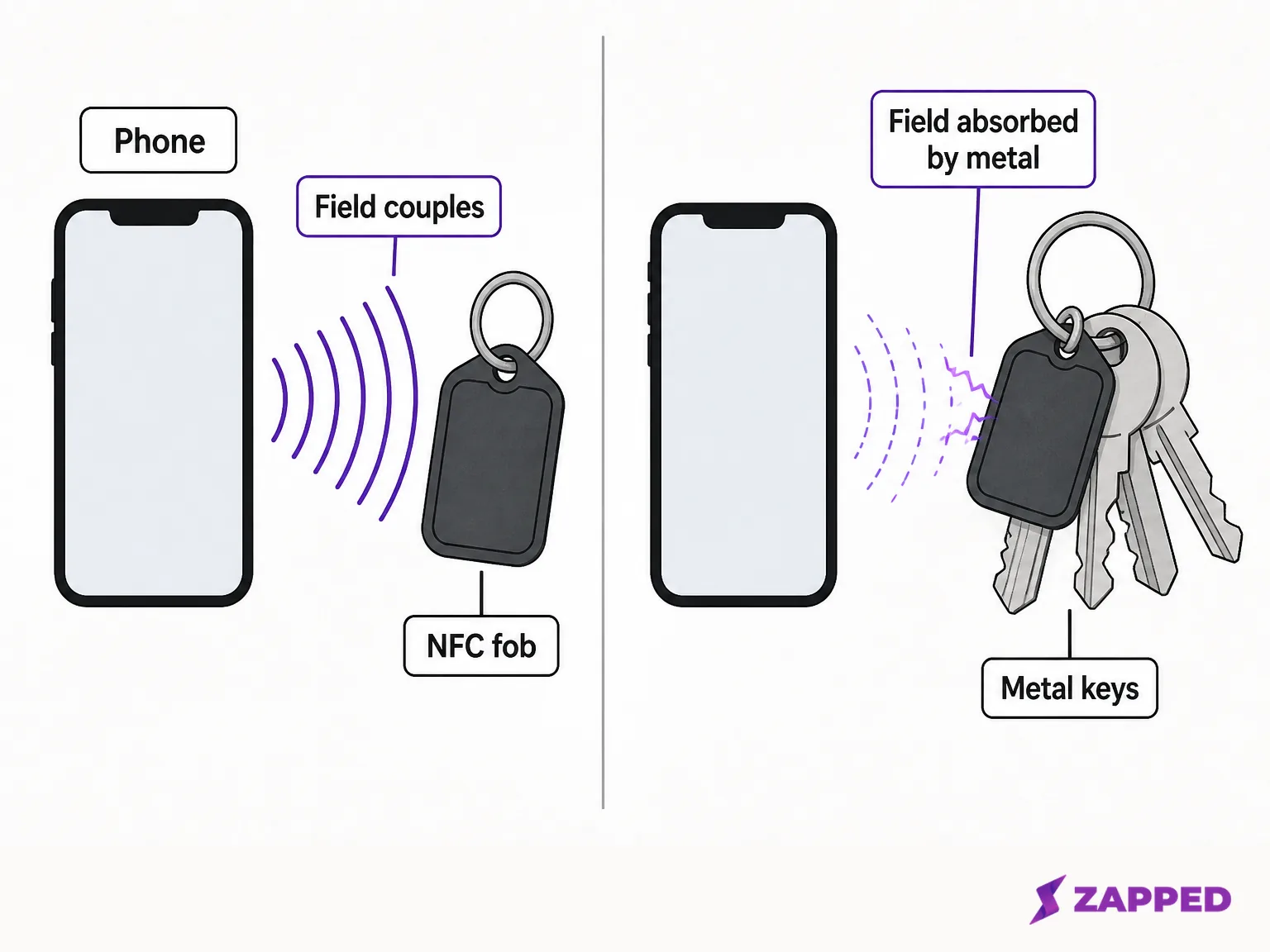
A phone typically needs to close to within about 4 centimeters, roughly 1.6 inches, before an NFC reader's field and a tag's antenna couple enough to exchange data, according to AndroidPolice's guide to how NFC tags work.
Shrinking that antenna to fit a keyring is the tradeoff a keychain fob makes. DTB NFC, a manufacturer that measures its own tags, reports that compressing the antenna to a compact size commonly drops range from 4 to 5 centimeters down to 1 to 2, even under otherwise ideal conditions.
That is one manufacturer's own measurement, not a universal constant. But it points at the mechanism plainly: less antenna means less range.
Then there is metal, which every keychain lives next to. NFCFYI explains that a conductive surface next to an antenna creates eddy currents that fight the reader's field, which can collapse a 4 centimeter read range down to zero.
Metal does not block the field the way a wall blocks light. It absorbs and conducts it instead, which is worse for a tap than a simple obstruction would be. A sticker stuck directly onto a metal laptop lid or product casing runs into the same absorption problem. See NFC sticker vs NFC business card for how that plays out for stickers specifically.
Kisi Academy, an access control hardware company with no stake in the keychain market, puts a ceiling on the whole picture: typical NFC range tops out around 10 centimeters even with nothing in the way. A fob that has already lost most of that range to a small antenna has very little left to lose to a ring of house keys.
Two official range figures describe this differently, and they are not actually in conflict. The NFC Forum's own Certified Compliant floor is just 5 millimeters, with a typical range up to 2 centimeters, while NXP's chip datasheet lists an operating distance up to 100 millimeters for the bare chip.
The Forum figure is a certification minimum. NXP's is a best case ceiling that depends on field strength and antenna geometry, exactly the geometry a keychain fob shrinks.
Where a fob has to sit against metal, the fix is a ferrite shielding layer between the antenna and the metal surface. NFCFYI recommends at least 0.3 millimeters for aluminum and 0.5 millimeters for steel, a spec none of the keychain vendors named here disclose on their own product pages.
Keeping the fob readable once it's on your ring
Two more things wear on a keychain fob that a flat card rarely faces. Repeated bending or pressure, exactly what a fob absorbs banging against other keys all day, can create small cracks in the antenna trace.
DTB NFC reports these cracks are often invisible to the eye but still break the circuit the tag needs to respond to a reader.
Moisture is the second risk. Water and other high moisture materials absorb energy at NFC's operating frequency, which DTB NFC documents as a way a wet pocket or a keyring caught in the rain can degrade a tap before any visible damage shows up.
The one thing you control directly is which face of the fob touches your keys. Custom artwork or a wrap that covers the antenna face reintroduces the same metal problem described above, so keep the chip side turned away from your keys and anything else metal on the ring.
If you plan to decorate the fob yourself, our guide on how to avoid blocking the NFC tap covers exactly what artwork and wraps do to the antenna underneath.
What actually fits on the chip
The NTAG213, the chip in most inexpensive fobs, holds 144 bytes of usable memory. Its siblings hold more, according to NXP's own product page for the family.
| Chip | Usable memory |
|---|---|
| NTAG213 | 144 bytes |
| NTAG215 | 504 bytes |
| NTAG216 | 888 bytes |
In practice, 144 bytes holds roughly a 130 character URL once NDEF compression is counted, too small for a full vCard contact record. Wakdev's knowledge base explains this is exactly why nearly every fob in this category redirects to a hosted profile instead of storing your contact fields directly on the chip.
Two separate protections exist, and buyers often mix them up. One is a permanent lock: once applied, the tag can never be rewritten again, worth avoiding unless you are certain the link will never change. The other is a reversible password, 32 bits long, that restricts access without freezing the tag for good.
Whether your phone will actually read it
On iPhone, the cutoff is specific. The SE (2nd generation) and later, along with the XR, XS, XS Max, and the 11 through 13 series, read tags automatically with the screen on, no app needed, according to Apple's own iPhone guide.
The 7, 7 Plus, 8, 8 Plus, and X can also read tags, but only after you manually turn on NFC Tag Reader in Control Center, and only for that one session.
| Device | NFC behavior |
|---|---|
| iPhone SE (2nd gen)+, XR, XS, XS Max, 11 to 13 | Reads automatically, no app needed |
| iPhone 7, 7 Plus, 8, 8 Plus, X | Reads only after manually enabling NFC Tag Reader each session |
| Android | Settings toggle, on state varies by device |
On Android, NFC reading is a Settings toggle, and Google's own Wallet help is direct that it is not guaranteed to already be on, since it is device dependent. That toggle, not a defective tag, is the first thing worth checking before you assume a fob is broken.
The vendor's durability claim, checked against the chip's own spec
gettap.co markets its keychain as rated for "10 Years Lifetime and up to 200,000 number of scans," without naming which chip is inside.
NXP's own datasheet for the NTAG21x family, which underlies most fobs in this category, states 10 years of data retention and 100,000 write cycles. That is a narrower, different claim than 200,000 scans: write cycles count how many times the tag's contents are rewritten, not how many times a phone can tap it to read.
The two figures are not necessarily incompatible, since a tag can be read far more often than it is rewritten. But gettap.co's own page never makes that distinction, and of the makers named here, only Tap Tag and Contact Co name a specific chip family, NTAG213, alongside their durability claims.
The DIY route to a keychain fob
You do not need a named maker to get a working keychain. A blank NTAG213 or NTAG215 keyfob costs a few dollars in a multi pack from any of several sellers, sold as a generic tag anyone can program rather than a branded product. If a flat card fits your use case better than a fob, the full walkthrough for building one at home covers the same blank-tag approach in card form.
NFC Tools by Wakdev, a free app with an optional paid Pro tier, writes a URL, contact, phone number, address, Wi-Fi, or Bluetooth record straight to a blank tag. It is also the app the NFC Forum's own product showcase links to for reading and writing tags on iOS and Android.
The 144 byte ceiling from the chip section above means the fastest path is a short redirect link, not a full contact record.
One correction worth making plainly: writing a tag is not something only Android phones can do. From the iPhone 7 running iOS 15.6 or later, NFC Tools can start a scan manually and write the tag directly from the phone.
For the full walkthrough, see our guide to how to program an NFC tag. If you are on Android specifically, the steps to write a new link to the fob with Android are laid out separately.
Rewriting the link later, if a job changes or a phone number updates, is well within the chip's rated 100,000 write cycles and 10 year retention. Wear is not a real constraint on casual reuse. For how this plays out across card materials generally, not just keychain fobs, see are NFC business cards reusable.
You also do not need a named maker to get a working profile behind the fob. Zapped's card sharing supports QR, link, and NFC tap on every plan, including Free, so a blank fob pointed at a Zapped card you control does the same job as a branded keychain.
The help center walks through programming an NFC business card step by step, so the capability is documented, not just claimed.
One limit worth knowing before you commit: the Free plan includes one card with five content blocks, so anyone wanting more than a single profile will want Starter or above.
Since NFC reading depends on your phone's model and settings, as the compatibility section above shows, a DIY buyer benefits from a QR fallback on the same tag. Our guide to adding a QR code backup covers exactly that.
Verdict: keychain or flat card
A keychain suits someone who wants their tag on them without a second item to carry, and accepts the range and metal tradeoffs already covered for that convenience. Field staff, booth staff, and anyone stationed at an event badge table are the clearest fit, since they already carry their keys everywhere a card would just sit in a bag.
Even there, a booth surrounded by other exhibitors' metal signage is no friendlier to a keychain than your own keyring is.
It also suits someone who either buys from a maker that states its terms plainly, the makers who charge only once, named earlier, or who goes the DIY route to sidestep the subscription question entirely.
A flat card suits everyone else. It suits anyone who wants the more reliable tap first, since a card's larger antenna does not share a ring with metal keys. For what a standard flat card and its profile actually cost across named sellers, see how much an NFC business card costs.
It suits anyone who wants a bigger writable chip for a fuller profile, and anyone unwilling to bet on a maker's silence about what happens after a subscription lapses.
For a broader look at how digital business cards for teams typically differ between field, remote, and event roles, our team sharing guide covers the rest.
If that is you, our guide to compare standard NFC business cards is the next stop.
Sources
Sources are current as checked in August 2026, except the Etsy figure, dated to a July 30, 2026 search capture.
- Tap Tag, Custom NFC Keychain
- Tap Tag, NFC Keychain Lite
- Tap Tag, keychains and signs collection
- 3dhoofcare, NFC Keychain For Your Business
- TapKeychains, digital profile collection
- Contact Co, Smart Keychain
- gettap.co, Tap NFC Leather Keychain product page
- Tapt pricing
- Mobilo pricing
- Popl pricing
- Popl, Amazon keychain listing
- Wave Connect, NFC products collection
- NXP, NTAG213/215/216 product page
- Wakdev, NTAG213 knowledge base
- Wakdev, NFC Tools app
- NFC Forum, NFC technology overview
- NFC Forum, product showcase for NFC Tools
- Apple, iPhone NFC Tag Reader guide
- Google Wallet Help, turning on NFC
- AndroidPolice, NFC tag guide
- DTB NFC, why NFC tags stop working
- NFCFYI, NFC on metal guide
- Kisi Academy, RFID and NFC interference
- Zapped help center, programming an NFC business card