NTAG213, and you can stop reading in about four minutes. A business card carries a link, an NTAG213 holds a link of roughly 136 characters, and almost no profile URL comes close to that ceiling.
The chip is the least consequential decision in this purchase.
Which is awkward, because the part number is usually the only thing a seller gives you to compare. Two NFC business cards sit in the cart, one costs more, and the difference is a number in a spec table nobody sourced. Here is where that number comes from, and why it is not what decides whether the card reads.
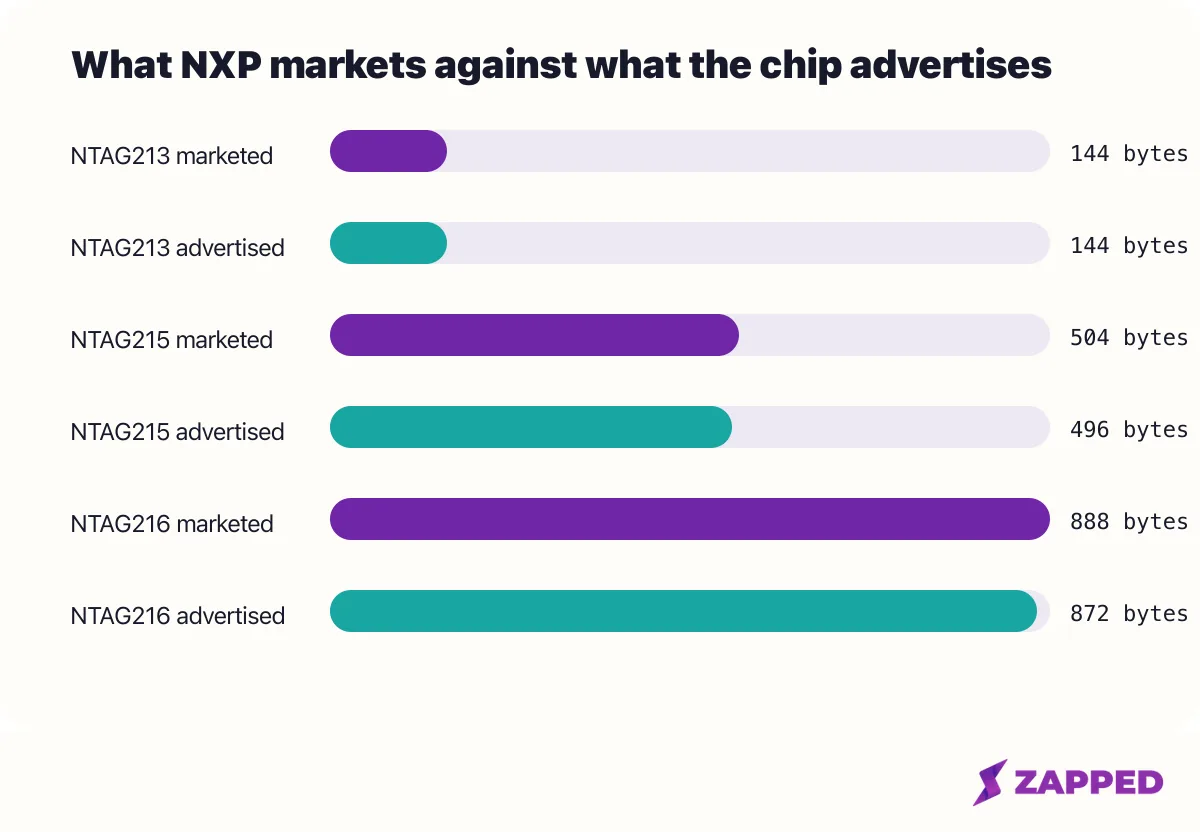
NXP markets 504 bytes. The chip tells your phone 496.
NXP publishes two different capacity figures for the same three chips, and both are its own. The product page sells 144, 504 and 888 bytes of user memory, and those figures sit in the page title. The data sheet puts the capability container's NDEF memory size at 144, 496 and 872.
The second set is what the chip tells a phone. The first set is the one that travels.
Source: NXP product page and NTAG213/215/216 data sheet Rev. 3.2, captured 2026-08-06.
Where the missing bytes go
Total memory on these chips is larger than the user area. NXP lists 180, 540 and 924 bytes across 45, 135 and 231 pages of four bytes each, of which 26 bytes are reserved for manufacturer and configuration data, plus the lock bits and a capability container of four bytes. What is left over is the user area everyone quotes.
Then the capability container advertises less again on the two larger parts: 8 bytes less on an NTAG215, 16 less on an NTAG216. An NTAG213 buyer is the only one of the three quoted a number they actually get.
What your phone actually reports
An Android phone asks the tag for its maximum NDEF message size and gets the capability container value back, not the raw user memory. Google's published documentation defines that call in exactly those terms.
So a writing app is working against 496 on an NTAG215, not 504. If you have ever written a tag from an Android phone and wondered why the reported capacity looked slightly mean, that is why.
How much URL actually fits, worked out
Bytes are the wrong unit for a buyer. Characters of URL are the right one, and the conversion is short enough to show in full.
Encoded as a single URI record, a link costs eight bytes of overhead on top of its own characters. Google's own encoder for Android accounts for five of those, and the other three are Type 2 Tag framing that NXP's delivery state shows sitting on the tag from the factory.
| What consumes it | Bytes |
|---|---|
| NDEF message tag byte | 1 |
| Message length field | 1 |
| Record header, type length, payload length | 3 |
| Record type, the single letter U | 1 |
| URI identifier code, which stores the prefix | 1 |
| Terminator byte | 1 |
| Total | 8 |
Subtract that from what each chip advertises and you get 136 characters on an NTAG213, 488 on an NTAG215, and 864 on an NTAG216. The prefix is free: the URI record format stores https:// as that one identifier byte rather than eight characters, so a 144 character link still fits the smallest chip.
Two corrections belong with those numbers, and both push down rather than up.
Past 254 characters the encoding switches to a longer record and overhead grows from eight bytes to thirteen, which puts an NTAG215 near 483 and an NTAG216 near 859. An NTAG213 can never reach that boundary, so it always stays on the short path.
An NTAG213 also leaves the factory with a lock control block of five bytes at the start of its user memory, which an NTAG215 and NTAG216 do not have.
An encoder that preserves those bytes has nearer 131 characters to work with. Whether a given tag writing app preserves them is not settled anywhere in NXP's public documentation.
That is where the tooling figure comes from. wakdev, who builds NFC Tools, documents 144 bytes as holding a URL of around 130 characters, and the gap between that and 136 is those lock bytes rather than a disagreement about the chip.
Even the smallest common chip holds a link far longer than a profile URL needs to be. That is where capacity stops being a decision and starts being trivia.
The one controlled test says the antenna decided it, not the chip
GoToTags ran the one controlled read distance comparison in this category, and its headline finding was not about chips at all. The variance it observed between suppliers, it reported, pointed to antenna design and production control dominating range more than the chip family did.
A custom rig held the reader at a measured height above each card. The cards sat in a jig on a surface with no ferrous metal in it, and every tag carried the same twelve character link.
Ten production cards were sampled per chip type, across five card types, read by an iPhone 11 and a mountable ACS reader.
Its worst performer is the interesting part. Generic NTAG215 cards bought on Amazon read at the shortest distances and with the widest spread of any sample, which the testers attributed to antenna design and manufacturing quality rather than chip architecture. NXP's own originality signature verified those chips as genuine.
Real silicon, badly built card, beaten by cheaper silicon in a better one.
Two more sources point the same way
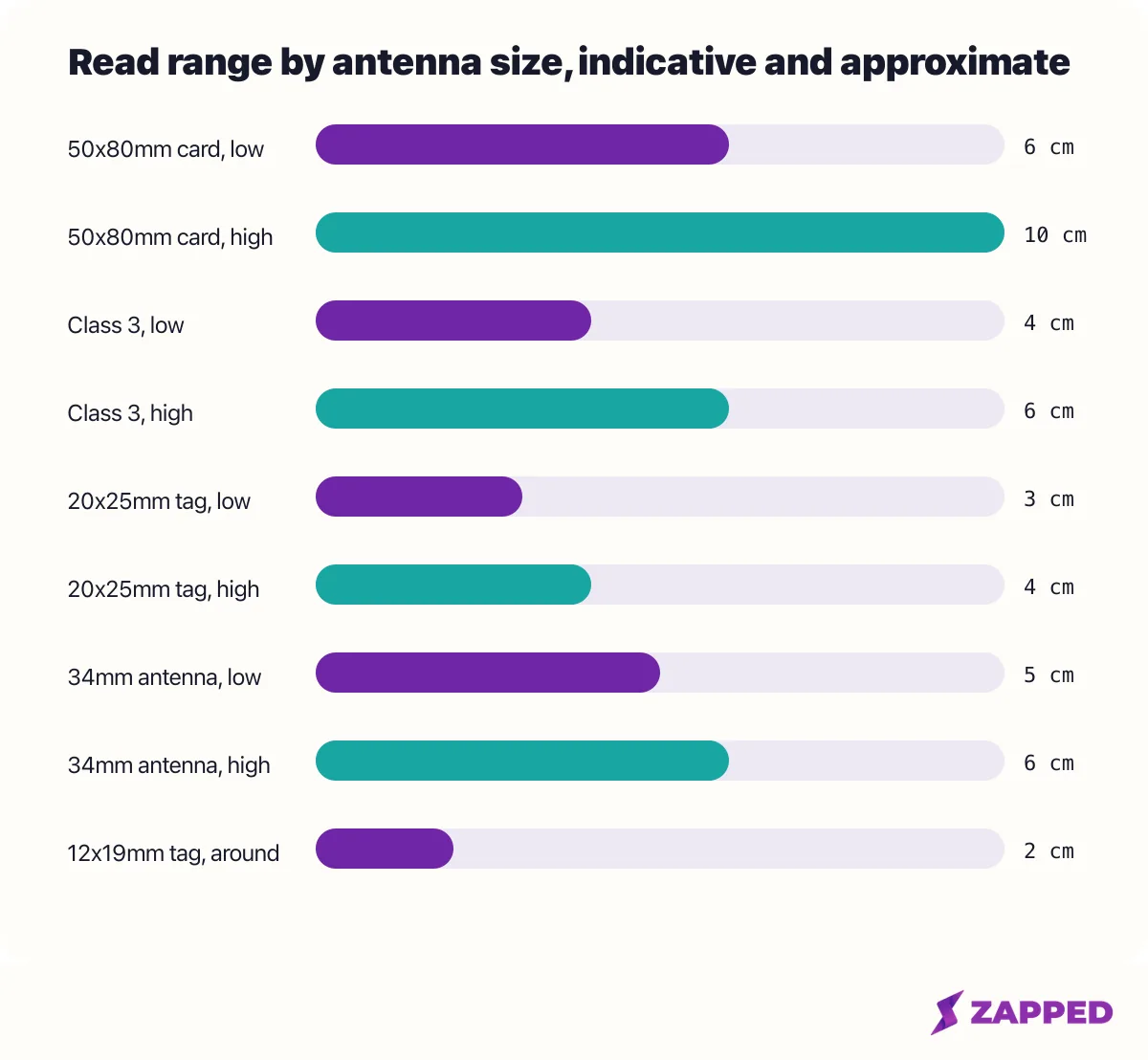
JL. Lebon, posting as an ST Microelectronics employee, gives smartphone read ranges by antenna class: 6 to 10cm for a credit card size antenna of 50 by 80mm, and 3 to 4cm for one of 20 by 25mm. He calls the figures only indicative and approximate, since smartphones vary in antenna size and power. His mechanism is plain, that a larger loop captures more of the field.
ST makes competing silicon and has no stake in which NXP part you buy.
Seritag, which converts tags rather than making chips, reports the same NTAG213 getting 5 to 6cm on a 34mm antenna and about 2cm on a tag of 12 by 19mm. Those are stated production expectations rather than a published data set. They point where GoToTags points.
NXP prints an operating distance of up to 100mm for the family and says it depends on field strength and antenna geometry. Read that as a ceiling for the chip with an ideal antenna. It is also the same number on all three parts, so it cannot separate them.
Source: JL. Lebon, an ST Microelectronics employee on the ST community forum, who calls his figures only indicative and approximate, and Seritag, captured 2026-08-06.
Where that argument stops
Chip choice does move range when the silicon genuinely differs. Seritag reports MIFARE Ultralight C, which carries an encryption engine, scanning at under a third the distance of a simpler NTAG213. GoToTags measured Type 5 chips reading roughly 1.5 to 2 times further than Type 2 chips like these.
So the claim is narrow, and worth keeping narrow. Within NTAG213, NTAG215 and NTAG216, which differ in how much memory they carry rather than in how they talk to a reader, the antenna and the build decide it.
Nobody has isolated NTAG213, 215 and 216 on the same antenna
The experiment this question implies has not been published. GoToTags compares protocol families and samples different card builds; it does not hold the antenna constant across the three memory tiers.
Nothing else comes close. No named publication has reviewed physical NFC business cards with a documented method the way it would review a phone, and the pages that claim tests sell the products they rank.
That absence is the whole reason spec tables run this category. A byte count is the only thing here that looks like objective information, so buyers rank chips because chips are the only thing anyone ranked for them.
It also means the honest answer has to be built from antenna and build evidence. There is no chip against chip range chart to read it off.
The decision matrix, and the rows that are not differentiators
Seven parts a card buyer might plausibly be offered, ten criteria applied identically to every one of them. Cells reading Not published are figures the relevant product pages do not carry.
| Criterion | NTAG213 | NTAG215 | NTAG216 | NTAG213 TT | NTAG 223 DNA | NTAG 224 DNA | NTAG 424 DNA |
|---|---|---|---|---|---|---|---|
| NFC Forum tag type | Type 2 | Type 2 | Type 2 | Type 2 | Type 2 | Type 2 | Type 4 |
| User memory as marketed | 144 bytes | 504 bytes | 888 bytes | 144 bytes | 144 bytes | 208 bytes | 416 bytes in a file system |
| NDEF memory the chip advertises | 144 bytes | 496 bytes | 872 bytes | Not published | Not published | Not published | 256 byte NDEF file |
| URL characters that fit, prefix free | 136 | 488 | 864 | Not published | Not published | Not published | Not published |
| Access protection | Password, 32 bits | Password, 32 bits | Password, 32 bits | Not published | Password, 32 bits | Mutual authentication, AES-128 | AES-128 secure messaging |
| Anti clone story | Seven byte UID, ECC originality signature | Same | Same | Not published | SUN authentication, ECC signature | SUN authentication, ECC signature | SUN, random ID, encrypted UID, EAL4 |
| Extra behaviours | None a card uses | None a card uses | None a card uses | Tamper wire | Not published | Not published | Not published |
| Phone compatibility (same everywhere) | Any NFC phone, by tag type | Same | Same | Same | Same | Same | Same |
| Retention and endurance (same everywhere) | 10 years, 100,000 writes | Same | Same | Not published | Same | Same | Not published |
| Business cards listed by NXP | Yes | Yes | Yes | No | No | No | No |
Two of those rows return the same answer in every column, and saying so is more useful than inventing a difference. Retention and write endurance are 10 years and 100,000 cycles wherever NXP publishes them.
Phone compatibility is a tag type question, not a chip question. Apple's framework reads NFC Forum types 1 through 5, Android requires every NFC phone to handle types 1 through 4, and neither Apple's Core NFC overview nor Android's NDEF documentation makes any chip model a requirement or an exclusion.
That has exactly one legitimate caveat, and it is about the handset. Apple's guide for iOS 14 lists iPhone XS and later as reading tags without opening an app, and iPhone 7 through X as needing the tag reader switched on in Control Center.
Two more rows are noise inside the NTAG21x family, and so is the criterion this table leaves out. The UID is seven factory programmed bytes on every one of them, and the printed read range is the same 100mm. Password protection is the same 32 bits, and NXP describes it as restricting memory operations, not as encrypting the tag or authenticating whoever is holding it.
Now the row that pays for the table. Every part NXP positions as more advanced than an NTAG215 gives a card buyer less writable room, not more.
NTAG 424 DNA's NDEF file is 256 bytes. NTAG 224 DNA has 208 bytes of user memory, NTAG 223 DNA has 144, and NTAG213 TT has the same 144 as a plain NTAG213 plus a wire that detects a broken seal on a package.
The specification ladder and the capacity ladder run in opposite directions.
What actually goes on the chip
A link. Almost always just a link, which is why programming an NFC business card is mostly the act of writing one URL and then never touching the tag again.
The evidence for that is where people fail. Reviewers of NFC Tools keep reporting the contact record failing while URL records work.
FookVrbo wrote in February that a contact tag reported itself written but would not scan on anyone's phone. Bettoman in May, that the contact section would not work. In the same month mowens1019 described the workaround he had arrived at himself, which was to host the details on a public page and write the link to the tag.
None of those people diagnosed a chip, and they are evidence about what buyers run into rather than about cause. Held next to the arithmetic, though, they push the same direction: the payload that survives contact with other people's phones is a URL, and a URL is small.
Zapped is built on that shape. The card is a public web page, so whoever taps it opens it in an ordinary browser with no app to install and no account to create, and saves the contact from there.
Because the page is live, the link you write to the tag never has to change when your title or your number does.
A working tap tells you nothing about what you bought
The chip barely decides how the card performs. It does decide what you were sold, and that is a separate question with a checkable answer.
A tag that fails NXP's own authenticity check will still tap perfectly. That is the uncomfortable part, and it is why "it works" is not an answer to "is it real".
On NXP's own community forum, a buyer posting as SudoSC described a range of NTAG21x tags bought from Amazon that behaved exactly as expected, counter mirror feature included. Every one of them came back from NXP's TagInfo app as a clone tag whose signature could not be verified against NXP's public key.
Two days later Fabian_R of NXP TechSupport answered on the record. NXP provides no support for those products, he wrote, and recommends not relying on them because the chip may be vulnerable.
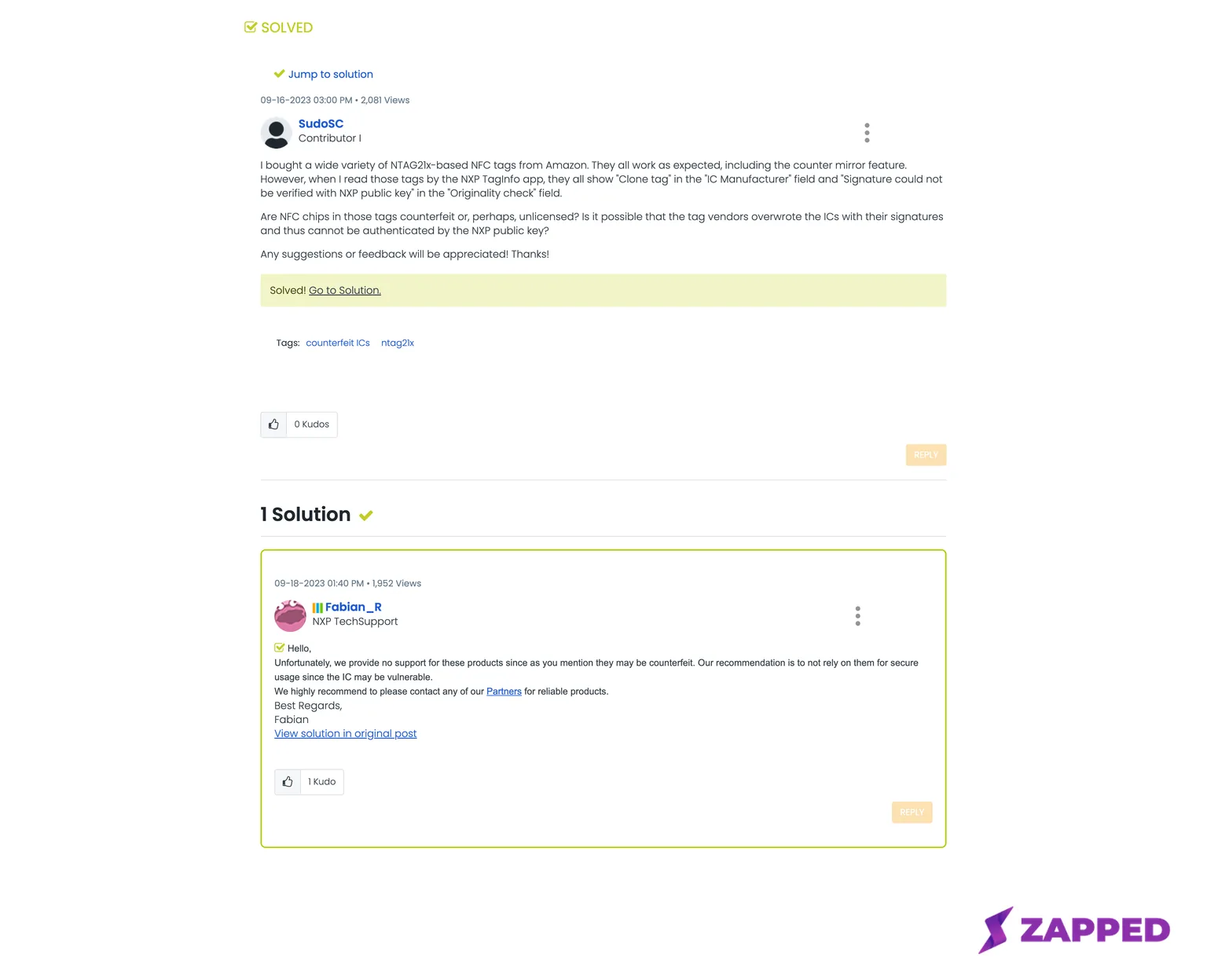
Source: NXP Community, thread opened 2023-09-16 and answered 2023-09-18, captured 2026-08-06.
One buyer, one batch, and worth reading as exactly that. What lifts it above forum noise is who replied, and that he did not dispute the diagnosis.
The ordinary tap never runs this check anyway. GoToTags notes that software reading only the NDEF data, which is what background tag reading on an iPhone does, cannot read the originality signature at all.
You can run it yourself in about five minutes. NFC Tools added signature verification for NTAG21x on iPhone in its 3.0 release, alongside the tag type and the memory size.
That last part is the sleeper. It is also how you find out whether the part number on the invoice is the part number in the card. If you are not yet sure what you are holding is an NFC tag at all, start one step back.
The check has a limit worth stating. GoToTags points out that a highly configurable chip allowing UID and signature manipulation could copy a valid tag undetectably. It still separates ordinary counterfeit stock from genuine parts, which is more than a tap does.
Why these cards die in the field, and it is never the memory tier
Amiibo Doctor, who has written a very large number of these tags by hand, names cold weather during shipping as generally the leading cause of broken NTAG chips. Bending is the other one: an NTAG chip cannot be bent without breaking.
Those are estimates from long experience rather than measurements. They are still more useful than a spec sheet here.
His diagnostic rule is worth stealing outright. One dead chip is a chip. Several dead chips in a row is your writer, or how you are holding it against the writer.
Set that against the number every comparison table leads with. Write endurance is 100,000 cycles, identical on all three parts, and nobody rewrites a business card a hundred thousand times. Cold and bending are the risks you will meet, not endurance.
Why NTAG215 is everywhere, and it has nothing to do with cards
Nintendo. Amiibo data is formatted specifically around NTAG215, an NTAG213 cannot stand in for it, and an entire hobbyist supply chain has grown up around blank NTAG215 stock as a result.
That community's own guidance is that the chips are interchangeable no matter who sells them, which flatly contradicts the supplier variance GoToTags measured. Both can be right, because they are answering different questions.
Writing an amiibo needs one successful write at contact distance, where antenna quality is invisible. GoToTags measured the greatest distance at which a first read succeeds, where it is anything but. Same chips, different test, different answer, and neither one is wrong.
For a card buyer the practical reading is blunt: the demand holding all that NTAG215 stock in place is a Nintendo compatibility requirement you will never use. What a finished card should cost is a separate question and a more useful one to ask.
What to buy
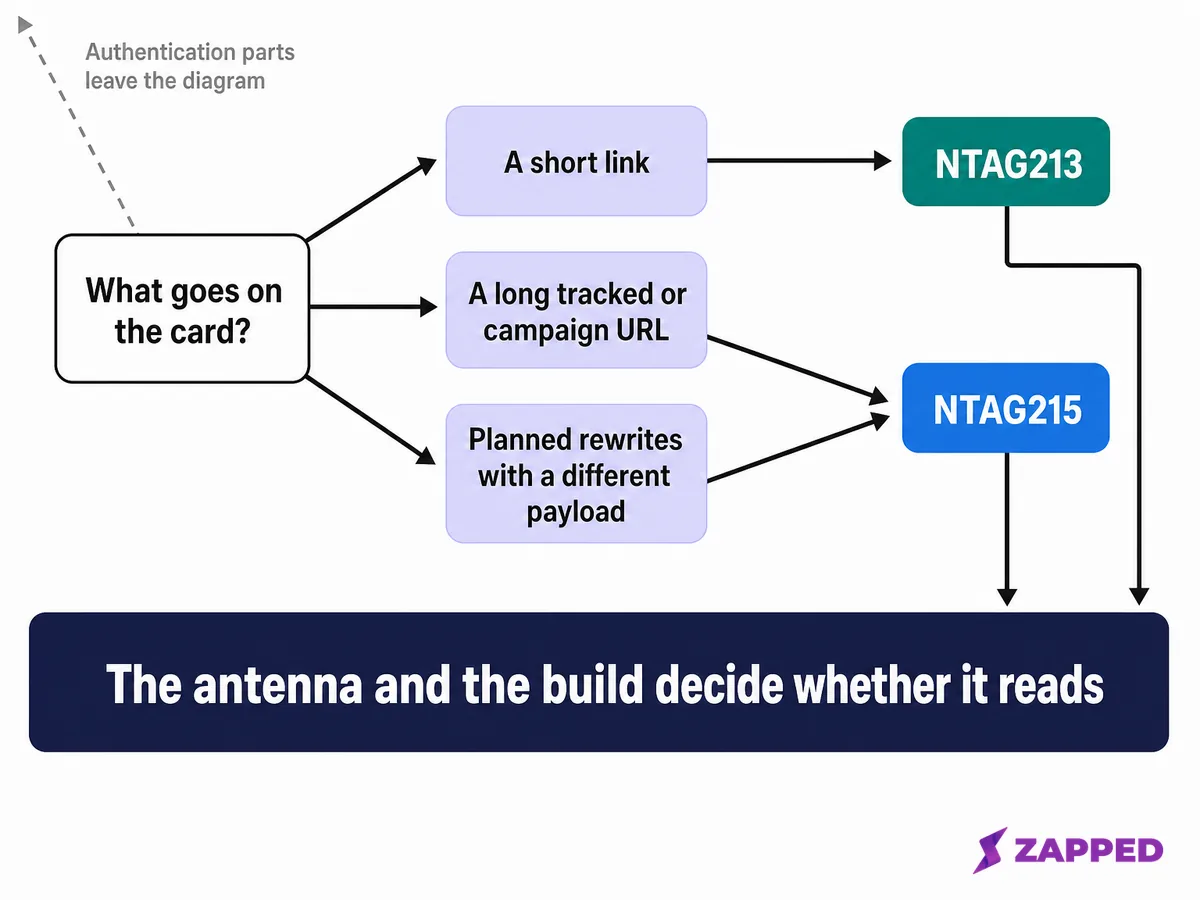
NTAG213, in a card that is built properly. Its 136 characters cover the overwhelming majority of profile links, and nothing else in the NTAG21x feature list differs at all. Same UID, same password, same retention, same printed range.
Spend the difference on the card, not the chip. Ask the seller what antenna size is inside, because that is the variable the evidence actually moves on. A converter who cannot answer has told you something useful about the converter.
Take NTAG215 only for a named reason. Long tracked or campaign URLs that run past 136 characters, or a plan to rewrite the same card with different payloads for different events. Future proofing is not a reason, it is a phrase.
NTAG216 is hard to justify for a business card. 864 characters solves a problem a card does not have.
The authentication parts are the wrong product. They trade writable room for anti counterfeiting and supply chain features, and NXP does not list business cards among their applications. If you want a finished product rather than blanks, the cards themselves are the decision that matters more.
What would change this. A published test isolating the three tiers on identical antennas, which would tell us whether the memory tier moves range at all. Or a payload that genuinely outgrows a link, which would put the capacity ladder back in play. Neither exists today.
Sources
- NXP, NTAG213/215/216 product page, checked 6 August 2026.
- NXP, NTAG213/215/216 data sheet, Rev. 3.2, 2 June 2015, document 265332.
- NXP, NTAG 213 TagTamper product page, checked 6 August 2026.
- NXP, NTAG 223 DNA and NTAG 224 DNA product page, checked 6 August 2026.
- NXP, NTAG 424 DNA product page, checked 6 August 2026.
- NFC Forum, specification catalogue, checked 6 August 2026.
- Apple, Core NFC framework documentation, checked 6 August 2026.
- Apple, iPhone User Guide, models that support NFC Tag Reader, iOS 14 edition, checked 6 August 2026.
- Google, Android NDEF class documentation, checked 6 August 2026.
- Google, Android NdefRecord class documentation, checked 6 August 2026.
- GoToTags, comparative analysis of NFC chip types and reading distance, published 23 October 2025, checked 6 August 2026.
- GoToTags, NFC chip originality signature, checked 6 August 2026.
- JL. Lebon, ST Microelectronics community, antenna size and reading range, answered 6 March 2024, checked 6 August 2026.
- Seritag, NFC tag scan distance explained, checked 6 August 2026.
- NXP Community, counterfeit NTAG21x ICs in retail NFC tags, opened 16 September 2023, answered 18 September 2023, checked 6 August 2026.
- wakdev, NTAG213 knowledge base entry, checked 6 August 2026.
- NFC Tools, Apple App Store listing, version 3.0 released 16 July 2026, checked 6 August 2026.
- NFC Tools customer reviews, Apple App Store, reviews dated February to July 2026, read 6 August 2026.
- Amiibo Doctor, troubleshooting NTAG215 chips, published 29 July 2020, checked 6 August 2026.
- Amiibo Doctor, the complete guide to NTAG215 chips, published 31 January 2021, updated 5 May 2023, checked 6 August 2026.