If you already own a writable tag, an NFC business card costs nothing beyond wherever you point it. A basic branded card with no subscription runs fifteen to twenty dollars. Premium materials push that toward eighty. A seller that requires a subscription instead of selling the card outright can run toward a hundred dollars a year.
That range moves less because of what a card is made of than because of something else: prices in this category don't hold still. Two findings below catch it happening, one where a price went dark, one where a price crept up in a week.
What actually moves an NFC business card's price
An NFC business card uses near field communication to open a link when a phone taps it, no app required on either end. We cover the mechanics in what an NFC business card actually is.
Three things move the number more than anything else: the material, whether a subscription is required at all, and whether the price you're looking at is still the price a week from now.
Material sets a wide range
Plastic and paper cards run under twenty dollars. Metal and premium cards cost more, and the spread is wide.
V1CE's collection page prices four materials in pounds, from Original at the low end to 24 karat gold at the top, all one time purchases with a lifetime guarantee.
The sticker price isn't the whole story
A Mobilo buyer's own Trustpilot account describes a refund for five metal cards that never worked, but the refund didn't cover the $80 customs fee he'd already paid. Even an accurate sticker price is rarely the whole cost.
The Popl finding: a price that used to exist
Popl shows the opposite problem: no price at all. Its pricing page states plainly that pricing is "customized for your exact needs" and quoted only in a meeting, not published anywhere. Its enterprise landing page offers nothing but a demo request.
That silence sits against a real public record. TechCrunch reported Popl's Pro tier at $4.99 a month in 2021.
A reviewer who tested the physical card puts the same tier at $7.99 a month, and a Trustpilot customer separately referenced the same figure. Neither number appears on an official Popl page now.
The shift itself is the finding: a published number becoming no number at all.
Even our own numbers moved
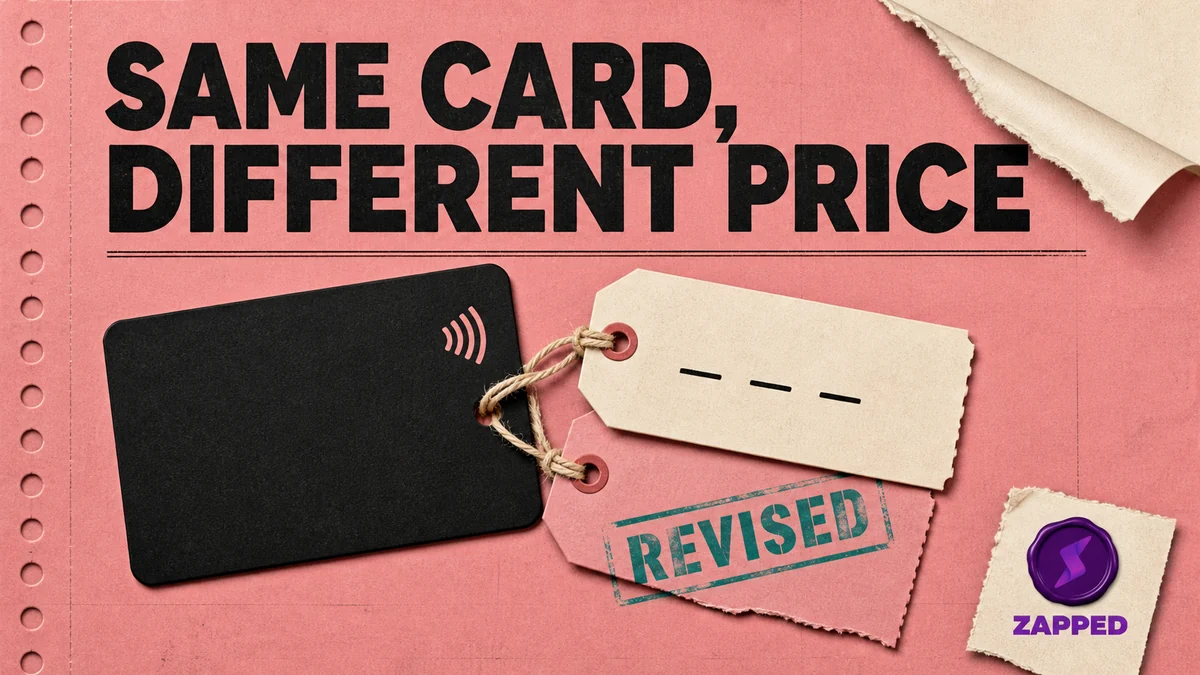
Our guide to NFC business cards listed dot's standard card at $30. The same product on dot's own store now lists at $48.
That's not an old number catching up to reality. It's a real price move inside a week, on a card with no subscription attached to explain the change any other way.
What the software side costs instead
Zapped prices the software side of this decision differently: one number per plan, not a moving target.
Free costs $0 with no credit card required. Starter is $14 a month. Professional is $49 a month, and NFC sharing is included on all three, not saved for a higher tier.
It doesn't sell the physical card, though. A reader who wants no subscription at all still needs to buy a blank tag or a branded card elsewhere. The plan above is the free half of that arithmetic, not the whole of it.
The point stands either way. A card and a subscription don't have to come bundled just because most sellers bundle them.
What you'll actually pay in the first year
Three things decide the number: whether you want no subscription at all, whether you're buying for a team of five or more, or whether only the cheapest possible hardware matters, regardless of software.
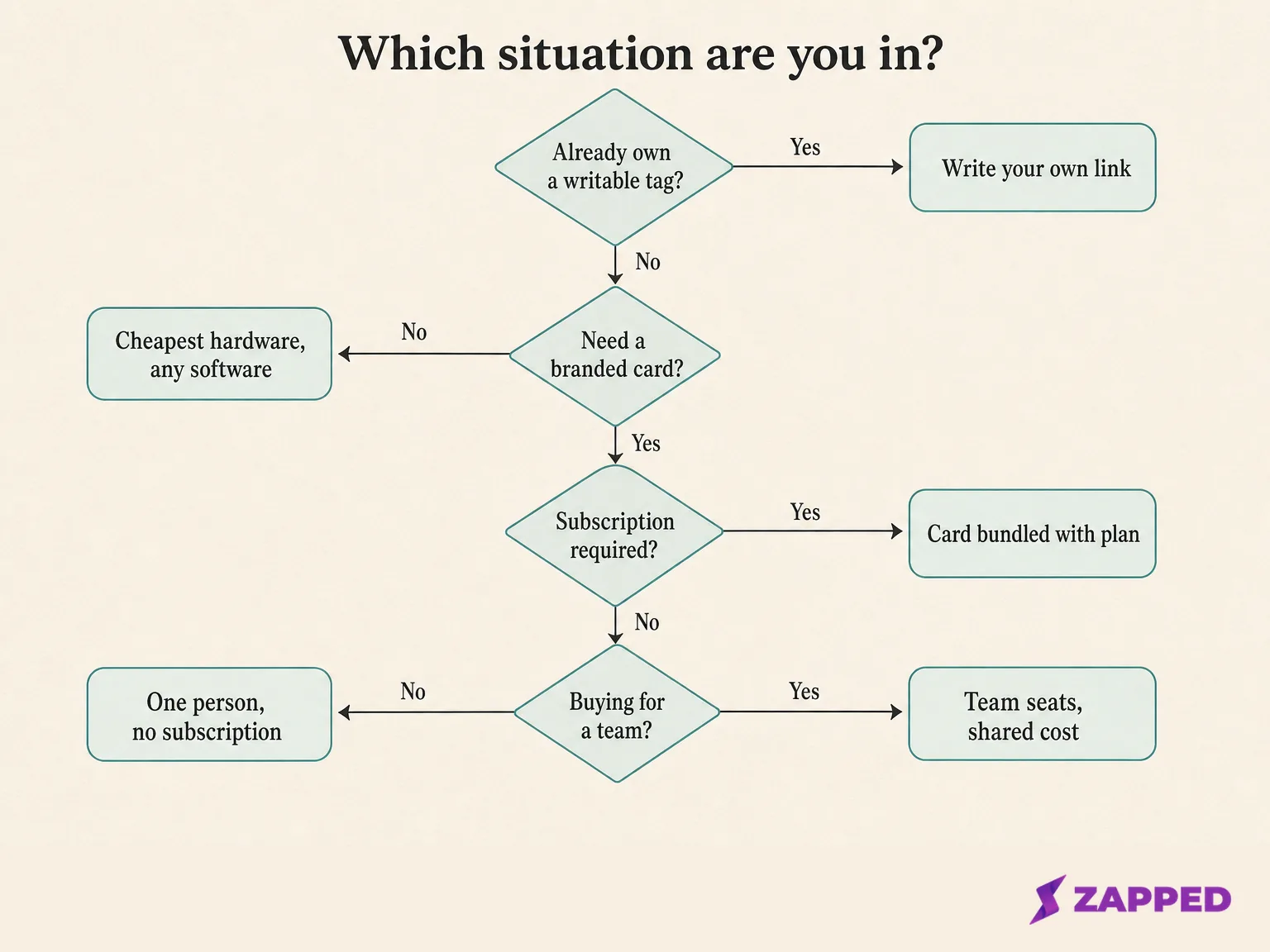
One person, no subscription
A standard branded card with no subscription requirement runs $15 to $80, depending on material, paid once. Linq's standard card is $14.99, and Tap Tag's lineup runs $14.95 to $79.95 across sixteen materials.
V1CE's Smart Card starts at £75, a separate currency kept on its own, never blended into a dollar total.
Each of these works on its own, by the seller's own product page. No software payment is required to share your contact information.
A small team, five to ten people
A cost most solo buyers never see starts here. Tapt's card price stays the same, but its platform utilization fee begins at five users: $69 a year for five to nine, on top of what each card costs.
Linq's card needs no subscription at any team size, but its optional Linq One add on for lead capture and a shared CRM runs $29 a month or $249 a year, per person who uses it, not per card.
A Mobilo team buyer's own Trustpilot account illustrates how a team order can cost more than the per card price implies. He describes per member printing fees he calls deceptive, resolved only when Mobilo deactivated the order.
If the cards are for a small business, pair the price check with the rollout questions in NFC business cards for small businesses, especially the one card pilot and QR fallback.
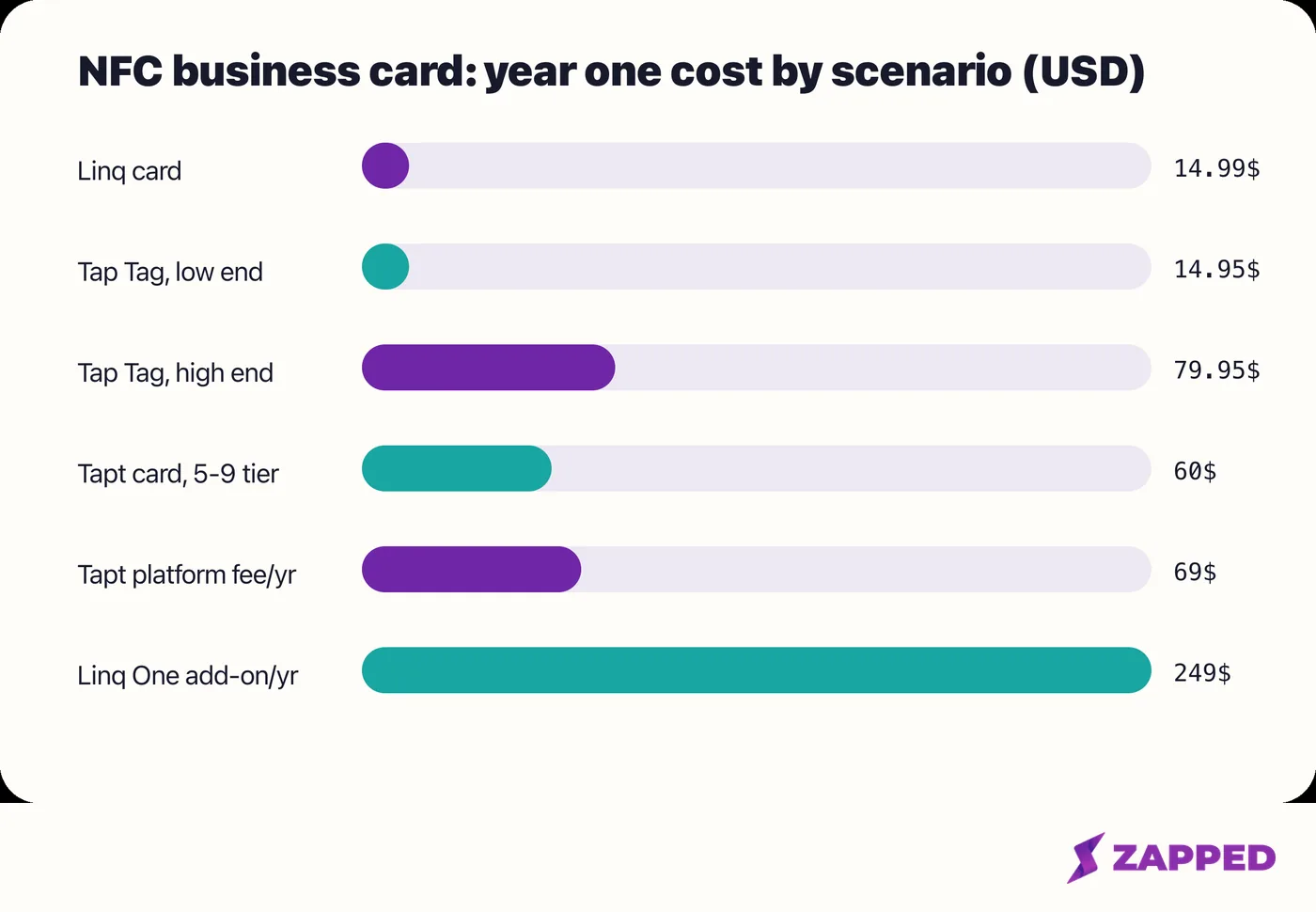 Sources: Linq, Tap Tag, V1CE, Tapt, captured 2026-08-05.
What a subscription buys beyond the tap
Here's what an optional subscription actually buys beyond tap sharing, seller by seller, plus one seller that gives no way to avoid it at all.
Linq One adds an embeddable lead capture widget, a second phone number with AI call summaries, and a small CRM, none of which the base card needs to function.
V1CE's Client Capture OS is a separate £49.99 a month product with a 30 day trial. Cancelling keeps the physical card working, a more specific exit policy than most sellers publish.
Tapt's fee isn't a software subscription at all. It's a platform utilization charge that funds the shared dashboard once a team passes four people.
OVOU is the one seller here with no way to buy the card on its own. Its Individual plan is $12 a month or $99 a year, with the card included in that price rather than sold separately.
Mobilo separately lists a $3 to $5 a month subscription that doesn't require a card purchase at all.
If your real question is the software subscription behind any of these cards rather than the card itself, our software subscription budgeting guide covers that ground directly.
A reader whose only goal is avoiding a subscription entirely, rather than minimizing total price, is better served by our guide to NFC cards with no subscription.
A Mobilo customer says removing the seller's own promotional branding from his card required accepting a Teams license upgrade he didn't otherwise need, a subscription decision arriving disguised as a support fix.
A V1CE cardholder separately reports that features he says were included in his original purchase were later gated behind a new subscription, resolved only after he escalated. Read the cancellation and downgrade terms before you buy.
A reviewer who otherwise rated Popl highly put it plainly: its paid tier costs more than free competing alternatives, worth weighing before you commit.
The cheapest setup, if you build it yourself
The cheapest possible hardware, regardless of software, has a floor well under a dollar. Tagstand sells a blank NTAG213 card at $0.55 a unit, down to $0.39 at a thousand units or more, no subscription attached at any quantity, and writing one yourself takes about ten minutes.
Tap Tag's own classic card, at the cheap end of its lineup, runs $14.95 to $15.95 for a small pack, with no account or app required to use it.
Either route needs somewhere to point the tag. Writing your own link is covered in program a blank tag yourself instead of buying a branded card. Zapped's Free plan, mentioned above, is one option for that destination at no added cost.
A reader who decides the physical tap isn't worth the setup at all can skip it entirely: a QR code costs nothing extra and still needs only the same profile behind it.
If you're ready to compare specific cards
The number on any single page is a starting point, not a total. A standard card with no subscription is the right default for one person: Linq, Tap Tag, and V1CE each sell one outright, no recurring fee attached.
Add a subscription only when you need what it actually buys: a shared dashboard for a team past four or five people, lead capture, or a CRM, not because a seller bundled it in by default.
The sticker price is the least reliable number in this category; what you pay every year, subscription included, is the real one.
If you want a keychain or another format besides a flat card, those run a different price band entirely.
Our full vendor comparison covers named sellers on cancellation terms, ownership, and getting your money out later, not just price.
Sources
- Mobilo pricing page, captured 2026-08-05.
- Mobilo Trustpilot reviews, captured 2026-08-05.
- Popl pricing page, captured 2026-08-05.
- Popl enterprise landing page, captured 2026-08-05.
- TechCrunch, "Popl tops $2.7M in sales", published April 19, 2021.
- Misaias Popl business card review, updated December 19, 2024.
- Popl Trustpilot reviews, captured 2026-08-05.
- dot black card product page, captured 2026-08-05.
- V1CE pricing page, captured 2026-08-05.
- V1CE NFC business card collection, captured 2026-08-05.
- V1CE Trustpilot reviews, captured 2026-08-05.
- Linq standard card, captured 2026-08-05.
- Linq One, captured 2026-08-05.
- Tapt storefront, captured 2026-08-05.
- Tapt pricing and platform fees, captured 2026-08-05.
- Tap Tag collection, captured 2026-08-05.
- Tap Tag classic card 3 pack, captured 2026-08-05.
- OVOU pricing, captured 2026-08-05.
- Tagstand blank NTAG213 card, captured 2026-08-05.
- Zapped pricing page, captured 2026-08-04.
- Zapped help center, how to program NFC business cards, captured 2026-08-05.
- Zapped's best NFC business cards buyer's guide, checked 2026-07-30.