Yes. An NFC business card is built to be reused, and NXP's own datasheet says so precisely: the chip is rated for 100,000 write cycles and ten years of data retention, at room temperature, with no fine print about ordinary tapping.
That number is nowhere close to being a real limit.
What actually ends a card's working life is the plastic, metal, or wood it lives inside, and whether the company running the service behind it is still around. Neither shows up on the chip's own spec sheet.
If you have not tapped an NFC card yet, see what an NFC business card is first. If yours has already stopped working right now, skip ahead: diagnose a card that has stopped tapping instead of reading through the durability case below.
What NXP actually rates the chip for
NXP makes the NTAG213, NTAG215, and NTAG216 chips found inside most NFC business cards, and its own datasheet gives one number for all three: ten years of typical data retention and 100,000 typical write cycles, both measured at room temperature.
Those two figures come from a single shared table. NXP did not publish separate ratings for the 144, 504, and 888 byte versions, because all three use the same EEPROM cell technology and differ only in how much memory they carry.
Ten years and 100,000 writes are not marketing rounding. They are the only numbers NXP states, with no minimum guarantee attached, which is about as close to a plain answer as a chip datasheet gets.
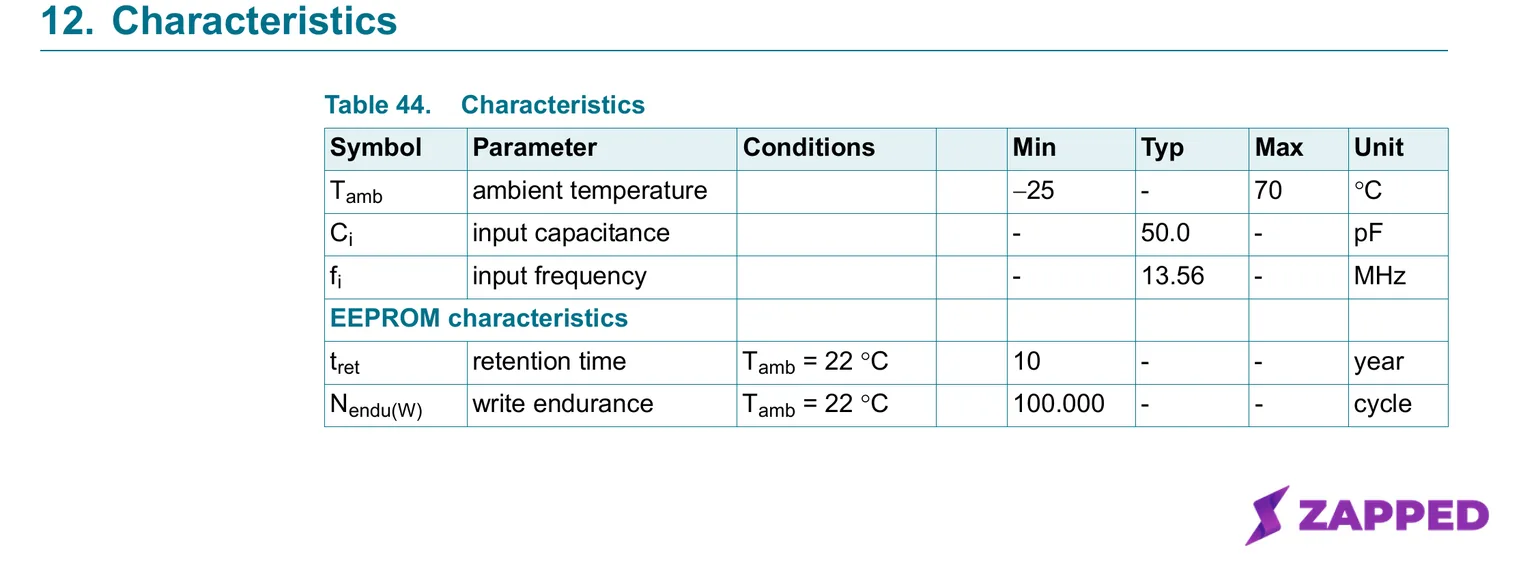 Source: NXP NTAG213/215/216 datasheet, Table 44, via Wayback Machine capture. NXP's own live page for this document no longer resolves. Captured 2026-08-05.
Tapping doesn't spend anything
The 100,000 cycles in that table belong to writes only. Its own symbol for the figure carries a W subscript, for write, and nothing else in the datasheet's 60 pages names a separate limit for reading.
The chip also carries a counter built into its hardware. It increases by one on almost every tap and climbs to 16,777,215 before it simply stops, and NXP describes that ceiling only as ordinary counter overflow, never as a warning or a wear limit.
Wakdev, the company behind the NFC Tools app, reaches the same conclusion independently in its own technical reference for this chip: only the write cycles are limited, and reading does not degrade it.
A card gets tapped, not depleted.
The card body answers to a different rulebook
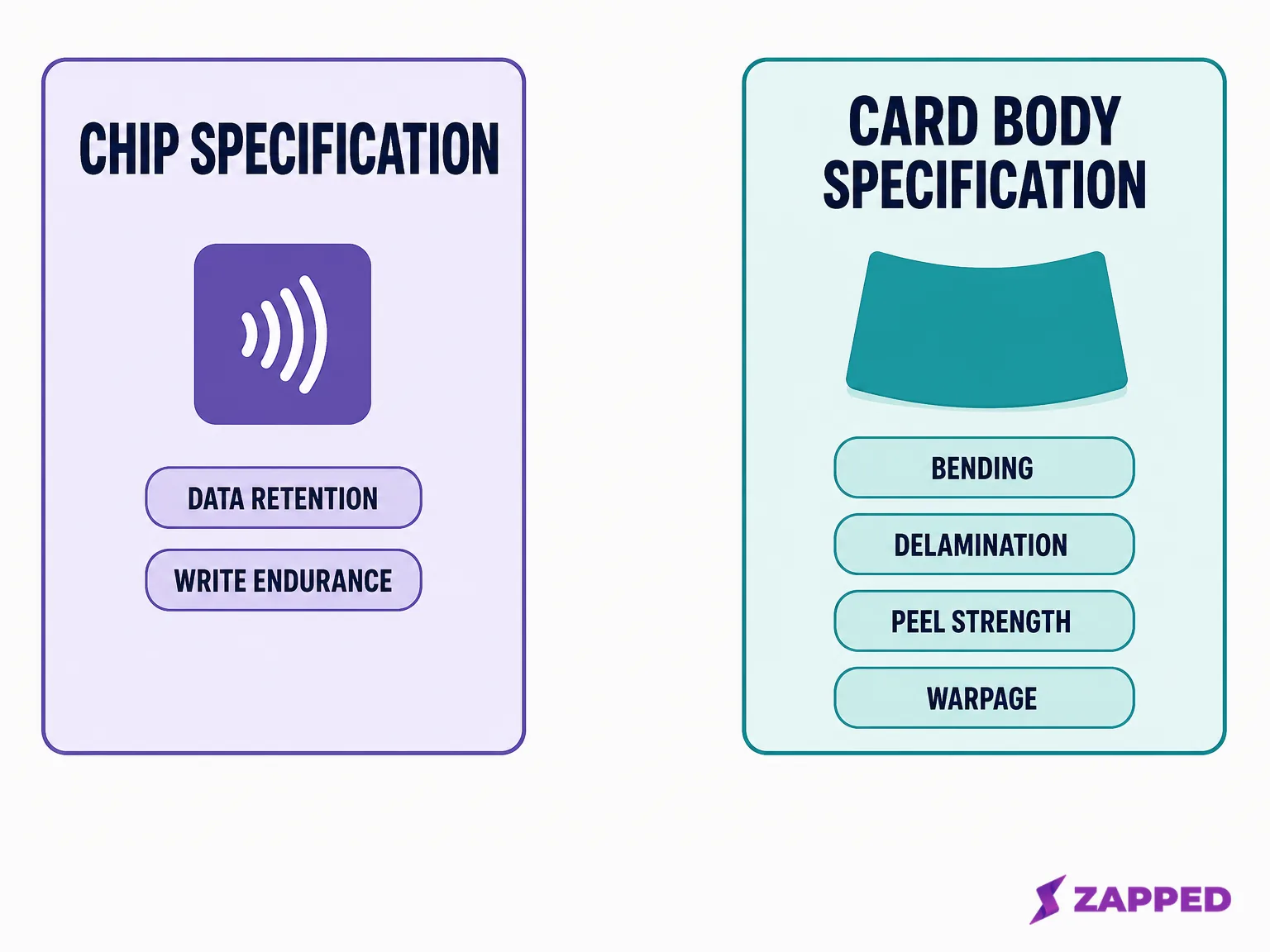 Source: original diagram illustrating ISO/IEC 7810 and ISO/IEC 10373-1 as a specification family separate from the NXP chip datasheet.
Card materials and construction answer to an entirely different document. ISO/IEC 7810 governs a card's physical characteristics, current as of 2019 and reconfirmed in 2025, and it never once references the chip inside.
The actual test methods live in a second standard, ISO/IEC 10373-1: dynamic bending stress, dynamic torsional stress, bending stiffness, peel strength, the technical term for delamination resistance, warpage, dimensional stability, chemical resistance, and blocking.
None of those terms appear anywhere in NXP's chip datasheet, and the chip never appears in either ISO document.
ISO/IEC 7810 also gives no consideration to how much prior use a card has had before testing, so passing it is a manufacturing baseline, not a stated number of years of carry. Thin, flexible cards fall outside its scope entirely; a separate standard, ISO/IEC 15457, covers those instead.
Metal cards fail a more basic test before durability even enters the picture. Conventional NFC tags do not work on metal at all, because the metal absorbs the radio field the chip needs to power up.
That is why cards built for metal surfaces need a layer of ferrite shielding built in. A keychain fob's smaller antenna runs into a related size limit of its own.
Lamination is a separate risk again, and it has nothing to do with carrying a card in a wallet for a year. Heat and pressure applied during finishing, whether by the seller or added later by the buyer, can warp a card or cause the layers to separate, according to BadgeZoo's own card care guidance.
Hotter and longer is not better.
What owners report after months of actual carry
Three separate Trustpilot reviewers who bought Mobilo cards independently report the same pattern. One found a metal card's signal too weak to work reliably, while a wood card from the same order worked amazingly. A second reviewer says a company switched an employee from metal to plastic after problems and had no issues since.
A third reviewer, who ordered five metal cards, says Mobilo's own support eventually acknowledged an issue with the metal line before sending plastic replacements. Three independent reports pointing at the same material pattern are worth more than any one of them alone, even though each is still a single customer's account.
Other reports are thinner and get one sentence each, attributed and not generalized into a defect rate. A real estate agent on Reddit says an OVOU card has kept working for a couple of years.
A different Reddit poster says a Wave card stopped tapping after about two weeks, with no response from support. Read together, these single reports say less about the category than the three converging Mobilo reports above; they are individual data points, not a pattern.
The real risk is who controls the chip, not the chip
A chip locked against writing cannot be reprogrammed by any ordinary write command. That mechanic belongs to how NFC cards can be rewritten, which covers lock bits and password protection.
The more common question is different: not whether the chip lets you write to it, but whether the company that wrote it is still around to let you.
MOO is the clearest example of that risk actually happening. It discontinued its NFC Business Cards+ line in March 2020, and by January 2023 the actions already programmed onto existing cards stopped working entirely. Customers could no longer change what their card did through MOO's own platform.
The chip itself never stopped working. MOO's own answer to whether a customer could still change the card was yes, naming outside apps that could still write to the tag, because the physical chip stayed reprogrammable the whole time.
The company's willingness to keep serving the card ran out years before the hardware did.
Whether a chip stores an action only a vendor can run, or a link its owner can edit, decides whether a card outlives the company that sold it.
NFC sharing on Zapped works the same way on every plan, including Free: program your own card with a link you control.
The card stays live after you edit it too. Zapped's own homepage FAQ says the printed QR code and shared links keep pointing at your profile even after you change what is on it.
MOO's cards depended on an action that MOO itself had to keep running. A tag holding a link you choose works differently: you decide where it points, and you can change it whenever you want.
The free plan covers one card. Anyone planning to program several cards for a team, including reassigning one after someone leaves, needs a plan with room for more.
Linq is a second, narrower data point pointing the same direction. TechCrunch reported in February 2026 that the company raised a $20 million round to move its business toward AI messaging infrastructure, after starting out as a digital business card.
That is a fact about where Linq's focus went, not about what happened to a physical Linq card already in someone's wallet.
Popl makes a specific reusability claim of its own. Its help center says accessories are reusable and can be reassigned to a new team member through its own dashboard. Deactivating an accessory removes its link to any profile, and Popl's own phrasing says it "can be reactivated to any card at any time."
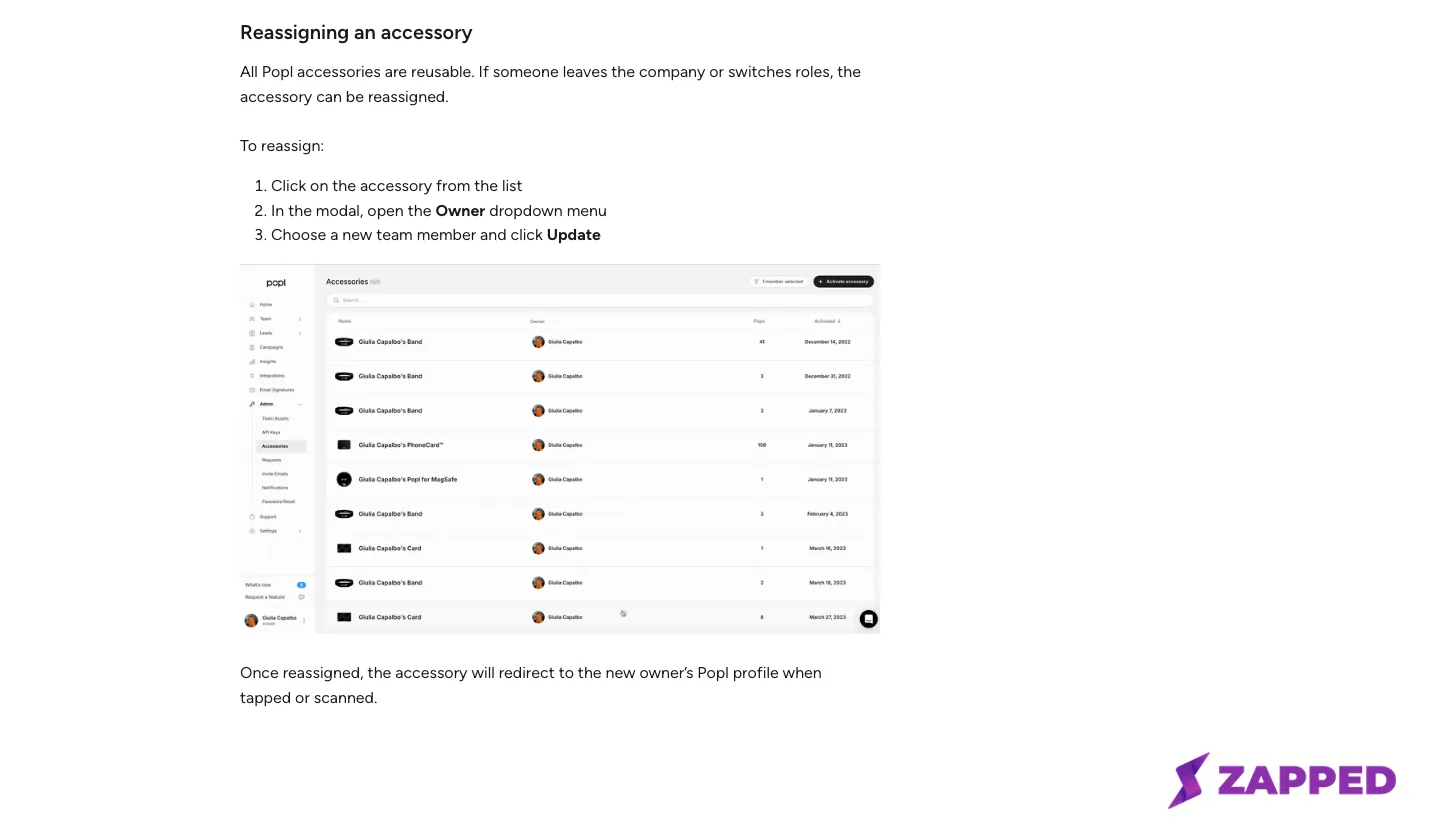 Source: Popl Help Center, Accessory management for your team, dated April 29, 2025. Captured 2026-08-05.
Independent security research complicates that picture. A researcher documented in 2022 that Popl writes a password to the tag the moment its app activates a card, blocking any other app from rewriting it. The lock can be removed with the right tools once the password is known, restoring the tag to an ordinary writable chip.
That is not an isolated report. A second Popl owner independently confirmed the same password worked and published a method using only two apps already on a phone.
Members of a biohacking forum describe the same lock happening to their own tags, and one recommends a competitor because it does not lock hardware it did not make.
The earliest of these reports dates to 2021, two years before the more detailed teardown above. The pattern has held for years, across different communities, not one bad batch someone happened to hit.
Both things are true at once, and the gap between them is the point.
Popl's own dashboard makes reassignment easy inside Popl's system. Leaving that system means finding and stripping a password lock with specialized tools, not opening a normal consumer NFC app.
Reusable, as Popl uses the word, describes what its own platform lets you do, not what the hardware will do for anyone else.
One scenario never turns up anywhere in the public record: someone changing jobs and handing their own NFC card to a replacement, or a team reassigning a departing employee's card to someone new. No published account describes anyone actually doing it.
What exists instead answers a different question. Popl's dashboard describes a capability the company sells, not a customer's account of using it after a real handoff.
The password lock reports above are about someone encoding a card again for their own unrelated reason, not a job change. Neither one is evidence about reuse across employers.
What actually ends a card's working life
Almost nobody needs to worry about the chip.
Ten years of retention and 100,000 writes, with reads that do not even count against that number, covers ordinary use with room to spare. Whatever ends a card's usefulness will not be the silicon.
Four things are worth checking before trusting a card long term, and none of them is the chip:
- Is it locked against writing for a purpose you did not choose
- Is it metal, and does it need ferrite shielding to work at all
- Has it been laminated, by the seller or by you, in a way that could warp it
- Is reassignment something the vendor's platform actually supports, or only advertises
Even a card that eventually fails, locked, damaged, or simply orphaned when a vendor exits the category, still has a fallback if it also carries a QR code: a printed code keeps working even after the chip physically dies.
If a card has already stopped responding, check whether the NFC business card is actually damaged before treating replacement as the only explanation.
Watch the card body and watch the vendor. Those are the two clocks that actually run out, and MOO's own customers found that out while their chips were still perfectly fine.
Sources
- NXP, NTAG213/215/216 datasheet, Table 44 and Section 8.6, via Wayback Machine capture of the document. Checked 2026-08-05.
- Wakdev, NTAG213 knowledge base page. Checked 2026-08-05.
- ISO, product page for ISO/IEC 7810:2019. Checked 2026-08-05.
- ISO/IEC 10373-1:2020, official preview hosted by iTeh. Checked 2026-08-05.
- ShopNFC, product guidance on ferrite shielding for NFC tags placed on metal. Checked 2026-08-05.
- BadgeZoo, card care guidance on lamination risk. Checked 2026-08-05.
- Trustpilot, Mobilo Card reviews, three separate reviews dated August 30 2023, April 12 2023, and August 8 2024. Checked 2026-08-05.
- Reddit, r/realtors thread on NFC business card experiences, posted October 3 2024. Checked 2026-08-05.
- Reddit, r/NFC thread on NFC business card experiences, posted October 13 2024. Checked 2026-08-05.
- MOO Support, NFC Business Cards discontinued. Checked 2026-08-05.
- TechCrunch, Linq raises $20 million to enable AI assistants to live within messaging apps, published February 2 2026. Checked 2026-08-05.
- Popl Help Center, accessory management for your team, dated April 29 2025. Checked 2026-08-05.
- IMcPwn, Cracking the Digital Business Cards, published September 11 2022, via Wayback Machine capture. Checked 2026-08-05.
- Reddit, r/NFC password removal thread, posted July 19 2023. Checked 2026-08-05.
- Dangerous Things forum, Popl lock warning thread, posted August 2 2023. Checked 2026-08-05.
- Reddit, r/NFC Linktree alternative thread, posted March 21 2021. Checked 2026-08-05.