A failed tap doesn't prove that an NFC business card is damaged. First separate a reader or interference problem, a locked tag, or a broken destination from a fault in the card's inlay or IC.
Use this order: identify the tag without writing, remove interference, then repeat the check on a second known good reader. Only then does physical damage become a plausible explanation, and even two failed readers don't prove it by themselves.
What a failed tap actually tells you
“The page did not open” is not a precise NFC diagnosis. There are several different states behind that experience:
- Not detected: the reader doesn't identify a tag at all.
- Detected and readable: the reader identifies the tag and can expose its data.
- Detected but locked or not writable: the tag responds, but a write operation is unavailable.
- Readable record with a destination failure: the tag record is visible, but its URL or profile doesn't complete the expected browser action.
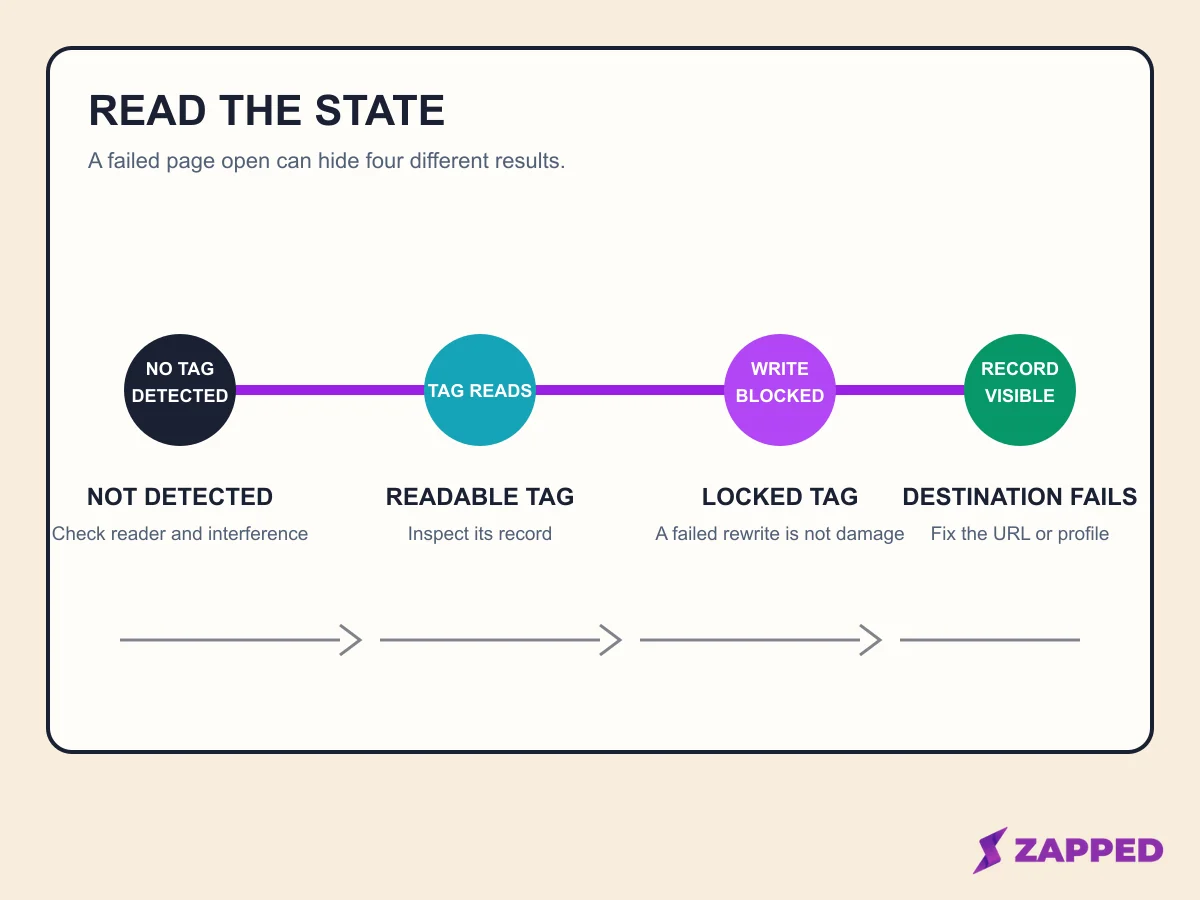
That distinction matters because a tag can communicate even when its destination is wrong, unavailable, or handled differently by the phone. The NFC Forum tag modes overview separates reading an NDEF message from the action that its contents may start.
If a read surface identifies the tag and exposes an NDEF record, a browser or profile failure alone doesn't confirm physical NFC damage. Phone and tag causes that occur before this controlled check are covered in the first pass for a dead card.
For the NTAG213, NTAG215, and NTAG216 family, NXP states that communication requires the IC to be connected to an antenna in its NTAG213, NTAG215, and NTAG216 data sheet. That supports keeping the antenna or inlay branch separate from memory and destination branches, but it doesn't identify the chip family in your card.
The same evidence ladder also explains why there's no battery replacement step for a typical passive tag. The NFC Forum describes batteryless operating modes in which the reader transfers power, while reader or writer mode handles reading and writing tag data. A passive card can still have an antenna, IC, memory, lock, or destination problem, but replacing a user battery is not the diagnosis.
Run a read only tag check before writing anything
Before trying to rewrite a URL, record what the card reveals. NFC Tools Read, or an equivalent compatible read only surface, can expose the manufacturer, tag type, serial number, technologies, memory information, writable or locked state, and NDEF data according to the app's Read view description.
Use the check as a record, not as a repair attempt. Note each field the tool actually shows, including whether the tag is detected, whether NDEF data is present, and whether the tag is writable or locked. If the app can't expose a field, record that it was not shown rather than guessing.
This diagnostic option is not universal. A business card may use a tag or format the app doesn't fully describe, and an unreadable result by itself doesn't prove physical damage. The useful question is whether the reader can identify the tag and what state it reports before any write operation changes the branch.
Rule out a locked tag and a broken destination
A failed rewrite is a separate result from a failed read. For NTAG21x tags, NXP says that static lock bits are irreversible and that pages locked against writing can't be reprogrammed by a write command in the NTAG21x data sheet. Therefore, “could not rewrite” doesn't equal “the card is damaged.” A tag that's detected and readable but locked may be doing exactly what its stored state permits.
If the read surface exposes an NDEF URL or another record, test the destination separately. A readable tag can point to a missing page, an unavailable profile, or a destination that the phone doesn't open as expected. That's a destination problem until the tag itself stops being readable.
For the broader lifecycle question, see whether NFC business cards are reusable. If the tag is readable and writable and you need to change its URL, use the programming path for NFC business cards.
Remove metal and case interference, then repeat the read
Run this controlled sequence before classifying the card:
- Enable NFC if the device requires it.
- Remove the phone case and wallet contents.
- Move nearby metal away from the phone and card.
- Place the card on the phone's intended reader area.
- Repeat the read and record what the reader reports.
The construction matters when metal is part of the card or its backing. Avery Dennison describes an NFC inlay built for metal surfaces, with a ferrite layer that isolates the magnetic field from metal and redirects the reader's inductive field. That explains why a metal card or metal backing can be an interference or construction issue rather than evidence of a damaged inlay. A metal form factor alone doesn't establish damage.
If the card reads after the case, wallet contents, or nearby metal are removed, keep the result as an interference finding. Don't turn it into a universal rule about every metal card. For the material and antenna design distinction, see metal NFC business cards.
Confirm the failure on a second known good reader
If the controlled retest still fails, use a second known good NFC capable reader. This can be another compatible phone or a reader you know can identify other NFC tags. Record the reader description, NFC setting, case and metal state, detection result, and any tag fields exposed.
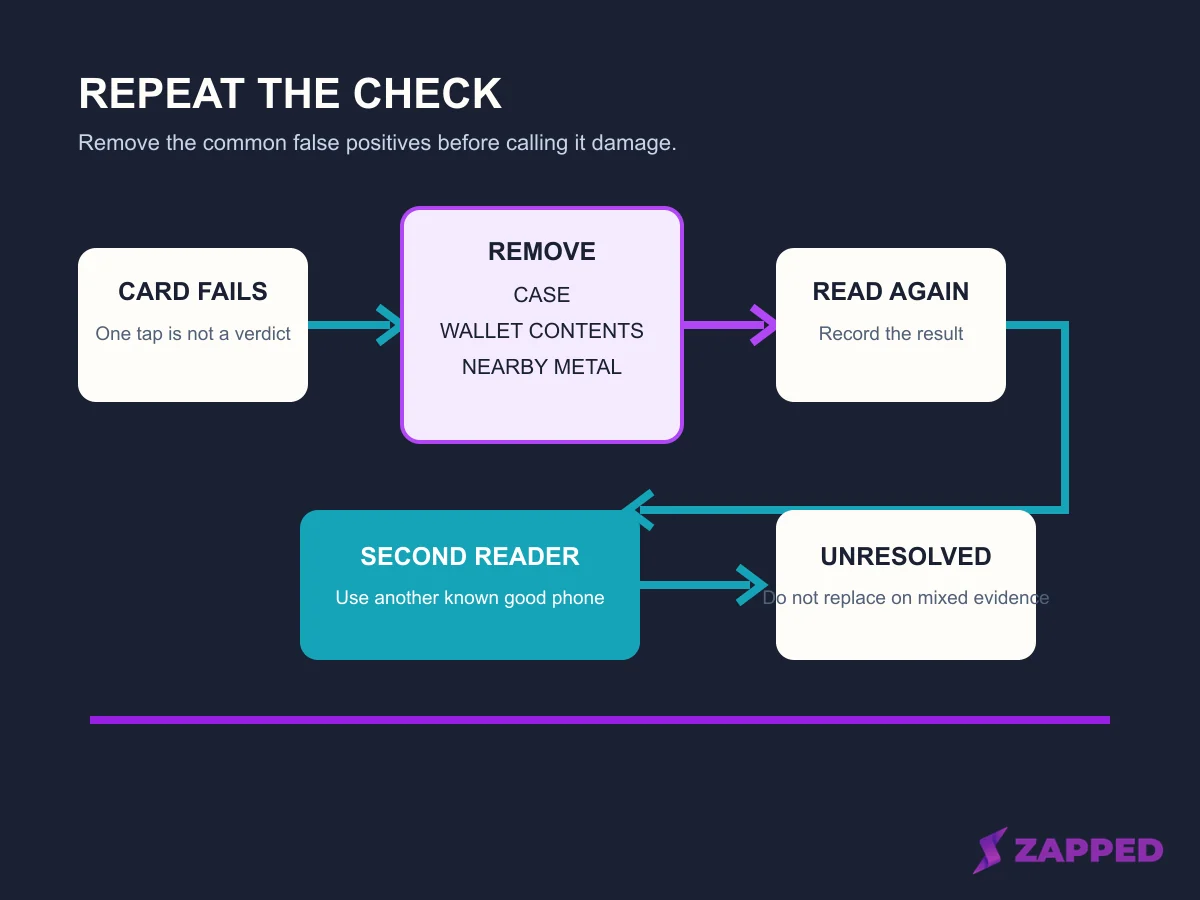
The decision is deliberately narrow:
- If one reader fails but the second reader identifies the tag, physical damage is not established. Continue with the readable tag's state and destination.
- If both readers fail after NFC is enabled and nearby metal or cases are removed, antenna or IC damage becomes plausible, but that outcome is still not proof of damage.
- If the results conflict or the setup can't be controlled, label the result unresolved. Don't replace the card or promise repair on mixed evidence alone.
For NTAG213, NTAG215, and NTAG216, the NXP architecture description makes the antenna connection a prerequisite for communication. A two reader failure therefore raises physical suspicion after the other checks, but it isn't a published damage threshold or certification that a particular card's antenna or IC has failed.
Inspect the body, then classify the result honestly
After the reader checks, inspect the card without cutting, bending, peeling, or attempting a repair. Look for a crease, puncture, delamination, exposed inlay, or another visible change. A card body can look intact while an embedded communication component remains unconfirmed.
ISO/IEC 10373-1 describes physical ID card test methods, while NXP separately documents the IC and antenna requirements for communication. A body durability check is not, by itself, a communication test.
Combine appearance with reader evidence, never with appearance alone:
| Reader result | Body or destination finding | Honest classification |
|---|---|---|
| Readable | Destination fails | Tag communication is demonstrated; investigate the destination. |
| Readable but locked | Write fails | A lock state can explain the failed rewrite; damage is not established. |
| Detected by one reader | Other reader fails | Reader or setup differences remain possible; physical damage is not established. |
| Not detected by two readers after interference removal | Visible damage or no visible change | Antenna or IC damage is plausible, but the test alone does not prove it. |
| Mixed or incomplete results | Any appearance | Unresolved; gather a repeatable result or ask for specialist assessment. |
A visible mark plus a readable tag is not a confirmed antenna fault. No visible mark plus repeated non detection can still leave physical suspicion qualified.
Repair, specialist recovery, or replacement
Can an NFC business card be repaired? Sometimes a damaged tag may be recoverable, but a finished business card is not automatically a consumer repair project. A 2017 damaged-tag study reported data recovery by adding an external loop antenna when the NFC chip remained intact. That's evidence for a specialist recovery possibility, not a safe recipe for opening and repairing your card.
Let the result determine the next step:
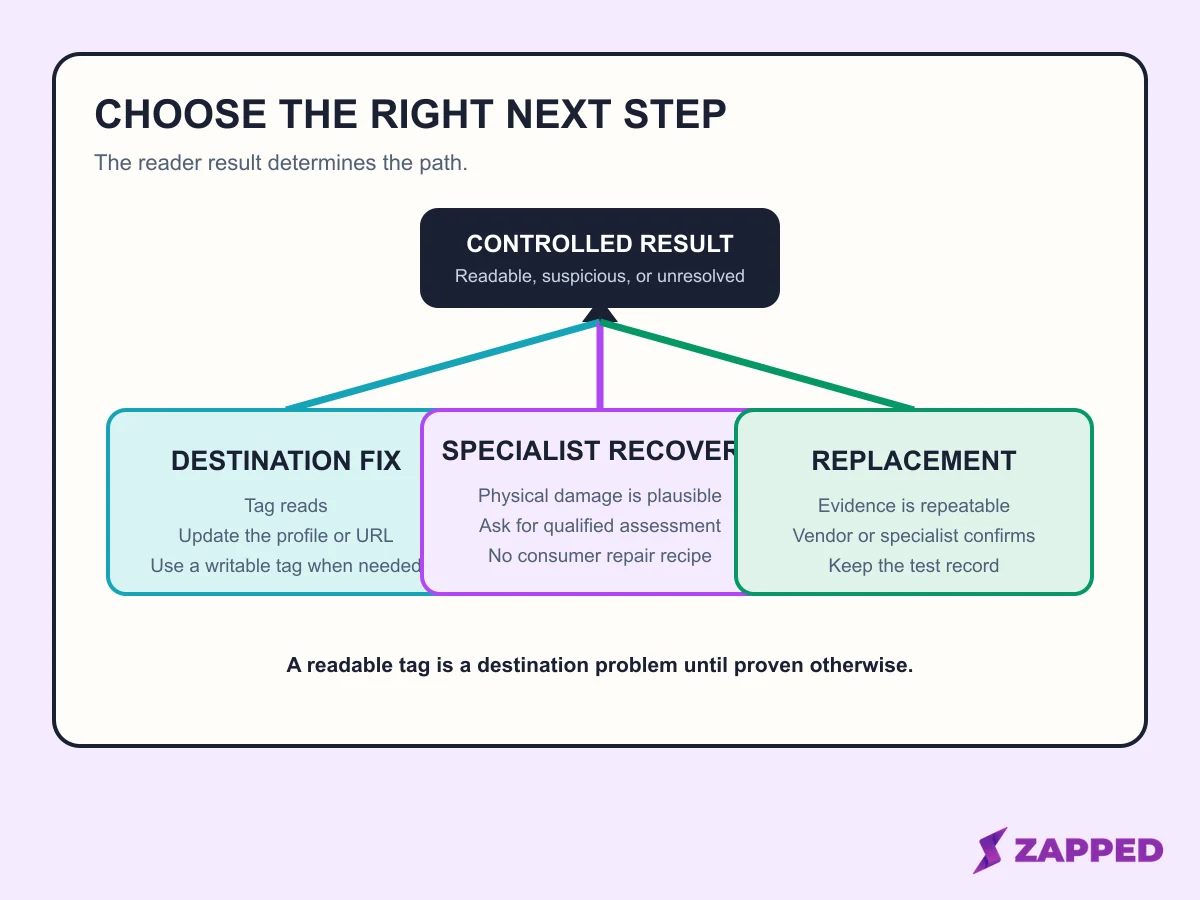
- If the tag is readable, fix its destination or use the programming path for NFC business cards when the tag is writable.
- If repeated controlled reads leave physical damage plausible, ask the card vendor or a qualified specialist whether recovery or replacement is appropriate.
- If the evidence is unresolved, keep the card and your test record until you can repeat the check. Don't promise that rewriting a URL or installing a different NFC app will repair a broken antenna, inlay connection, or IC.
If a readable tag only needs a better destination, Zapped's digital business card platform can provide a browser based profile URL that's shared by NFC, QR code, or link. Keep that option beside the readable tag branch, not beside unresolved hardware failure.
Record the evidence before replacing the card
Keep a short record before ordering a replacement:
- Date, if it helps you compare repeated checks.
- Reader model or description and whether NFC was enabled.
- Case, wallet contents, and nearby metal state.
- Detected or not detected.
- Tag type or UID when exposed.
- Writable or locked state.
- NDEF presence and the destination response.
- The result from the second reader.
Replacement is a considered next step after these controlled checks, not the first explanation for a dead browser handoff. A readable tag points toward destination or programming work. A locked tag points toward its stored permissions. A repeatable two reader failure after interference removal makes physical damage plausible, while an unresolved result calls for another controlled check or specialist assessment.
Sources
2026-08-11
https://www.nxp.com/docs/en/data-sheet/NTAG213_215_216.pdf
https://nfc-forum.org/learn/nfc-technology/
https://play.google.com/store/apps/details?hl=en_US&id=com.wakdev.wdnfc
https://rfid.averydennison.com/en/home/product-finder/bullseye-on-metal.html
https://www.sciencedirect.com/org/science/article/pii/S1756378X17000231
https://www.iso.org/cms/%20render/live/en/sites/isoorg/contents/data/standard/07/04/70482.html