Metal NFC business cards can work, but the metal finish is not proof that the card will tap. Buy one only when the seller explains how the antenna is isolated from the metal body, where to tap, which side reads, and what happens when NFC is unavailable.
The useful distinction between a standard NFC inlay placed against metal and a design for metal surfaces built with ferrite or another engineered separation is documented by Avery Dennison. A QR fallback and an editable destination make the card easier to recover, but they cannot fix an antenna that was never designed for its metal enclosure.
Why metal changes the NFC antenna problem
NFC communicates through magnetic induction at 13.56 MHz over a short distance. The phone and card need their antennas to couple cleanly during the tap. The NFC Forum explanation of NFC technology is useful background if you want the category basics before judging a particular card.
Metal close to the coil changes that system. Texas Instruments explains that metal can damp the antenna, change its inductance, shift its tuning, and reduce performance enough to make a tag unreadable. That is why “metal body” and “NFC chip included” are not compatibility evidence by themselves.
Ferrite changes the construction rather than merely adding a different chip. Texas Instruments describes ferrite as a way to reduce the detuning effect from nearby metal, but the complete antenna still needs measurement and tuning in its final enclosure. A tag designed for metal surfaces therefore has a different job from a standard inlay pressed directly against a metal surface.
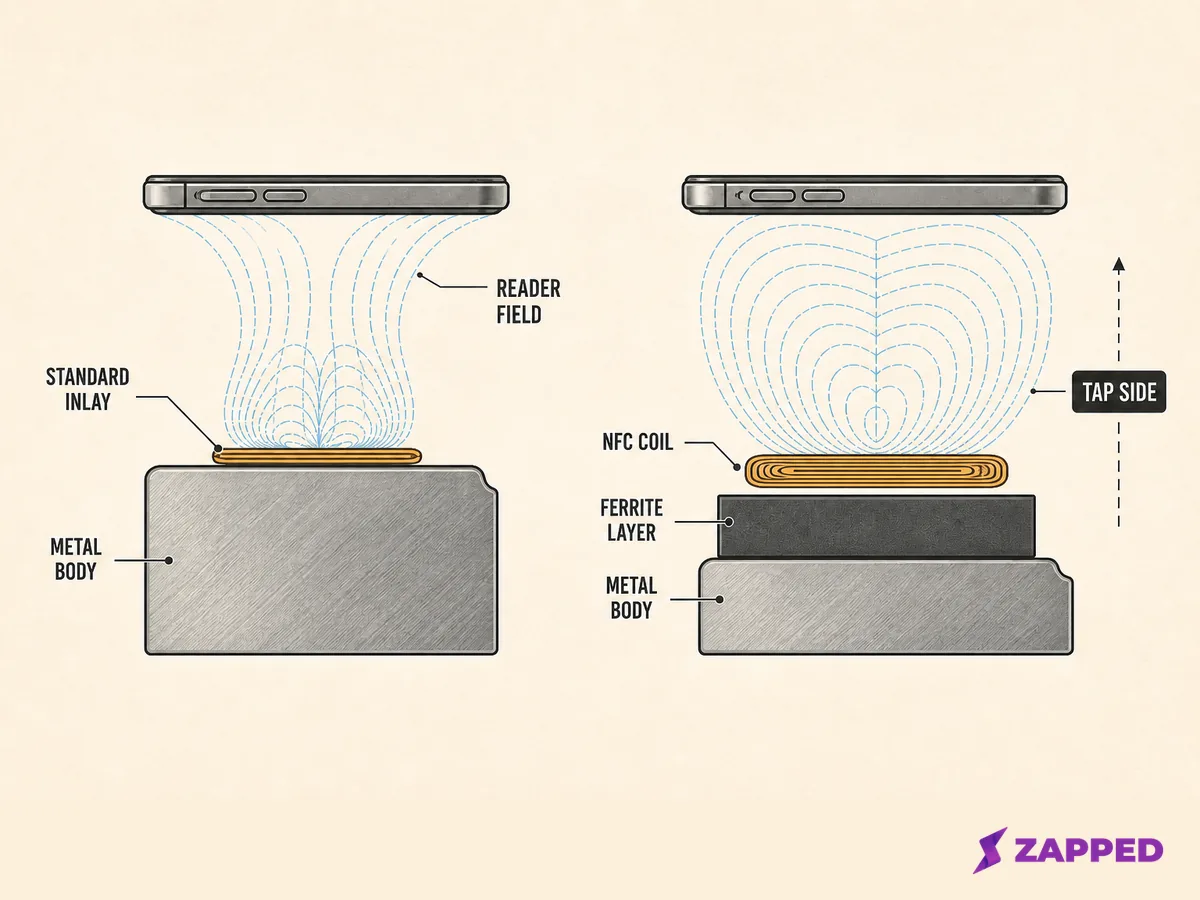
Conceptual diagram based on the antenna guidance from Texas Instruments and the NFC Forum. It shows the construction relationship, not a measured read result.
The chip remains a separate question. NXP lists NTAG213, NTAG215, and NTAG216 as Type 2 tags with 144, 504, and 888 bytes of user memory. Those figures describe the chip family, not how well a finished metal card reads. Antenna geometry and field conditions still matter.
What ferrite or isolation construction means
Look for a product page that names the layer between the metal and the coil. Ferrite is the clearest term, but a seller may describe a composite build, an isolation layer, or a tag designed for metal surfaces. The wording should explain the relationship between the body, the antenna, and the separating material.
The construction can be more involved than a metal face with an inlay underneath. GoToTags describes a composite metal card with a metal face, ferrite, an NFC inlay, adhesive, and a flexible PVC layer. Its description says the card scans from the side without metal, which is exactly the kind of orientation detail a buyer needs.
RFIDSU gives another documented example: a stainless card with a machined recess holding a tag designed for metal surfaces, made from PET with a copper coil inlay and ferrite shielding. Its product page documents that construction.
That is a construction example, not a reason to declare one supplier the winner. The point is that the page tells you what separates the coil from the body.
A named independent build makes the same issue concrete. In the Pulse NFC project, Ethan Greenhouse describes an aluminum card that needed ferrite isolation, several sticker revisions, and material trials before the final build was reported to read on iOS and Android. That finding belongs to that project. It is not a reliability result for the category.
How to read a metal NFC product page
Treat the product page as a specification to verify, not a promise to fill in yourself. Before ordering, look for answers to these questions:
- What metal is the body made from?
- Is the coil separated from it by ferrite or another named layer?
- Where is the antenna or tap zone?
- Which side reads, and does orientation matter?
- Is there a QR fallback?
- What record is written to the tag, and can it be changed or locked?
- Can the destination be edited without replacing the physical card?
- Is there a sample process or named device test, with the conditions described?
The first two questions are the gate. If the page only says “metal NFC business card,” “NFC 215,” or “tap to share,” keep construction as an open buyer question. A chip number does not reveal whether the finished assembly was tuned for the metal body.
The product examples show why this check matters. V1CE documents stainless steel, a QR code, a live digital page, and a tap workflow on its metal card page. The reviewed page does not document ferrite, antenna geometry, or a controlled read test.
My Metal Business Card documents a stainless body, an NFC 215 chip, coding, and a QR option. Its reviewed page does not clearly document ferrite or construction designed for metal surfaces.
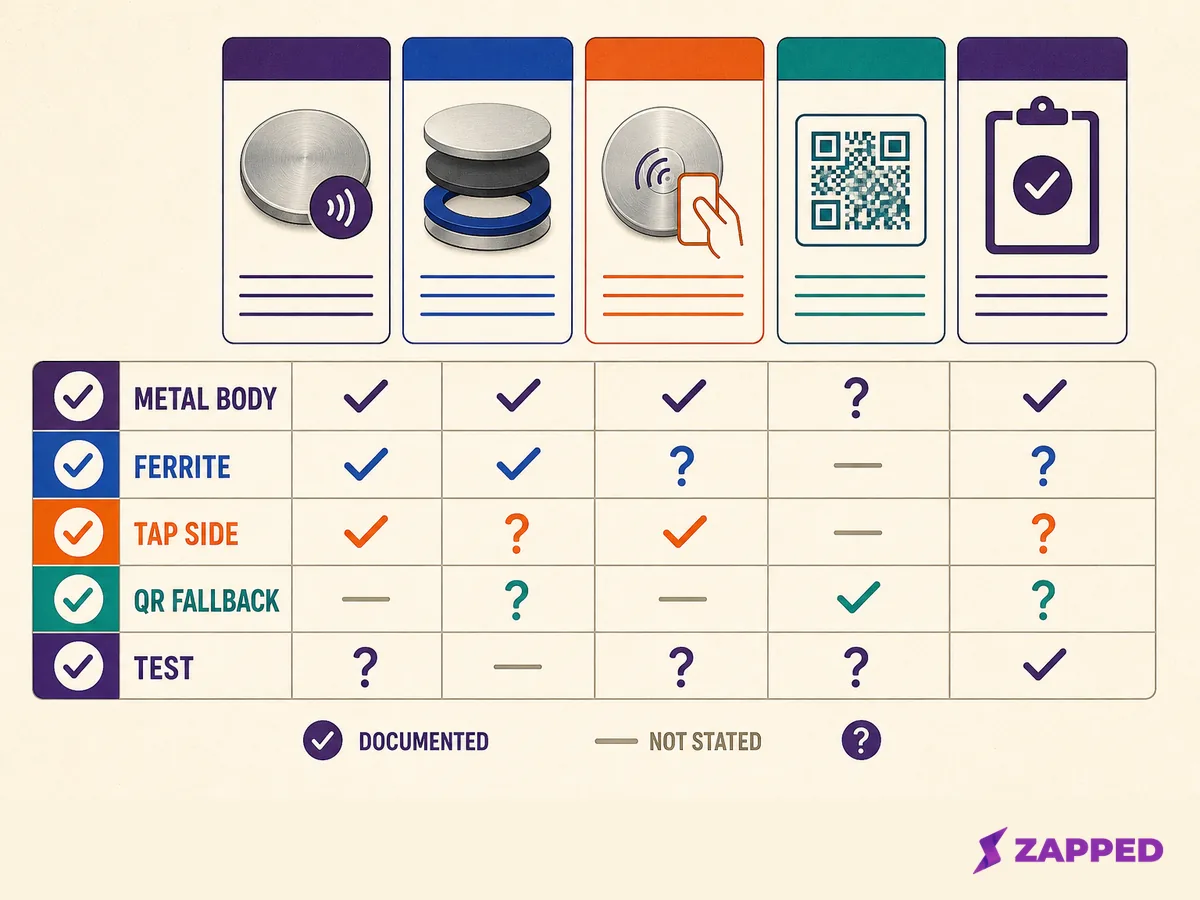
Comparison fields drawn from reviewed product pages for GoToTags, RFIDSU, V1CE, and My Metal Business Card. Missing construction details remain questions, not proof of failure.
For a deeper look at the format boundary, compare this construction check with the discussion of NFC stickers versus NFC business cards. The relevant question is not whether both products contain NFC. It is whether the antenna and its surroundings suit the surface where you plan to use them.
Design the card around the tap zone
A metal card should show the user where the antenna is. Mark the tap area with enough visual clarity that someone can find it without guessing from the logo, the edge, or the most attractive part of the design. NFC Forum guidance also emphasizes identifying antenna location for a positive experience.
Do not assume the decorative metal face is the reader location. If the seller documents a side without metal, keep that side available for the handoff. Do not promise a read from both sides unless the exact product documentation or a recorded test establishes it.
Keep the QR route visible and scannable. V1CE documents a QR fallback as part of its smart card feature set, and a code with clear contrast gives the recipient another path when NFC is unavailable, the tap zone is unclear, or the phone does not read the card as expected. The guide to digital business card QR codes covers the destination and scan experience that sits behind that fallback.
The tag should point to a destination that can survive ordinary content changes. If the URL or profile can be edited, the physical card does not need to be reprinted whenever your contact details or offer changes. That does not make every destination portable, so ask who controls the link and what happens if you leave the service.
Approve a sample before a larger order
Ask the seller to identify the exact tap side and zone on the sample. Use the same destination on an iPhone and an Android phone, with each screen awake and unlocked, and follow the marked location. If the seller claims that the card reads from both sides, check both orientations rather than treating that claim as implied.
Then scan the QR code and confirm that it opens the same destination. The QR route is not proof that NFC works. It is the recovery path that keeps the handoff useful when the physical tap is awkward or unavailable.
Record what was actually shown: the readable side, the tap zone, the device conditions, the destination, whether the tag can be rewritten, and whether the seller supplied construction details. If the sample behaves differently from the product page, stop there and ask for an explanation before buying a batch.
Once the construction is approved, learn how to program NFC business cards so the physical trigger points to the intended destination. Keep the final URL stable when possible, and use the hosted profile to change ordinary content later.
If a card is already in hand and a tap fails, the NFC business card troubleshooting guide is the right next stop. This article's job is earlier in the decision: make the antenna construction and fallback visible before the order is placed.
Put an editable destination behind the card
The metal card is only the physical trigger. The destination might be a profile, a link, or another web page, and that destination determines what the recipient can do after the tap or scan.
Zapped provides a digital card that people can reach through a QR code, link, or NFC tap. The recipient opens it in a normal browser without installing an app or creating an account, and the live card can be edited after sharing.
For the destination workflow, see the Zapped NFC programming guide. Zapped provides the editable profile destination behind the physical card, while the hardware remains a separate card construction choice.
That separation is useful when comparing products. Judge the metal card by its antenna construction, tap zone, orientation, and fallback. Judge the destination by whether you control it, can update it, and can give people a usable route when tapping is inconvenient.
When the premium material is worth it
Choose metal when the physical impression and handoff context justify a more engineered card. The finish can be part of how you present yourself, but the purchase only makes sense after the seller answers the construction questions and a sample follows the marked workflow.
Choose a simpler card or keep asking questions when the seller cannot identify ferrite, an equivalent isolation layer, the readable side, or the QR route. An unclear tap is a workflow problem, and a premium surface does not make that problem smaller.
For the broader material and profile decision, see the guide to metal digital business cards. For a wider provider and ownership comparison, the best NFC business cards guide belongs in the next tab. Neither replaces the construction check this article owns.
Common questions about metal NFC business cards
Can a metal NFC business card work?
Yes, a metal card can work when its antenna is designed for the metal body. The seller should document ferrite or another isolation layer, identify the tap zone and readable side, and provide a way to recover through QR when needed.
Is an NFC 215 or 216 chip enough?
No. NTAG215 and NTAG216 identify chip families and memory capacity. They do not prove that the antenna and finished metal assembly were tuned to read well.
What is a tag designed for metal surfaces or built with ferrite?
It is a construction that separates or isolates the NFC coil from the metal surface. Ferrite is one documented approach. The important proof is the seller's explanation of the layer and its position in the finished card.
Will a metal card read from both sides?
Do not assume it. Some documented composite cards specify scanning from the side without metal, so confirm the readable side and orientation for the exact card you are considering.
What if the tap fails?
Scan the QR code, then check the marked zone, readable side, phone state, and destination. For a purchased card, use the NFC business card troubleshooting steps after checking the physical instructions.
Can the link behind the card change?
It can when the destination is an editable profile or URL. Ask who controls the destination and whether changing the profile leaves the physical card and QR code pointing to the same live address.
Sources
- Texas Instruments antenna design guide, checked 2026-08-06.
- NFC Forum technology overview, checked 2026-08-06.
- NXP NTAG213, NTAG215, and NTAG216 documentation, checked 2026-08-06.
- Avery Dennison on metal NFC construction, checked 2026-08-06.
- GoToTags metal NFC card construction, checked 2026-08-06.
- RFIDSU stainless metal card construction, checked 2026-08-06.
- Ethan Greenhouse's Pulse NFC project, checked 2026-08-06.
- V1CE metal card page, checked 2026-08-06.
- V1CE smart card features, checked 2026-08-06.
- My Metal Business Card page, checked 2026-08-06.