Some NFC business cards will shrug off a swim. Some will die in a jacket pocket that went through the wash. The word "waterproof" on a product page won't tell you which one you're holding, because it names no test, no depth, and no duration. What will tell you is the IP rating, and this is how to read one before you trust a card near water.
One more reason to care: underwater NFC research shows that submerging the tag and reader can sharply shorten read range. So even a card that survives the water may not tap well while it's wet.
What "waterproof" actually means
"Waterproof" on its own isn't a specification. An IP rating only describes the exact conditions it covers.
Even a real rating is narrower than it sounds. Water protection under IEC 60529 covers only the exact conditions tested: fresh water, a specific depth, and a specific time. It doesn't automatically extend to salt water or chlorinated pool water.
The water ratings also aren't cumulative beyond IPX6, so an immersion rating doesn't confirm that a product passed a lower numbered spray or jet test. A seller's claim needs the tested condition behind it, not just the word "waterproof."
How to read an IP rating on a product page
The IP code is two digits after the letters IP. The first digit is dust and particle protection, from 0 to 6. The second digit is water protection, from 0 to 9. A card rated IP67 is fully dust tight, which is the first 6, and can survive immersion, which is the second 7.
The water digit is the one that matters here, but it isn't a single ladder. Here's what each level actually covers:
- IPX0: No protection.
- IPX1: Dripping water, vertically.
- IPX2: Dripping water at a 15 degree angle.
- IPX3: Spraying water at up to 60 degrees from vertical.
- IPX4: Splashing water from any direction.
- IPX5: Low pressure water jets from any direction.
- IPX6: Powerful water jets from any direction.
- IPX7: Immersion in up to 1 meter of fresh water for 30 minutes.
- IPX8: Immersion beyond 1 meter, conditions specified by the manufacturer.
- IPX9: High temperature, high pressure water jets.
Most consumer products that claim water resistance are rated IPX4 through IPX7. An IPX4 card will survive rain and splashes, which covers most networking events. An IPX7 card has been tested for brief submersion, which covers dropping it in a sink or a puddle.
The key gap: above IPX6, the water tests aren't cumulative. A product rated IPX7 has passed the immersion test but isn't automatically IPX5 or IPX6. If you need a card that survives both jets and immersion, the seller needs to list both ratings.
Also note that the rating applies to the finished product as sold, not to the card after you've punched a hole in it, engraved it, or otherwise modified it. Any physical change to the card body may compromise the seal the rating was tested on.
What submersion does to an NFC tap
NFC runs at 13.56 MHz. Underwater NFC research found that submerging the tag and reader cut read range sharply at that frequency, up to roughly 80 percent, effectively forcing the two into near contact before a read would register. The same testing measured a smaller drop, around 30 percent, for the lower 125 to 134 kHz frequencies used by some other RFID systems.
Those exact percentages are published findings, so treat them as reported rather than broadly established. The direction of the finding, water badly degrading a 13.56 MHz read, is the useful takeaway either way.
Google's own Wallet troubleshooting guide lists device settings, default app configuration, screen locks, and terminal or card certification as possible tap to pay problems. It does not list moisture. That omission is not proof about every water related tap failure, but it is a reason not to treat the guide as support for one.
The one vendor claim worth naming, and why to distrust it
Popl's support content states that all of its accessories except the PopCode sticker are waterproof and weatherproof. That sentence is worth reading exactly as skeptically as it deserves to be read.
It names no IP number. It describes no test method, no immersion depth, no duration. It's a marketing claim, not a spec, and the exact wording remains unverified. Treat it as one vendor's word, not evidence about the category.
Carry that pattern to any other vendor's page. A bare "waterproof" claim, from any company, is not a rating. If a seller wants you to believe their card survives water, look for a real IP number with a stated test method behind it. Without that, the claim is marketing until proven otherwise.
The card is not just the chip
Water damage to an NFC business card isn't one failure mode. It's three separate things happening to three separate layers, and a seller's waterproof claim may only cover one of them.
The first layer is the card body itself. A printed-card durability study separates the base material's physical stability from the printed surface and the embedded electronics. A card that survives a splash may still delaminate in a hot car, warp in a sauna, or crack when flexed. Water is one stressor among several, and the study's framework is a reminder that durability claims need to name which layer they cover.
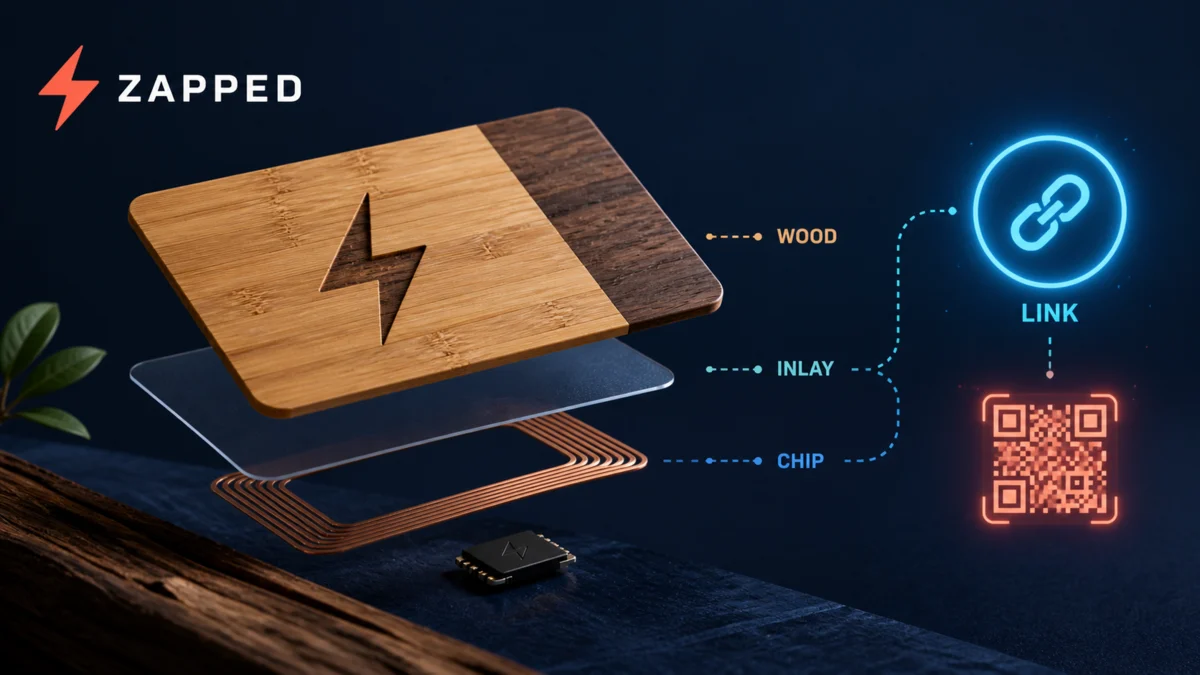
The second layer is the antenna. The copper or aluminum coil that wraps around the card's edge is the most physically exposed part of the NFC system. It doesn't have its own water rating because it isn't a standalone product, but it's the part most likely to fail from corrosion, from adhesive breakdown, or from the card swelling and breaking the coil's continuity. A card that looks fine after a swim may have a cracked antenna trace that only shows up as an intermittent read.
The third layer is the chip. The NFC integrated circuit is the most protected component, usually sandwiched between the card layers. It's also the least likely to fail from water alone. The chip's failure mode is usually heat, bending, or a manufacturing defect, not moisture reaching the die.
When a seller says a card is waterproof, they may mean the card body, the whole assembly, or nothing specific at all. The IP rating framework does not distinguish these layers because it rates the finished product, not the components. A card that passes IPX7 immersion as a finished assembly may still have a card body that fades, a printed surface that smears, or an antenna that corrodes weeks later.
Heat, soap, and the washing machine question
The most common real world water event isn't a pool or a beach. It's a washing machine, and it's worth understanding why that's a harder test than it sounds.
Household dishwashers typically run at temperatures up to around 60 degrees Celsius, and a clothes washer is in the same range for hot cycles. That is well above the temperature at which many adhesive bonds in laminated cards begin to soften. Add detergent, which is a surfactant designed to penetrate and lift material, and mechanical tumbling, and you have a test environment far more aggressive than the fresh water immersion that an IPX7 rating specifies.
This is why the laundry tag category exists as a separate product. NFC laundry tags are built with high temperature substrates, sealed antennas, and industrial housing designed for repeated commercial laundering. They cost more than a standard NFC card because they are engineered for a genuinely harsh environment, not because the basic NFC chip is different.
If your card goes through a wash cycle and still works, that's good luck, not a spec. If it goes through and stops working, the vendor probably wasn't lying about water resistance in general. They were describing a narrower test than the one your card just failed.
What water does to the tap, in practical terms
The underwater read range finding is worth translating into a real world scenario, because it changes what you should expect at the pool, the beach, or the sink.
If you're handing your card to someone at a poolside event and the card is wet, the tap may still work, but it'll be slower and less reliable. The reader, which is the phone, may also be wet. Both the tag and the reader being damp is the worst case from the research, because the signal degradation compounds.
Salt water is worse than fresh water for electronics in general, and the IP rating system does not extend an immersion rating from fresh to salt. If a card is rated IPX7 and you take it in the ocean, the rating does not cover that. Ocean water is conductive and corrosive in ways fresh water is not.
The practical takeaway isn't to panic about a damp card. A card that gets splashed at a networking event and is dried off will almost certainly work fine. The time to be careful is prolonged submersion, hot water, or water with soap or salt in it, which is exactly the scenario a vendor's bare waterproof claim does not help you evaluate.
Who this actually matters for
Most business card use doesn't involve water at all. The card sits in a pocket, goes to a meeting, comes back. The waterproof question matters if you work outdoors, at pools, on boats, at the beach, in kitchens, or in any environment where the card will get wet on a regular basis.
It also matters if you're the kind of person who puts things through the wash. Not because a business card is likely to be laundered, but because a card that lives in a jacket pocket will eventually be in that jacket when the jacket goes in the machine. Knowing the failure modes, and knowing what a vendor claim does and does not cover, is the difference between replacing a $5 card and being surprised.
What to actually do
Skip the drama and handle water the way you would handle it with any card in your wallet.
Don't deliberately submerge or launder an NFC business card unless its seller gives you a rating and conditions that cover that use. NFC laundry tags are hardened industrial products for uniforms and work overalls, built for commercial and industrial laundering rather than ordinary card use.
Choose a tag made for that job rather than assuming any card will survive a washing machine.
Treat a bare "waterproof" claim as incomplete until the seller names the rating and test conditions behind it.
Where the Zapped profile fits
Everything above is about the physical tag someone taps, the plastic, metal, or wood object that sits in a pocket. It isn't about the profile that opens when the tap works.
A Zapped card is a shared web page, reachable by QR code, NFC tap, or link, with no app required to view or save the contact. The physical tag and the web profile it opens are separate.
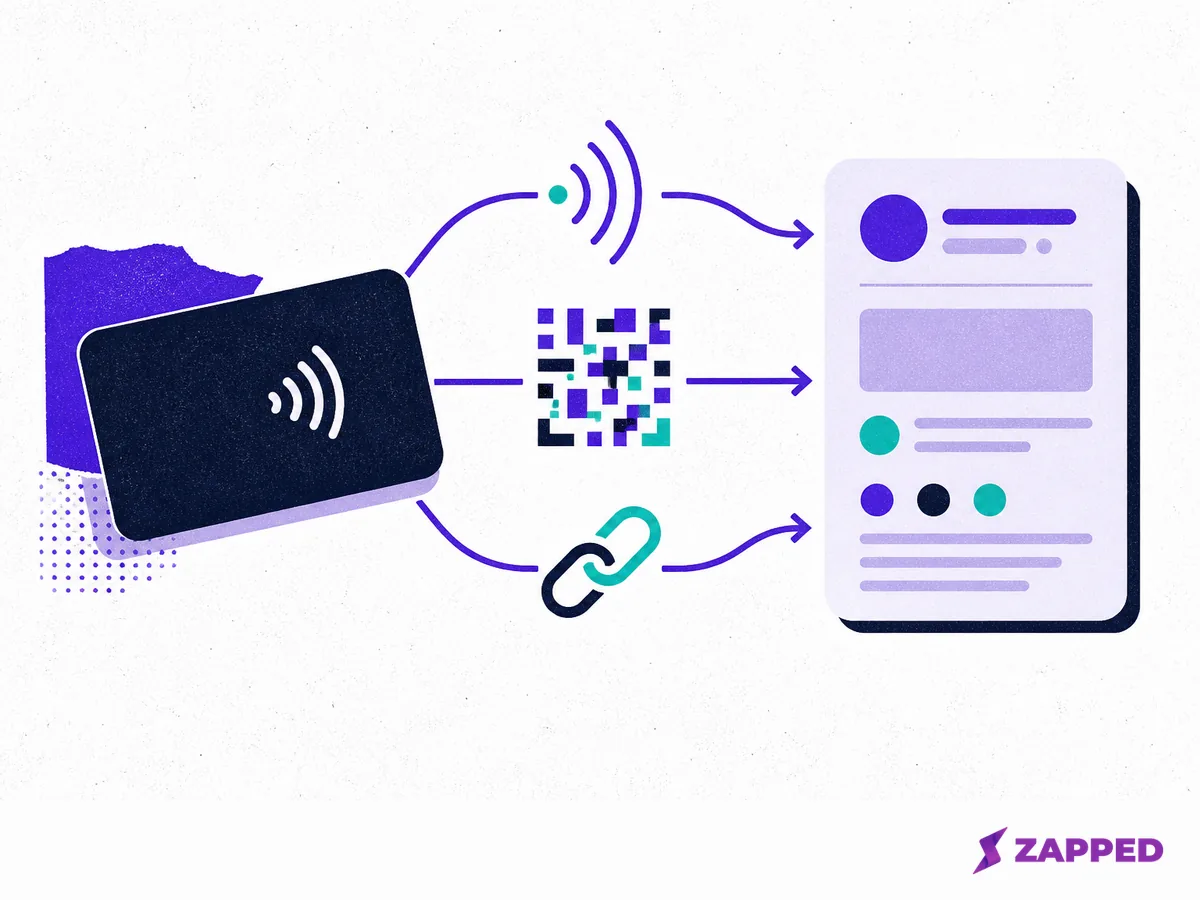
The same web profile, reached by tap, scan, or link.
Choose the card material for how it will actually be carried, and use Zapped to share the profile behind the tap.
Sources
- Wikipedia's IP code article, checked 2026-08-08.
- IEEE underwater NFC paper, checked 2026-08-08.
- printed card durability study, checked 2026-08-08.
- Popl support article on accessory waterproofing, checked 2026-08-08.
- Google Wallet troubleshooting guide, checked 2026-08-08.
- Shop NFC laundry tag product listing, checked 2026-08-08.
- Zapped homepage, checked 2026-08-08.