A plastic or PVC NFC business card is a sensible physical carrier for a printed card. The material name alone does not prove read reliability, durability, rewriteability, or profile ownership, so verify the body, antenna, chip, finish, stored URL, fallback, and provider terms separately.
Plastic is a practical baseline when you want a familiar body with room for printing and an embedded NFC inlay. The useful question is whether the complete construction and the destination behind the tap fit how you will use the card.
What a plastic NFC business card actually contains
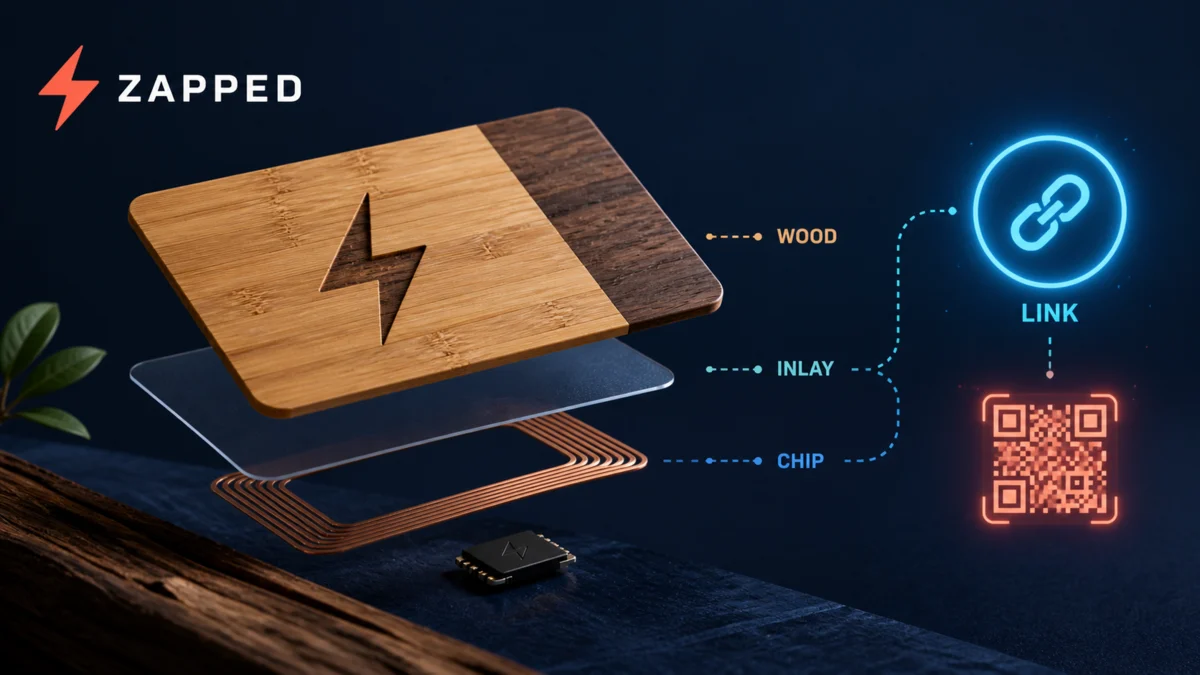
Most buying confusion comes from treating four different things as one product:
- The carrier: the PVC or other physical body, printed face, protective layer, and edges.
- The NFC hardware: the antenna and integrated circuit inside the card.
- The payload: the data written to the tag, often a URL or redirect address.
- The hosted profile: the web destination and any account, subscription, or management service behind that address.
The NFC Forum explains that an NFC tag carries an NDEF payload, while NXP documents that the NTAG21x integrated circuit needs an antenna to communicate. The plastic body holds that assembly. It does not turn the chip into a hosted profile, and the profile does not describe the physical inlay.
At purchase time, this distinction exposes missing information. A supplier can name PVC, an NTAG chip, and an attractive printed face without answering who controls the URL after a tap or whether the tag can be written again.
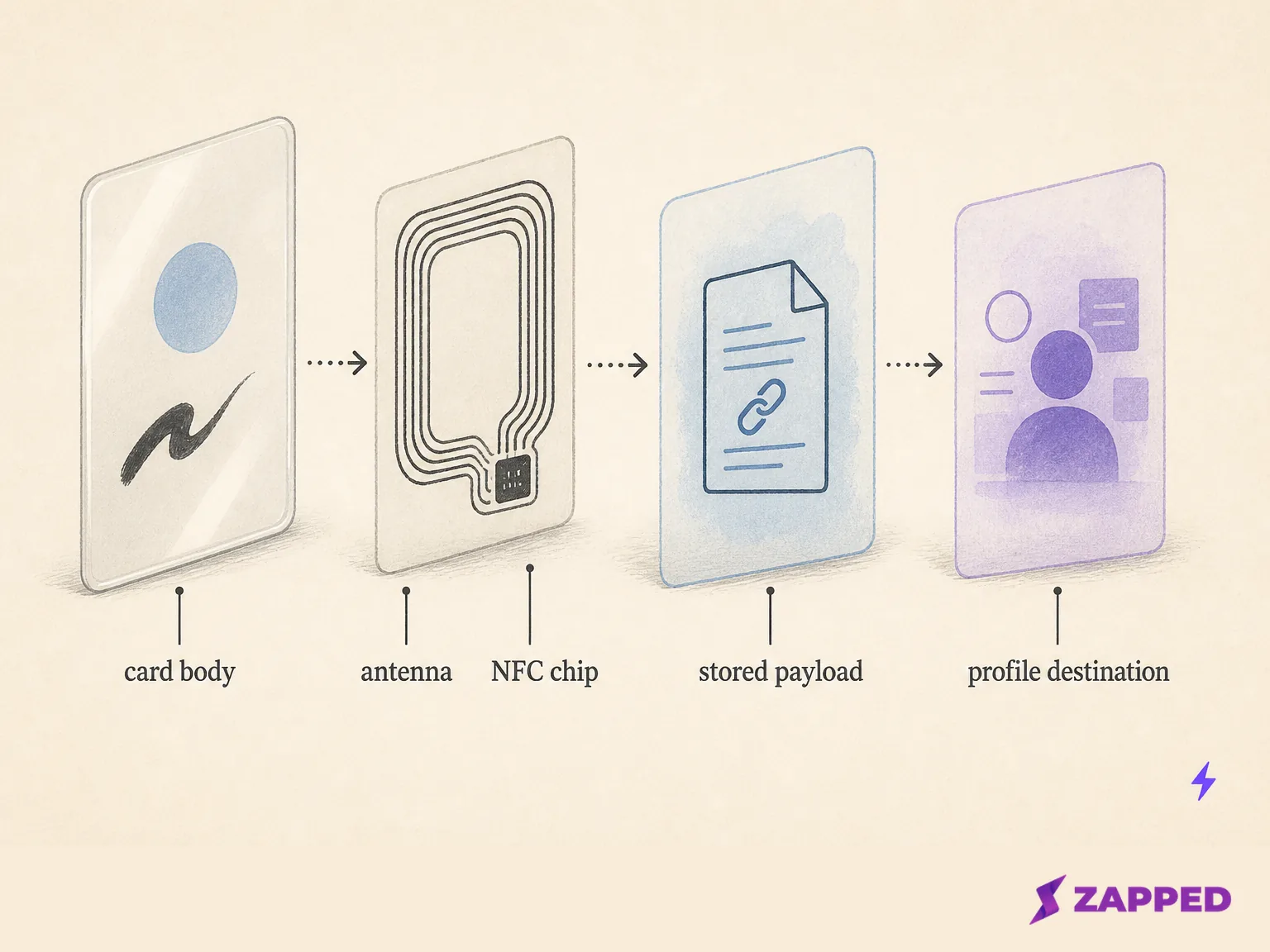
Conceptual diagram showing the physical carrier, NFC hardware, stored payload, and browser destination as separate layers.
If the printed face, tap zone, and QR fallback are part of your decision, the NFC business card design guide covers that visual handoff. Here, the focus is the material and construction questions that come before final design.
What should the supplier disclose?
Ask for a construction description, not only the word plastic. Find out whether the body is PVC, PET, a hybrid, a composite, or another substrate, and how the antenna and chip sit inside it.
GoToTags lists one printed PVC card with an NTAG213, CR80 dimensions, a copper antenna, and PVC and integrated circuit materials inside the card. Seritag lists a custom PVC NTAG213 construction with a copper coil and an option for the buyer to encode the tag. Those pages describe their products, not every plastic NFC card.
Treat thickness the same way. The familiar ID 1 card reference is roughly 0.76 mm, or 30 mil, but that is a format reference, not proof that a particular NFC card conforms to a standard. Ask for the finished card's nominal thickness, including the inlay and lamination.
The wooden NFC business card guide helps when the substrate and finish change with the material. A wood card raises different questions about the body, surface, and inlay. Keep those questions separate from any claim that plastic is a universal winner.
Before you approve a card, ask these construction questions:
- What is the body material and finished thickness?
- Where are the antenna and chip, and what surfaces is the card designed to contact?
- Which chip family is installed, and what tag state will it have when delivered?
- What printing system, coating, overlaminate, and edge finish are available?
- Can the supplier provide a physical sample or a small order before a larger run?
The guide to metal NFC business cards explains why metal needs antenna isolation and a marked tap side. For plastic, confirm that the card is intended for ordinary surfaces, and do not assume the same construction will behave the same way near metal.
Why tap behavior belongs to the whole construction
The phone does not read the word PVC. It couples with the card's antenna. Antenna geometry, tuning, operating volume, alignment, the surface under the card, and nearby metal can all change the result. NFC Forum guidance points to an easy to locate antenna, a suitable contact surface, enough operating volume, and testing of the finished tag experience.
A chip number is not a reliability score. NXP's documentation separates the integrated circuit from the antenna and describes integration across different shapes, dimensions, and materials. The finished card still has to make those parts work together.
One published field study reported about 2.5 to 3 cm for a perpendicular tag in its own mobile phone setup. It found no observed wood effect in that setup and reported that metal prevented reading. The study used a MIFARE Standard 1K tag in a construction setting, not a current PVC business card, so it cannot provide a universal plastic range.
Tefeli's published review gives a second, narrower warning. The card seller reported that nine cards worked on its set of modern phones, while two cheaper cards had lower tap rates on an older Huawei P30. The review did not identify which cards were PVC, so it supports phone and card variation, not a material ranking.
The NFC sticker versus NFC business card guide helps when you are deciding between a card carrier and a sticker, or when the surface under the tag is part of the problem. Ask the seller where the antenna is and approve the exact construction you plan to buy.
Durability is a construction question
Plastic can give you a familiar card surface, but vivid print is not the same as abrasion resistance. A technical paper from the Society for Imaging Science and Technology separates substrate stability from image stability and discusses ink or dye systems, overlaminates, and tests for abrasion, flexure, heat, humidity, ultraviolet exposure, water, and chemicals.
Turn “durable plastic card” into specific questions. What protects the printed face? How are the edges finished? Does the supplier show the same finish on a sample? Will the card live in a wallet, sit on a desk, or be handled at every meeting? Those uses create different demands even when the body material is identical.
Card industry commentary describes PVC as common in lower cost cards, while PET, PET and PVC hybrids, and polycarbonate appear in some applications where longer service life or greater durability matters. That is context, not a lifespan study for a specific NFC business card. Do not turn a comparison from payment or identity cards into a fixed promise about your card.
TechRadar's buying guidance for printed cards points buyers toward thickness, coatings, materials, quality, and sample kits. If the finish matters to your brand, approve a sample or small order before committing to a large batch.
Lifecycle questions deserve the same precision. European environmental reports describe concerns around PVC additives, production, use, and end of life, but they do not assess one NFC business card with its ink, laminate, copper or aluminum antenna, silicon chip, packaging, shipping, reuse, and disposal route. Ask the supplier what it can document instead of issuing a blanket sustainability verdict.
What the chip stores, and what rewritable means
The chip and the profile are not the same storage layer. NXP lists different freely available user memory for NTAG213, NTAG215, and NTAG216, along with locking and password protection controls. Those figures describe the IC, not the finished card's print wear, bending, surface abrasion, water exposure, or life in a wallet.
An unlocked tag can be encoded again. A permanently locked tag cannot be programmed again. A password protected tag is different from both, and a dynamic redirect is different again. The guide to whether NFC cards can be rewritten goes deeper into those states.
Seritag documents a redirect model in which the stored URL remains in the tag while software changes the final destination. That can be useful when you want to update a profile without rewriting the card, but it depends on the provider's implementation. It is not a universal property of NFC or PVC cards.
Ask the supplier or service these questions before accepting pre encoded cards:
- Is the tag unlocked, password protected, or permanently locked?
- What exact URL or NDEF record will be written?
- Can the URL be changed by rewriting the tag, by changing a redirect, or both?
- Who controls the account and the destination behind the URL?
- What happens to the destination if the account closes or the service terms change?
NFC Forum specifications describe NDEF and tag operations. They do not set a business card vendor's rules for profile ownership, subscriptions, redirects, or account closure. Those are commercial terms, so read the named provider's policy instead of assuming the physical card transfers the profile with it.
Put a live profile behind the card
Once you choose the carrier, you still need a destination that works for people who tap, scan, or receive the link directly. A visible QR code or short URL gives recipients another route when the tap is inconvenient, the antenna location is unclear, or the phone does not respond as expected.
Zapped can be the live public destination behind a chosen NFC card. Its documented card can be shared by NFC, QR code, or link, and the recipient opens it in a normal browser without installing an app or creating an account. The relevant next step is Zapped's guide to programming an NFC business card.
The buyer checklist
Before a large order, run the same four checks against the physical card, NFC layer, payload, and profile service.
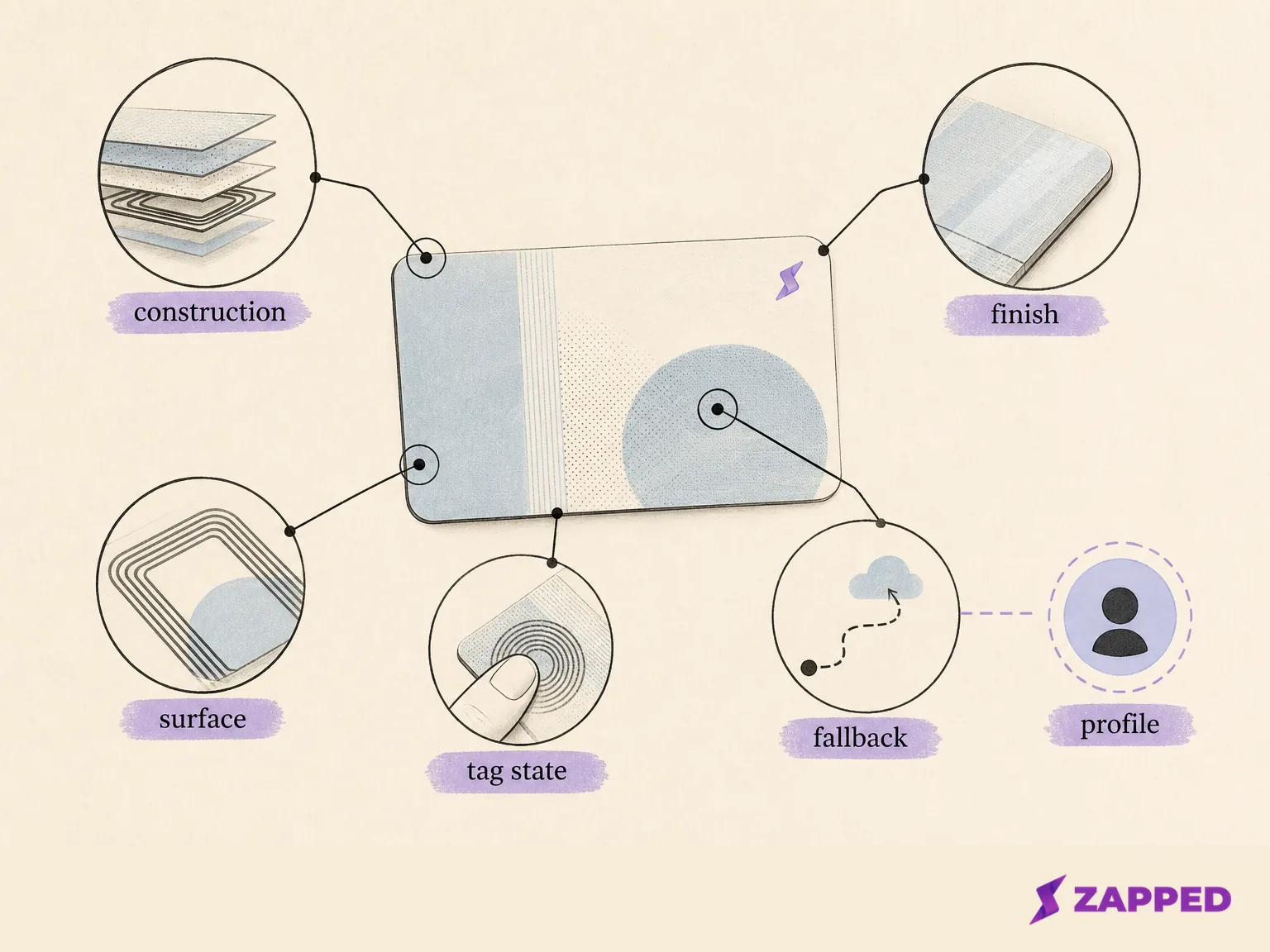
Conceptual buyer checklist for reviewing construction, finish, tag state, fallback, and profile destination before ordering.
Carrier
- Confirm PVC, PET, a hybrid, or another named substrate.
- Confirm finished thickness and card format. Treat 0.76 mm or 30 mil as a reference, not certification.
- Ask about print method, coating, overlaminate, edge finish, and sample availability.
- Ask what the supplier can document about materials and disposal.
RF hardware
- Confirm the antenna location, chip family, and intended contact surface.
- Ask whether the card is designed for ordinary surfaces or metal.
- Test the exact sample with the phone conditions and tap position you expect to use.
- Do not use the chip memory number as a substitute for a finished card check.
Payload
- Record the exact URL or NDEF record written to the tag.
- Confirm whether the tag is unlocked, password protected, or permanently locked.
- Separate rewriting the tag from changing a provider managed redirect.
- Print a QR code or short URL as a fallback when the design allows it.
Hosted profile
- Identify who controls the account and destination.
- Check whether the URL stays live when the profile is edited.
- Ask what happens if the account closes or a subscription ends.
- Confirm that the recipient can open the destination in an ordinary browser.
Verdict
Choose plastic when you want a familiar printed carrier and the supplier documents the complete construction. It is a practical baseline, not a guarantee of read performance, lifespan, or a portable profile.
Skip the large order when the seller hides the inlay, tag state, finish, fallback, or destination ownership. Approve a sample or small order, confirm the tap path, scan the QR route, and write down what remains under your control. For the final write and check, use the guide to program NFC business cards.
For a wider comparison of card products, recurring software, QR fallback, and ownership questions, see the best NFC business cards guide. Plastic is a good starting point when the paperwork and handoff are as clear as the card face.
Sources
- NFC Forum technology overview, checked 2026-08-08.
- NFC Forum specifications, checked 2026-08-08.
- NFC Forum guidance on NFC user experience, checked 2026-08-08.
- NXP NTAG213, NTAG215, and NTAG216 data sheet, checked 2026-08-08.
- NXP NTAG21x product information, checked 2026-08-08.
- GoToTags printed PVC NTAG213 card, checked 2026-08-08.
- Seritag custom PVC NTAG213 card, checked 2026-08-08.
- Seritag NFC encoding guidance, checked 2026-08-08.
- Seritag tag password and lock guidance, checked 2026-08-08.
- Society for Imaging Science and Technology paper on printed card durability, checked 2026-08-08.
- ICMA commentary on card material and service life, checked 2026-08-08.
- TechRadar card printing review, checked 2026-08-08.
- Published NFC field study, checked 2026-08-08.
- Tefeli review of nine NFC business cards, checked 2026-08-08.
- European Commission PVC report, checked 2026-08-08.
- Zapped homepage, checked 2026-08-08.
- Zapped NFC programming help, checked 2026-08-08.