Usually, no. A normal NFC business card uses a passive tag, so the card needs no battery or charging. The phone or NFC reader still needs power because it creates the electromagnetic field that briefly energizes the tag.
That distinction matters when a tap fails. Check the reader, the tag position, and the backup route before you assume the card needs a battery or needs replacing. For the broader category, see what NFC business cards are.
The card is passive, the reader is powered
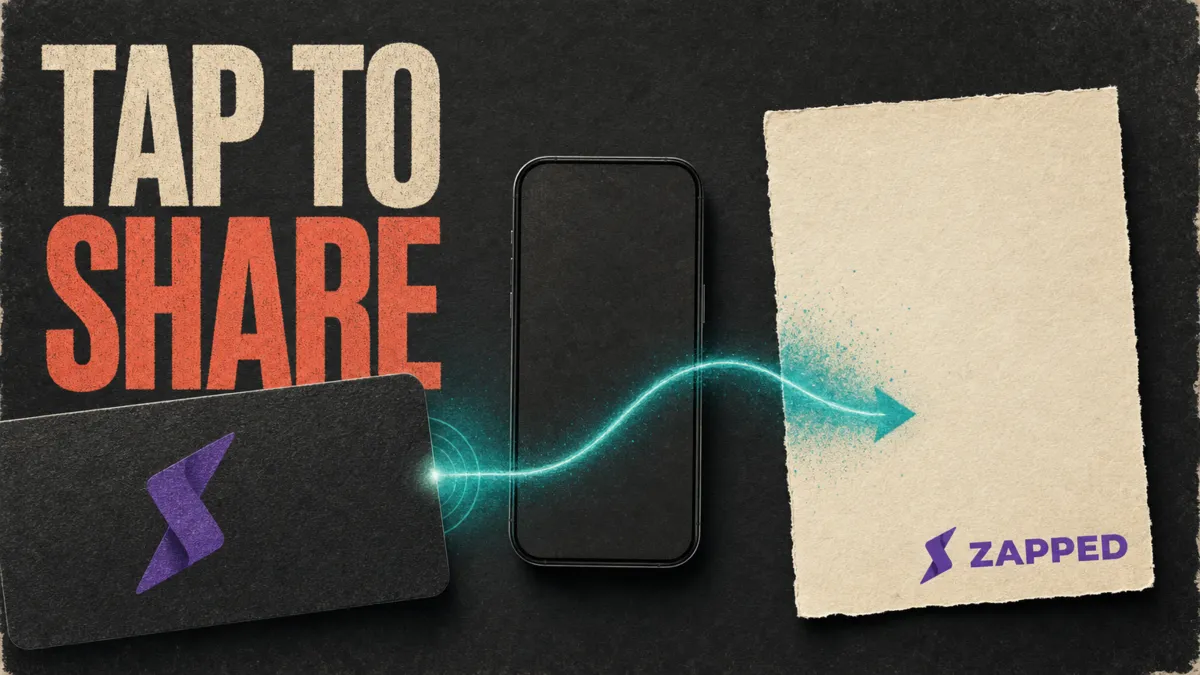
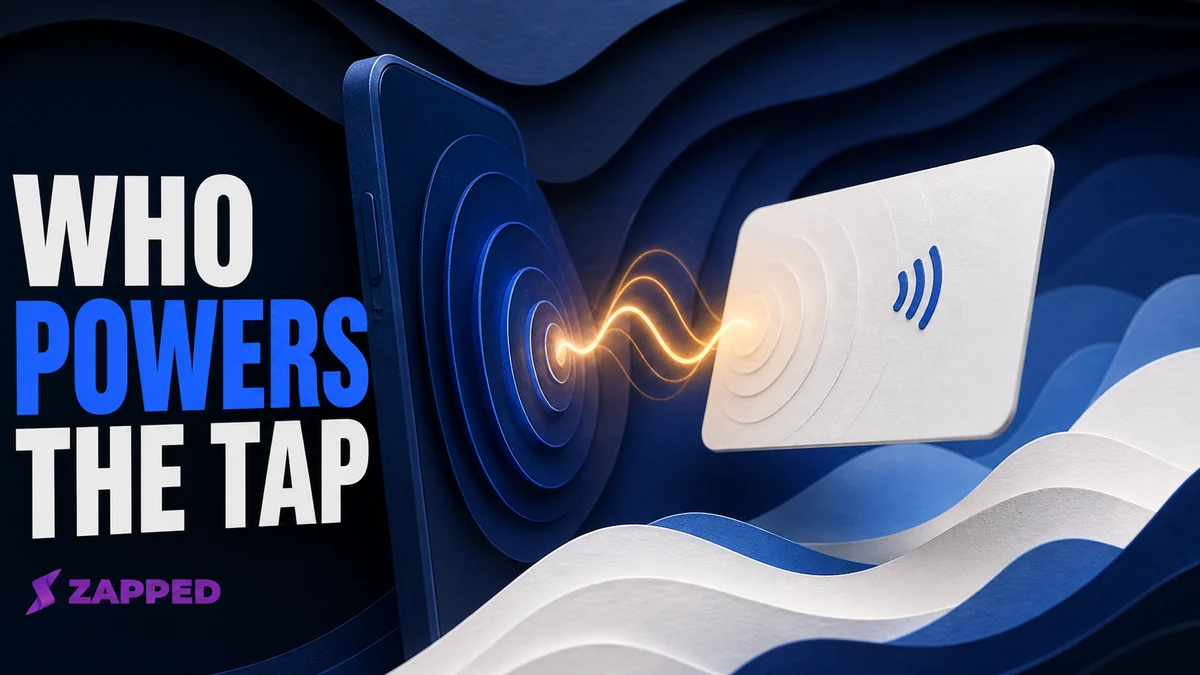
In an ordinary tap, the phone or other reader generates a short range electromagnetic field. The antenna in the card couples to that field, and the chip harvests enough energy to wake up and exchange its small stored payload. The card is using energy supplied by the reader for the transaction.
The tag then answers without generating its own field. In passive communication, ETSI defines the initiator as the field generator and the target's response as load modulation. In plainer terms, the tag changes how it loads the reader's field so the reader can detect the response.
The NFC Forum's description of reader mode assigns the same roles: the device generates the field, while the passive tag uses that field to power its electronics while it is in range. That is the hidden power chain behind most tap cards.
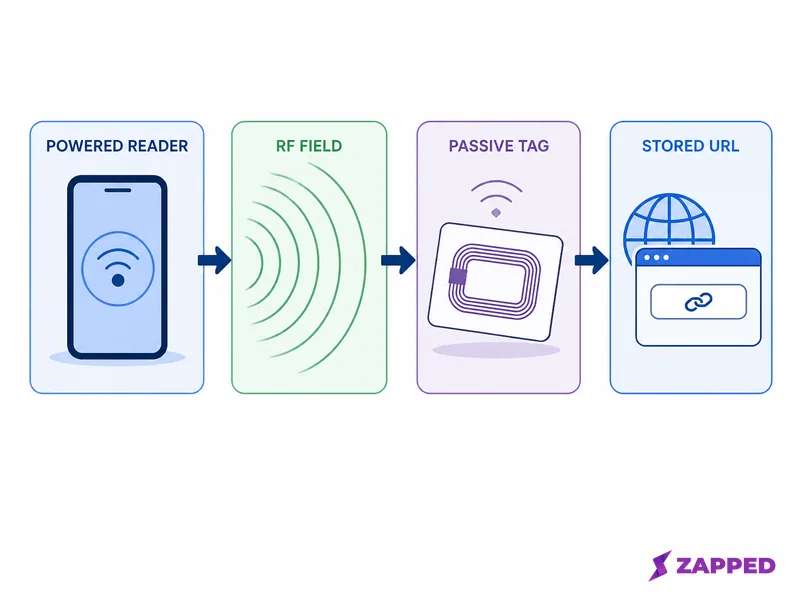
The reader supplies the field, the passive tag returns the stored URL, and the phone handles the next step.
The phone's job does not end when it detects the chip. It interprets the stored URI, decides what should open it, and uses its normal network connection to load a web destination. The tag read and the profile loading step are related, but they are not the same event.
Android's Tag API describes an NFC tag as a passive device powered by the Android device's NFC field. It lists cards, stickers, and key fobs as possible tag forms. Android's reader and writer documentation also separates reading passive tags from other NFC modes.
One representative chip family shows why this architecture appears in business cards. NXP lists NTAG213, NTAG215, and NTAG216 as NFC Forum Type 2 tag integrated circuits, with business cards among their target uses and contactless transfer of data and energy. That supports the normal design, not a claim that every card uses those exact chips.
If the broader handoff is still fuzzy, how a tap business card works covers the exchange from the reader's point of view. This page's narrower point is where the power comes from.
Four hardware roles that are easy to confuse
The word NFC describes a communication technology, not one universal piece of hardware. A passive card, a powered reader, an active device, and a battery assisted device can all appear in conversations about NFC while doing very different jobs.
| Role | Power source | Who creates the field | Business card relevance | What to do with that fact |
|---|---|---|---|---|
| Passive tag or card | Energy harvested from a nearby reader | The reader or initiator | The ordinary URL or NDEF card | Expect no card battery, but provide a powered compatible reader |
| Powered reader or writer | Phone battery, USB, or mains | The reader | The phone or dedicated unit that starts the tap | Reader power does not mean card power |
| Active NFC device | Its own power at both endpoints | The initiator and target use their own fields | A different hardware class | Do not infer this design from the word NFC alone |
| Battery assisted or semi passive device | A battery runs some circuitry, while reader power may still handle communication | It depends on the device design | An exception or specialized design | Check product specific documentation |
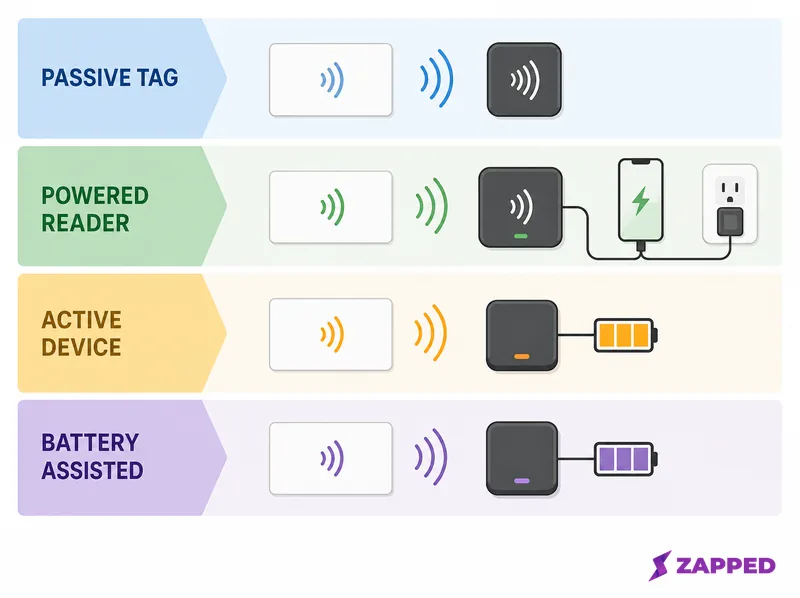
The ordinary card is the passive role. The powered reader is the part that starts the field.
ETSI describes active communication as a mode in which both the initiator and target use their own RF fields. That is a standards distinction, not proof that normal business cards contain batteries. It tells you why the passive card architecture should not be confused with every device that uses NFC.
RFID Journal's explanation of passive and active tags makes the category contrast easier to apply. It describes active tags as having their own power source, passive tags as drawing power from the reader, and semi passive tags as using a battery for circuitry while communication still depends on the reader.
A community design discussion describes a battery powered reader being developed to read passive cards, but that is a reader exception, not evidence that the card has a cell inside it. If a product combines a battery with an NFC card, read its own specifications carefully and treat that product as a separate design.
What must be powered for a tap to work
Start with the reader. A passive card cannot create the field it needs, so the phone or dedicated reader must have usable NFC hardware and power to energize the tag. A separate reader can fill that role, but it still needs compatible NFC hardware and its own power source.
On Android, Google says the device usually looks for tags while the screen is unlocked, unless NFC is disabled in Settings. Manufacturer behavior can vary, so the practical check is simple: wake and unlock the phone, then confirm NFC is enabled where the platform requires it.
Apple documents a different path. iPhone XS and later support background tag reading without opening an app first, but Apple lists blockers such as the first unlock after a restart, an active reader session, Wallet, Camera, or Airplane Mode.
For model specific steps, use the guide to scan an NFC business card on iPhone.
The card and reader also need to be close and aligned. NFC is a close range interaction. The NFC Forum describes a typical range up to 2 centimeters, while Android describes NFC connections as typically requiring 4 centimeters or less. Those are useful boundaries, not a promise that every card reads at one fixed distance.
NXP lists an operating distance up to 100 millimeters for the NTAG21x family, but qualifies it by field strength and antenna geometry. That chip level figure is not an everyday business card range. The antenna in the finished card, the phone's antenna, and their alignment all affect the coupling.
Finally, separate a successful tag read from a successful web visit. Apple's background flow looks for a URI record and can open a link in Safari when no associated app handles it. A tag can be detected while the browser, URL, or network step still needs attention.
For the full branch by branch diagnostic path, use the guide to fix an NFC business card that is not working. For this question, the useful order is reader first, position second, payload and destination third.
Batteryless does not mean unlimited or offline
Batteryless operation removes the need to charge the card. It does not turn NFC into a room scale signal or make every phone behave the same way. A batteryless tag read also does not guarantee that the hosted destination will load without network access.
That is why a QR code or direct link is a practical companion. If a recipient's phone cannot complete the NFC handoff, a visible alternative lets the conversation continue without turning a device limitation into a card replacement.
Batteryless also does not establish infinite physical life or unlimited rewrites. NXP lists 10 years of data retention and 100,000 write cycles for the NTAG21x family. Those are representative chip specifications, not a promise about every finished card, its materials, or the service behind its destination.
For the deeper question of writing and rewriting NFC cards, see how NFC cards can be rewritten. The battery answer is about power during a tap, not a guarantee that every part of a card lasts forever.
A five question check before replacing the card
Use this sequence when a tap appears dead:
-
Does the phone or reader have NFC hardware and enough power right now? A passive tag needs a reader that can generate the field.
-
Is the reader in the state needed to discover a tag? Check NFC settings, screen state, and the platform's documented blockers.
-
Is the card close to the actual NFC antenna area? Move it slowly across the back of the phone instead of assuming the center is the antenna.
-
Did the reader discover a tag, or did the browser and network step fail afterward? A detected tag points the investigation toward the URI or destination.
-
Is a QR code or direct link available? A fallback keeps sharing moving when the recipient's phone cannot complete NFC.
The result tells you what to do next. A reader problem calls for a different phone or reader state. A position problem calls for better alignment. A payload problem calls for checking what was written. A destination problem calls for checking the URL or network. A fallback problem calls for adding a QR route, not adding a battery to a passive card.
If you need to create and test that backup route, see how to create and share an NFC digital business card and how to create a digital business card QR code.
Put the destination where the tap can reach it
The physical tag is only the handoff. The useful experience is the public profile that opens after the read, plus a second route for the moments when NFC is unavailable.
Zapped is a digital business card platform that lets a user share a public vCard by NFC, QR code, or direct link, and its public card opens in a normal browser without an app. The NFC card can carry the public profile URL while the printed QR code and shared link remain available as backups.
The instructions for programming an NFC business card recommend writing the public URL, testing it with another compatible phone, and keeping a QR fallback.
If several people need shared profile destinations and ownership rules, see digital business cards for teams. That is a rollout question, while the hardware decision here stays the same: the card can be passive, but the reader must be powered.
The practical verdict
Do NFC business cards need batteries? The ordinary passive card does not. The reader does need power, compatible NFC behavior, close coupling, and a usable path to the destination.
When a tap fails, check those reader and handoff conditions before shopping for a battery powered card. In most cases, the battery question is really a diagnosis of the part of the system that starts the conversation.
Sources
Sources checked in August 2026:
- NFC Forum, NFC Technology
- NFC Forum, Reader Mode Interoperability
- Android Developers, Tag API
- Android Developers, NFC overview and basics
- Apple, Adding Support for Background Tag Reading
- ETSI TS 102 190, NFCIP 1 Interface and Protocol
- NXP, NTAG213, NTAG215, and NTAG216
- RFID Journal, passive and active tags
- r/NFC, battery powered NFC reader design discussion, captured September 2023
- Zapped homepage
- Zapped Help Center, programming an NFC business card