There is no universal most secure digital business card. Choose the platform and physical carrier that can show current evidence for the data and sharing path you will use, then run this checklist before comparing brands.
The key distinction is simple. Hosted software security covers the account, profile, data, permissions, redirects, and lifecycle. NFC security covers the physical tag, its NDEF payload, its write state, and the destination it opens. A strong answer has to address both when both are part of the handoff.
Security depends on what the card exposes
Start with the information, not the vendor badge. A public profile may expose only a name, phone number, email address, booking link, and social profiles. A lead workflow may also collect form submissions, enrichment, analytics, device data, internal notes, and employee identities.
The owner matters too. A solo professional can manage one profile and one account. A team needs roles, approvals, provisioning, offboarding, ownership of public routes, and a clear answer for what happens when someone leaves.
Write down every sharing path before you score a platform: browser profile, QR code, NFC tap, email signature, Wallet pass, CRM, or custom domain. If you are still choosing the wider product format, start with this digital business card comparison. If you need a broad feature inventory first, use this digital card app feature checklist, then return here for the security controls.
Map the storage path as well. Where digital business cards are stored separates the hosted profile, the recipient's saved contact, and the team's CRM record so the security review does not treat them as one system.
The minimum bar should rise with the exposure. Ordinary public contact details can use a smaller control set than a team platform holding lead records and analytics. The phrase “most secure” becomes useful only after the data, people, and delivery paths are named.
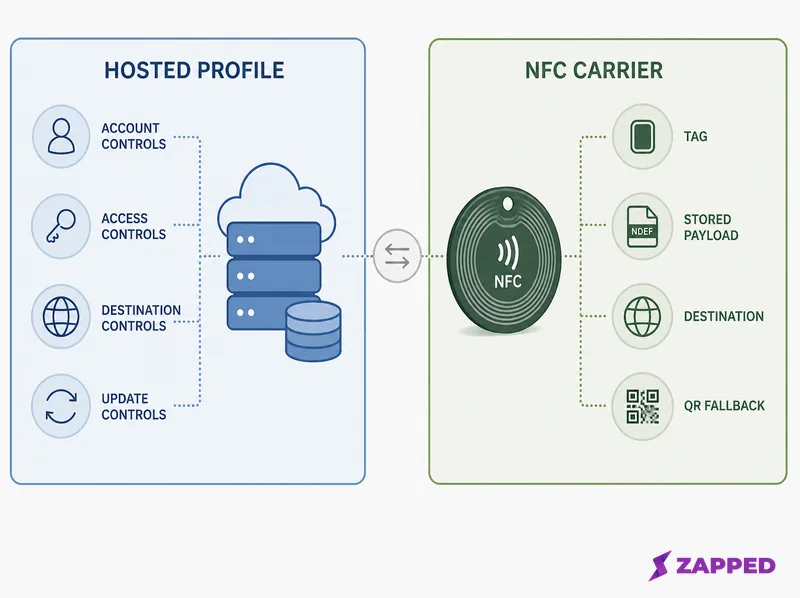
How to evaluate the most secure digital business card
Use a 100 point software score, but treat it as a decision aid rather than a certificate. The weights below force the review to cover the controls that a polished security page can leave vague.
| Dimension | Weight | Evidence to request | Minimum decision question |
|---|---|---|---|
| Independent assurance and scope | 20 | Current SOC 2 Type II report, ISO/IEC 27001 certificate, system boundary, audit period, auditor or certification body, exceptions, and subservice coverage | Is the hosted card service in scope for the period being claimed? |
| Data governance and privacy | 20 | Fields collected, analytics, enrichment, subprocessors, purposes, retention, deletion, and export | Can you explain what is collected, why it is collected, how long it stays, and how it leaves? |
| Identity, access, and administration | 20 | MFA, SSO, SAML or equivalent, roles, approvals, audit history, session controls, provisioning, and offboarding | Can the team enforce least privilege and remove access without orphaned cards? |
| Application and link security | 15 | HTTPS, secure development, vulnerability response, destination validation, redirect behavior, and custom domain controls | Can the reader reach the expected destination without an uncontrolled redirect path? |
| Incident, availability, and recovery | 15 | Notification terms, status history, backups, recovery objectives, support path, and continuity evidence | What happens when the hosted card service is unavailable or reports an incident? |
| Portability and exit | 10 | Data export, profile ownership, cancellation, reassignment, QR or NFC outcome, and deletion timing | Can you leave or offboard without losing control of the public contact route? |
Award points only for current evidence that identifies the relevant service in scope. A badge or vendor sentence is a useful prompt, but it is not the same thing as seeing the report, certificate, policy, or test detail that answers your question.
Use these bands to interpret the total:
- 85 to 100: A strong documented fit, subject to scope and configuration checks.
- 70 to 84: A plausible fit with evidence gaps to resolve before sensitive or large team use.
- 50 to 69: Suitable for low sensitivity public sharing unless due diligence closes the gaps.
- Below 50: Not secure enough for the stated use, even before a hard requirement is considered.
Any failed hard requirement overrides the total. Missing scope for a sensitive rollout, uncontrolled redirects, no workable offboarding path, or an ordinary URL tag used as a credential should stop the recommendation.
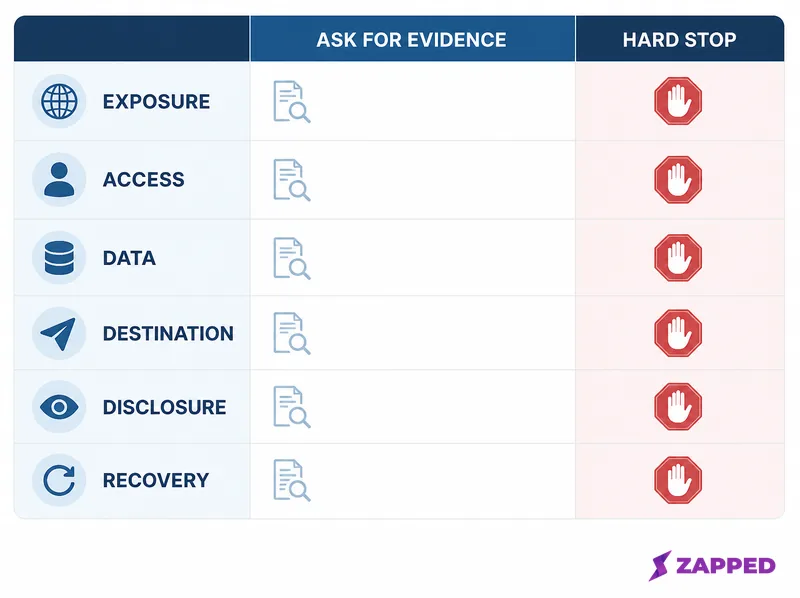
SOC 2 and ISO claims need scope attached
SOC 2 is an examination of controls at a service organization against relevant Trust Services Criteria. Those criteria cover security, availability, processing integrity, confidentiality, and privacy. The result is about the system and controls described in the report, not every product a company sells.
ISO/IEC 27001:2022 concerns an information security management system and its risk management process. It is a different assurance signal from SOC 2. A certificate still needs an organization, process, and service scope before it tells you whether the hosted card platform is covered.
Ask for five pieces of context before awarding the assurance points:
- The exact system boundary and service name.
- The audit or certificate period.
- The auditor or certification body.
- Exceptions, qualifications, and management responses.
- Subservice organizations and whether the card service depends on them.
Then ask the direct question: does the service that hosts the public profile, account, analytics, and team data appear in that scope? A page that says “SOC 2 Type II” without those details receives a disclosure note and a request for proof, not automatic full credit.
NIST Cybersecurity Framework 2.0 is useful for checking whether the conversation covers governance, identification, protection, detection, response, and recovery. OWASP ASVS 5.0.0 is a useful reference for web application controls and secure development questions. Neither is a certification for a digital business card.
Privacy is a lifecycle question, not a policy badge
The FTC’s business guidance on privacy and security recommends collecting only what is needed, protecting it, and disposing of it securely. Turn that principle into a data map for the card service.
Ask which sender, recipient, device, diagnostic, usage, analytics, and enrichment fields are collected. Separate what the card needs to open or save a contact from optional data used for product improvement, measurement, personalization, or marketing.
Next, ask where each field goes. The policy should name purposes, subprocessors, retention periods, deletion rights, and export paths clearly enough for an owner to act. “We respect privacy” is positioning. A process for removing a card, profile, contact record, and team member data is a control to verify.
Blinq’s privacy policy describes device, app, network, usage, diagnostic, performance, enrichment, retention, and deletion topics. That makes the policy worth reading beside its digital business card security disclosure, not a substitute for it.
HiHello’s privacy summary says users can export and delete their data and that the company does not sell it. It also describes usage analysis to improve the service. Those are stated policy positions. Ask how the process works, what is deleted, what is retained, and how the result is documented.
Account controls decide whether teams can contain risk
For a team, account security is more than a login screen. Match MFA, SSO or SAML, roles, approvals, audit history, session controls, and least privilege to the organization’s size and sensitivity.
Ask how a new member is provisioned, what an administrator can see or change, and how access is removed after departure. The same conversation should cover public profile ownership, team workspaces, custom domains, QR codes, and NFC destinations. An employee account should not become the hidden owner of a route the company still needs.
Wave’s enterprise page publicly describes SOC 2 Type II, GDPR, SAML based SSO, SCIM provisioning, admin controls, controls to lock user content or brand colors, deprovisioning, and custom domains. Treat those as disclosures to investigate. Ask for the scope, configuration details, and the exact offboarding behavior relevant to your rollout.
If the rollout has broader branding, analytics, and deployment needs, continue with this guide to digital business cards for teams after you finish the security specific checks.
Inspect the link path from the tap or scan to the profile
The reader does not experience your security page. The reader experiences a tap or scan, an address, a redirect chain, a browser warning or a profile. Check the complete path.
Confirm HTTPS and the expected domain before the profile opens. Ask whether a user supplied destination can create an arbitrary redirect, whether destinations are allowlisted, and whether the service shows a warning before leaving its trusted domain.
OWASP’s open redirect guidance treats uncontrolled redirects as a phishing and exploit chain risk. A smart redirect can be useful, but it is also a control surface. Ask who owns the destination, who can change it, and what happens when a profile or campaign is reassigned.
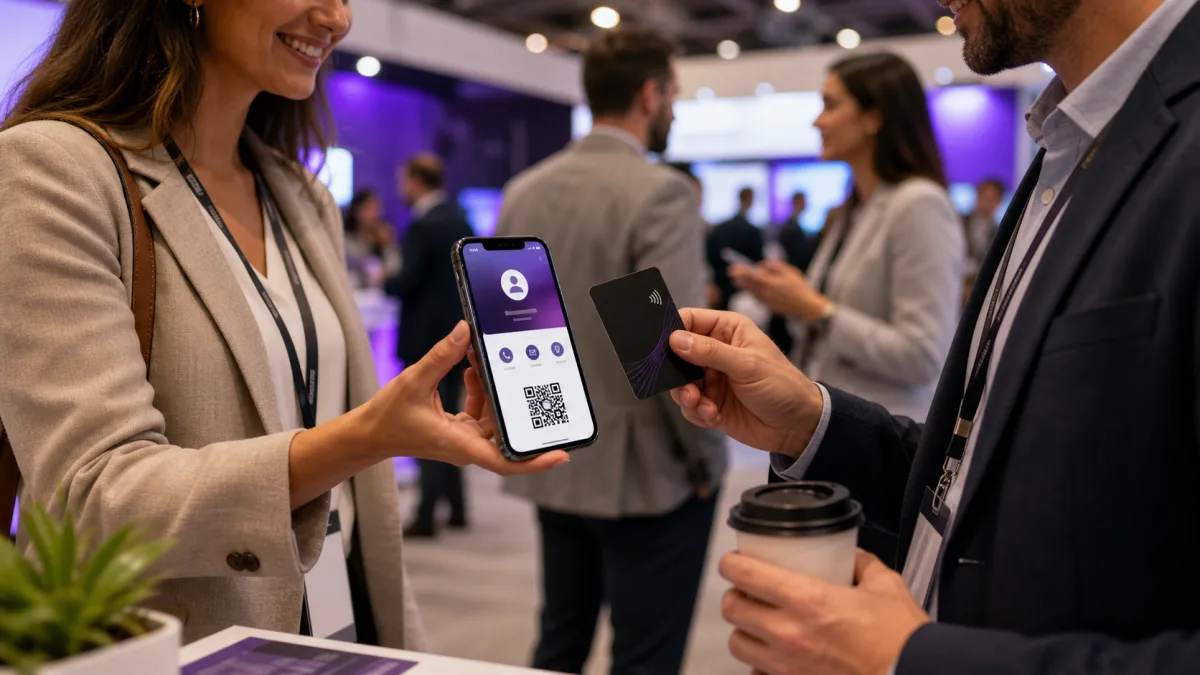
The FBI’s QR code alert warns that QR codes can lead to phishing pages, data theft, or malicious software. That is a reason to check the source and destination, not a reason to abandon QR codes. For the broader consumer context, read whether NFC business cards are safe, then see how an NFC business card can be used for phishing for the tag to destination trust boundary.
Check incident response, recovery, and exit before rollout
Before a team publishes a profile, ask for a short written answer to each of these:
- How are incidents reported, and through which support or security channel?
- What status history, backup, recovery objective, and continuity evidence is available for the profile host?
- Who owns the public profile URL, QR code, custom domain, and NFC destination?
- What happens after cancellation, downgrade, reassignment, or employee offboarding?
- What export format is available, and when are profile and contact records deleted?
These questions connect availability to ownership. A platform can be easy to share and still create an uncomfortable exit if the public route, data export, or replacement process is unclear.
Do not treat a policy promise as an observed outcome. Ask for the documented path, identify who can perform it, and make the result part of the rollout record. That is especially important when a QR code is printed or an NFC tag is distributed widely.
NFC hardware is a separate security decision
An NFC tag is usually a carrier for an NDEF message, often a URL. NFC Forum’s technology overview describes payloads that can represent an internet link, phone number, message, map location, contact data, or another action. Android’s NFC documentation explains how NDEF URI records are mapped to the tag dispatch system.
That tells you how the tag carries an action. It does not prove that the destination is safe, that the tag is authentic, or that the finished card will survive its environment. Keep the hardware score separate from the software score.
| Hardware check | What to record | Why it matters |
|---|---|---|
| Tag identity | Exact chip family, NFC Forum tag type, memory, and manufacturer traceability | “NFC card” is too vague to establish capabilities or lock behavior. |
| Destination payload | First NDEF record, URL spelling, HTTPS, redirect chain, and QR destination | The reader acts on the payload, which can point somewhere stale or unsafe. |
| Write and lock state | Writable, password protected, or permanently read only state, plus who can change it | An unlocked tag can be repointed. A permanent lock can block recovery after a mistake. |
| Authenticity and integrity | Originality signature, signed NDEF record, or application layer authentication where the use case needs it | Convenience password protection is not the same as cryptographic authentication. |
| Physical construction | Antenna location, metal or ferrite needs, substrate, bending, water, and replacement policy | A chip data sheet does not prove how the finished card behaves in a wallet or on a surface. |
| Recovery path | Visible QR code or short link, tested independently, with a documented replacement route | The workflow should not depend on one tap succeeding. |
NXP’s pages for NTAG213, NTAG215, and NTAG216 list read only locking, an ECC based originality signature, and configurable password protection. The datasheet says password protection is disabled initially and describes it as a convenience measure, while pointing to application layer cryptography for higher protection.
Read only locking is a separate control from password protection. It can prevent later rewrites once lock bits are applied, but it does not secure the website behind the tag. If you need the detailed write and lock mechanics, see whether NFC cards can be rewritten.
The NFC Forum also defines a Signature Record Type Definition and an Authentication Protocol for use cases that need signed records, authenticated data, or a secure channel. Its specification says certificate verification and revocation are outside the Signature Record Type Definition’s scope. Do not assume that a basic URL tag uses these mechanisms.
For physical card selection, hand off to this NFC business card comparison. The relevant question here is not which material looks best. It is whether the carrier, payload, lock state, destination, and fallback route fit the workflow.
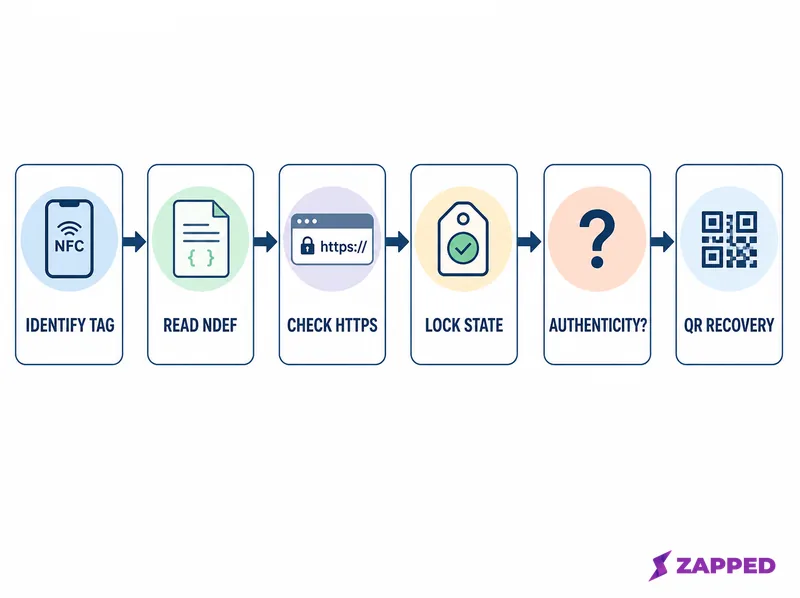
Match the minimum bar to the use case
Use the score to make a decision, not to create a universal league table. The same public profile can be reasonable for one person and unsuitable for a team if the data, permissions, or exit requirements change.
| Use case | Minimum software bar | NFC or sharing requirement | Hard stop |
|---|---|---|---|
| Low sensitivity public profile | HTTPS, clear privacy terms, deletion or export, controlled destinations, and QR recovery | Tag identity and destination still matter, and QR should remain available | Uncontrolled redirect or no recovery route |
| Small team | Assurance scope, MFA or SSO, roles, retention, deletion, incident path, and export | Ownership and offboarding must be documented | Orphaned profiles or unowned public routes |
| Enterprise rollout | Current report or certificate scope, least privilege, provisioning or deprovisioning, subprocessors, recovery, and exit | Exact tag model and replacement process | Missing scope or another failed hard requirement |
| Hosted NFC profile | Software bar for the profile plus tag and destination inspection | Writable or locked state must match the recovery plan | Treating the tag’s physical security as proof of hosted security |
| Authentication, payment, or access control | Purpose built authenticated system and threat model | An ordinary public URL tag is not a credential | Commodity URL tag used as an authentication factor |
For a low sensitivity public profile, the reasonable minimum bar is HTTPS, clear privacy terms, data deletion or export, controlled destinations, and a recovery route such as QR. For a team or enterprise rollout, add current assurance scope, SSO or MFA, least privilege, provisioning or deprovisioning, retention and deletion terms, subprocessors, incident response, and export.
Where Zapped fits when the job is a simple public profile
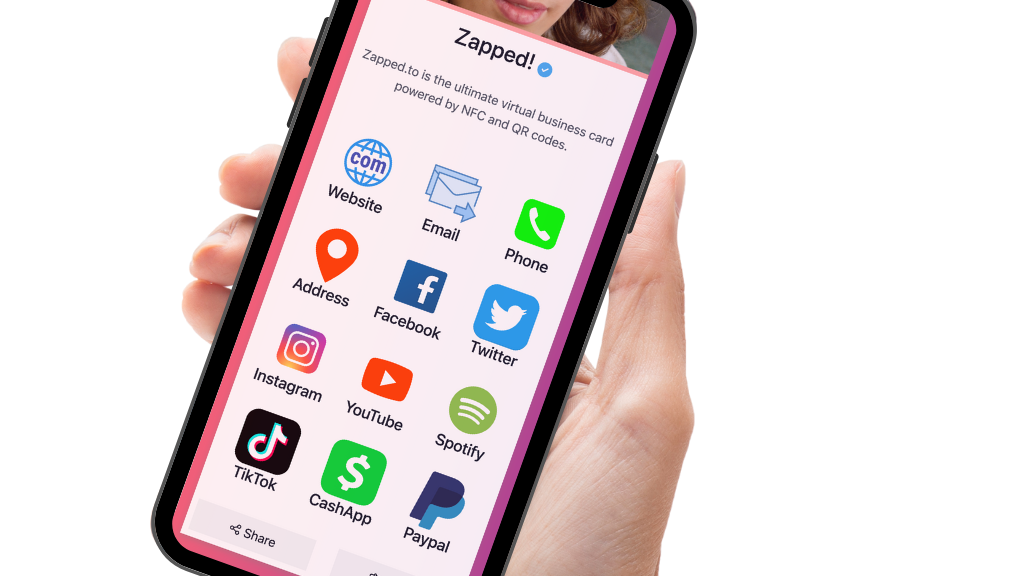
If your decision lands on an editable public profile for ordinary contact details, Zapped is one workflow example to consider. You create the card in a browser and share it by QR code, link, or NFC tap. The recipient opens the public card in a normal browser without installing an app, then can save the contact.
That makes the browser and recovery path relevant to a low sensitivity sharing workflow. Apply the same checklist to the data, account, destination, and carrier you configure.
Public security pages show disclosures, not the whole answer
Public security pages are useful because they tell you what to ask about. They are not a substitute for mapping the claim to the service, period, exceptions, subservices, configuration, and exit path.
| Provider | What its public page says | What the buyer still needs to verify |
|---|---|---|
| Blinq | SOC 2 Type II, GDPR readiness, SSO, and annual testing or outside audits | Current report, exact system scope, period, exceptions, subservices, and how the card service is covered |
| HiHello | SOC 2 Type II, encryption at rest and in transit, annual outside penetration tests, vetted subprocessors, and multi region backups | Report access, scope, period, test detail, subservice coverage, and the behavior of the relevant account and profile |
| Wave | SOC 2 Type II, GDPR, SAML based SSO, SCIM provisioning, admin controls, controls to lock user content or brand colors, deprovisioning, and custom domains | Report and product scope, tenant configuration, destination ownership, and offboarding evidence |
| Popl | Its announcement says an independent auditor examined control design and operating effectiveness and reviewed vendor and outside security | The auditor’s report, scope, period, exceptions, subservices, and the exact hosted card service |
The unresolved questions are the point of the table. None of these public disclosures, by themselves, establishes a universal most secure provider. They give a buyer a focused request list before a sensitive rollout or a broad card distribution.
The broader product decision is separate. After reading a disclosure, use the Blinq digital business card review or the HiHello digital business card review for fit, pricing, and product limits rather than turning a security page into a winner verdict.
The practical verdict
For low sensitivity public sharing, choose the provider and carrier that meet the basic link, privacy, deletion, and recovery bar. The right answer may be a simple hosted profile with a clear destination and a QR fallback, provided the owner understands what data is collected and how the public route can be changed or removed.
For teams, require assurance scope, access controls, offboarding, subprocessors, incident handling, export, and ownership evidence before rollout. For NFC, inspect the carrier and destination separately, then keep QR recovery available.
For authentication, payment, or access control, use a purpose built authenticated design rather than an ordinary public URL tag. NFC can support authenticated use cases, but that requires an application specific protocol and threat model, not a security assumption attached to a tap.
The useful question is not “who says secure?” It is “who can show the controls and lifecycle this workflow needs?” That change in question is what makes the most secure digital business card decision practical.
Frequently asked questions
Is SOC 2 enough to call a digital business card secure?
No. Ask for the exact service scope, report period, exceptions, subservice coverage, and the controls that matter to your data. Then review privacy, account access, redirect safety, recovery, export, and deletion.
Is NFC itself secure?
NFC is a carrier and data exchange technology. A basic URL tag can dispatch a link, but it does not automatically authenticate the destination or the person using it. Inspect the payload, destination, write state, authenticity options, and recovery route.
Does locking an NFC tag secure the website?
No. Lock state controls whether the tag can be rewritten. Hosted software, HTTPS, redirects, account access, profile ownership, and the profile lifecycle remain separate decisions.
What happens when a digital card subscription ends?
Ask for the documented outcome for export, the profile URL, QR code, NFC destination, reassignment, and deletion timing. Do not assume that a route stays live, disappears immediately, or remains under your control.
Can a QR code be the security fallback?
Yes, if the source and destination are controlled and the reader checks the link path. A QR code is a link carrier, so it should have the same HTTPS, destination ownership, redirect, and recovery checks as an NFC payload.
Sources
Sources below were reviewed in August 2026. Vendor pages establish the disclosures each vendor makes about its own service. Standards and public guidance establish what the relevant controls and technologies mean.
Standards and public guidance
- NIST Cybersecurity Framework 2.0
- OWASP Application Security Verification Standard 5.0.0
- AICPA Trust Services Criteria
- AICPA SOC 2 reporting guide
- ISO/IEC 27001:2022
- FTC privacy and security guidance
- FBI QR code fraud alert
- OWASP open redirect guidance
NFC and platform documentation
- NFC Forum technology overview
- NFC Forum specifications
- NXP NTAG213, NTAG215, and NTAG216 product page
- NXP NTAG213, NTAG215, and NTAG216 datasheet
- Android NFC documentation
Vendor disclosures
- Blinq digital business card security page
- Blinq privacy policy
- HiHello Trust and Security
- HiHello privacy summary
- Wave Connect enterprise page
- Popl SOC 2 security announcement
Zapped product source