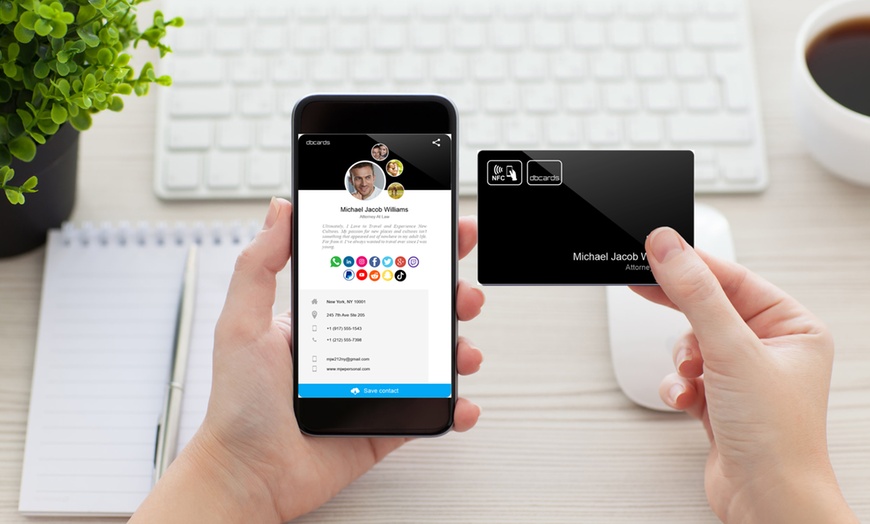
The best digital business card for a financial advisor is the one that fits the firm's governed handoff and follow up workflow. That usually matters more than the card with the most templates, integrations, or analytics tiles.
If you are choosing for a referral meeting, conference, seminar, or advisory team, decide what must happen after the recipient opens the card. The right option should make the next step clear while keeping identity, approved content, follow up, review, and records under control. For a broad category overview, start with this digital business card comparison.
What “best” means for an advisor
A digital card is often treated as a polished contact page. For an advisor, it can also become the first doorway to firm information, credentials, service descriptions, booking links, disclosures, testimonials, or a lead capture route. Each of those pieces can create a separate review question.
The SEC's investment adviser marketing guide says an advertisement must not contain an untrue material statement or omit information needed to keep it from being misleading. It also requires fair and balanced treatment when benefits are presented with material risks or limitations.
For broker dealer affiliated advisors, FINRA Rule 2210 defines correspondence, retail communications, and institutional communications, then applies content standards to communications with the public. FINRA's 2026 oversight report describes the same practical test: claims should be fair and balanced, with material qualifications included.
That does not make a digital card a regulated form. It means the card belongs inside the firm's review process when its content or links are used in business communication.
The useful question is not “Which app has the nicest card?” It is “Which option can our firm approve, distribute, measure, and update without losing control?”
The scorecard to use before comparing platforms
Write the scorecard first. Otherwise, a feature list will quietly decide for you.
Content governance
Ask who owns the profile, who approves edits, how outdated credentials are removed, and what happens when a title, firm, service description, or disclosure link changes. If the profile can contain testimonials, endorsements, ratings, performance references, or specific investment advice, route those items through the firm's compliance or legal function before publication.
The SEC also identifies disclosure, oversight, written agreements, and disqualification conditions when registered investment advisers use testimonials or endorsements in an advertisement. Its 2025 risk alert calls out testimonials, endorsements, and third party ratings as areas that need compliance attention.
Recipient friction and sharing fallback
The recipient may be standing across a table with an unfamiliar phone, limited time, and no interest in installing another app. Compare the browser path, QR code, link, NFC option, contact save flow, and what happens if one method fails.
The mechanics belong in a separate guide to ways to share a digital business card. For an advisor, the important question is what the recipient can do next without creating a second source of confusion.
Contact exchange and lead capture
A card can show your details. A separate form or exchange flow may collect the other person's details. Treat those as different jobs.
Ask where the recipient's name, email, phone number, source label, consent context, and notes go. Then ask who owns the destination, whether the fields map cleanly, how duplicates are handled, and how the approved follow up is reviewed. Community discussions often frame the need as collecting the other person's details so follow up does not depend on memory, but those discussions do not prove that a product completes the workflow.
For the technical side of tap based collection, see what NFC lead capture can and cannot do. The advisor specific questions are source, consent, review, and retention.
CRM, export, and records path
Vendor documentation may mention CRM integrations or exports. That is a starting point for diligence, not proof that the destination is the firm's approved system.
Ask for the exact destination, field mapping, owner, timestamp, export format, version history, and retrieval process. FINRA's social media guidance says business communication records are treated according to content, not the device or technology used, and states a three year minimum for the records covered by that guidance.
The period and rule set can vary by firm status and record type. The platform needs to fit the firm's records design, rather than define it.
Team administration and access
For a team, check central templates, role based access, approval ownership, onboarding, offboarding, and the ability to identify which profile produced a communication. A profile that looks consistent is not enough if former staff can still edit it or a current credential cannot be corrected quickly.
The general mechanics are covered in digital business cards for companies and digital business cards for teams. This article's extra question is whether those mechanics fit the firm's supervision and review responsibilities.
Privacy and security evidence
Request the evidence that matches the data flow: access controls, account recovery, encryption statements, subprocessors, data deletion, audit history, and incident handling. Do not turn a security page into a compliance ranking. A vendor statement, an audit report, and a firm's own approval are different things.
Use this security evidence checklist when the card connects to forms, contact records, analytics, or team workspaces.
Analytics, cost, and failure recovery
Analytics are useful only when the events have a defined meaning. Decide whether you need share to view, contact exchange, qualified lead, follow up time, or records completeness, then confirm which events the platform actually documents.
Pricing should be compared by billing view and plan scope. Avoid a universal price table when some vendors publish custom quotes or incomplete details. Also ask what happens after a mistaken edit, a staff departure, a broken link, or a change to an approved disclosure.
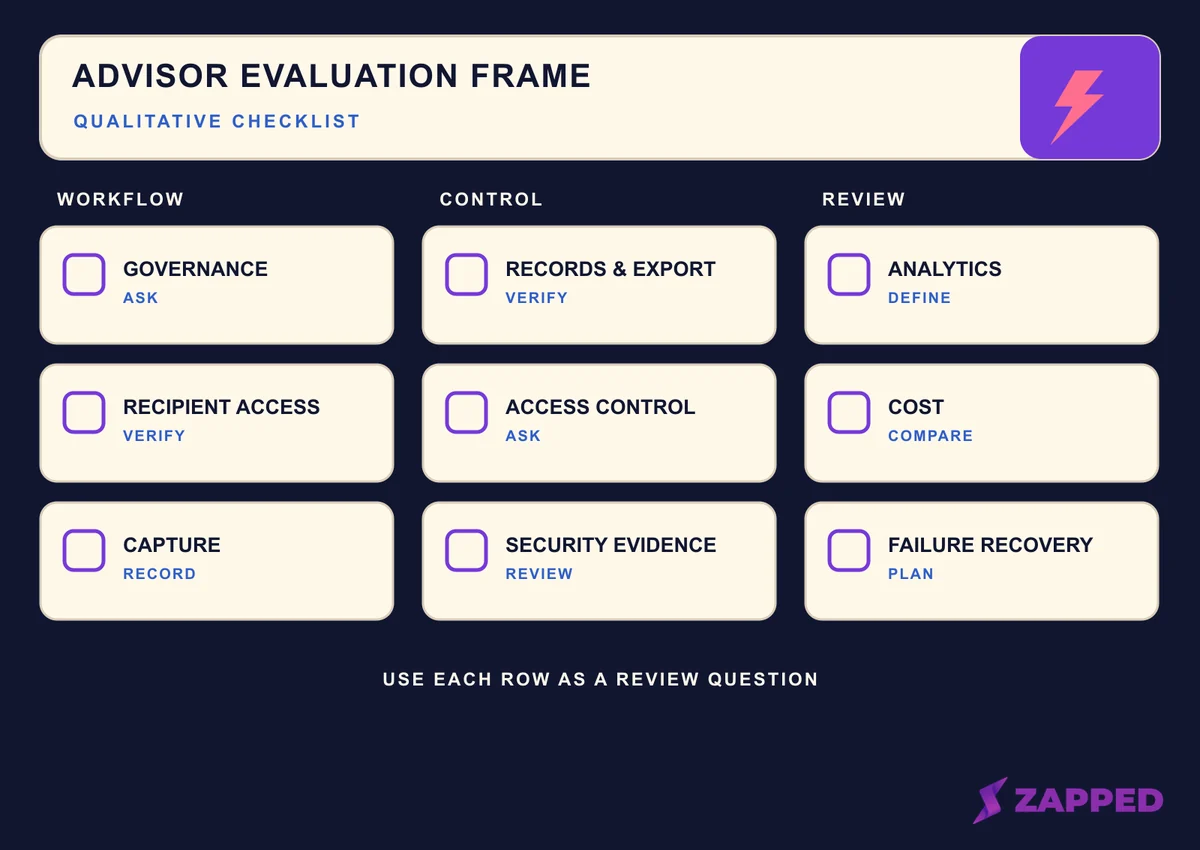
Conceptual evaluation frame. The criteria are prompts for firm review, not scores or rankings.
Platform fit by operating model
There is no responsible universal winner in the available evidence. The useful comparison is between operating models and the proof each one needs before rollout.
Solo RIA at a referral meeting
Prioritize a clear browser path, an editable profile, approved content, one useful next action, and a simple way to record the referral context. The card should not force a prospect to choose between five competing buttons. A firm approved booking link, resource page, or contact route is usually easier to review than a profile packed with every available block.
Analytics can help you see whether the referral source is producing views or contact exchanges, but do not treat a view as a qualified lead. Set the definition with the person who owns follow up.
Broker dealer affiliated advisor at a conference
Prioritize firm review, fair and balanced claims, stable links, source labels, and a records path the firm approves. The conference setting creates pressure to move quickly, which is exactly when an unreviewed claim or personal capture route can slip through.
FINRA Notice 11 39 says the firm must determine whether a technology provides the retention and retrieval functions it needs. A vendor's export button therefore answers only one part of the question. Read the full notice before treating any capture flow as ready for firm use.
Multi advisor practice with central control
Look for a central owner, current templates, role based access, approval checkpoints, offboarding, and a way to correct credentials across profiles. The team should be able to explain which content is shared, which content is individual, and who can publish each change.
HiHello's current pricing page documents individual and team plans, card analytics, admin and deployment, and CRM integrations for its Business offering. Those are vendor documented capabilities, not evidence that a firm's records or supervision requirements are satisfied.
Blinq's business page lists custom lead capture forms, AI enrichment, CRM integrations, a corporate contact book, SSO, SCIM, training, and custom reporting. It also states Business billing per card per month, with separate annual and monthly figures. Treat these as Blinq's stated features and pricing, then verify the exact plan, destination, permissions, and billing view with the vendor and your firm.
Popl separates event lead capture and digital business card plans, with custom quote positioning on its pricing page. Its support documentation lists branded profiles, instant sharing, basic lead capture, CSV, Outlook and CRM export, and engagement analytics.
Those details are vendor documentation, so confirm the actual fields and approval path before relying on them.
Seminar and event heavy practice
Separate the card view from the lead capture and records systems. The card can introduce the advisor. The capture route can collect the visitor's information. The records system can preserve the approved communication context. Those are connected steps, but they do not become one system merely because a platform places them on one dashboard.
Give each step an owner. The event source label, consent context, approved form, follow up queue, review process, and retention design should be explicit before the first attendee scans a code.
What a financial advisor should put on the card
Build the card around one safe next step. A restrained profile is easier to review and more useful to a recipient than a miniature website with no clear route.
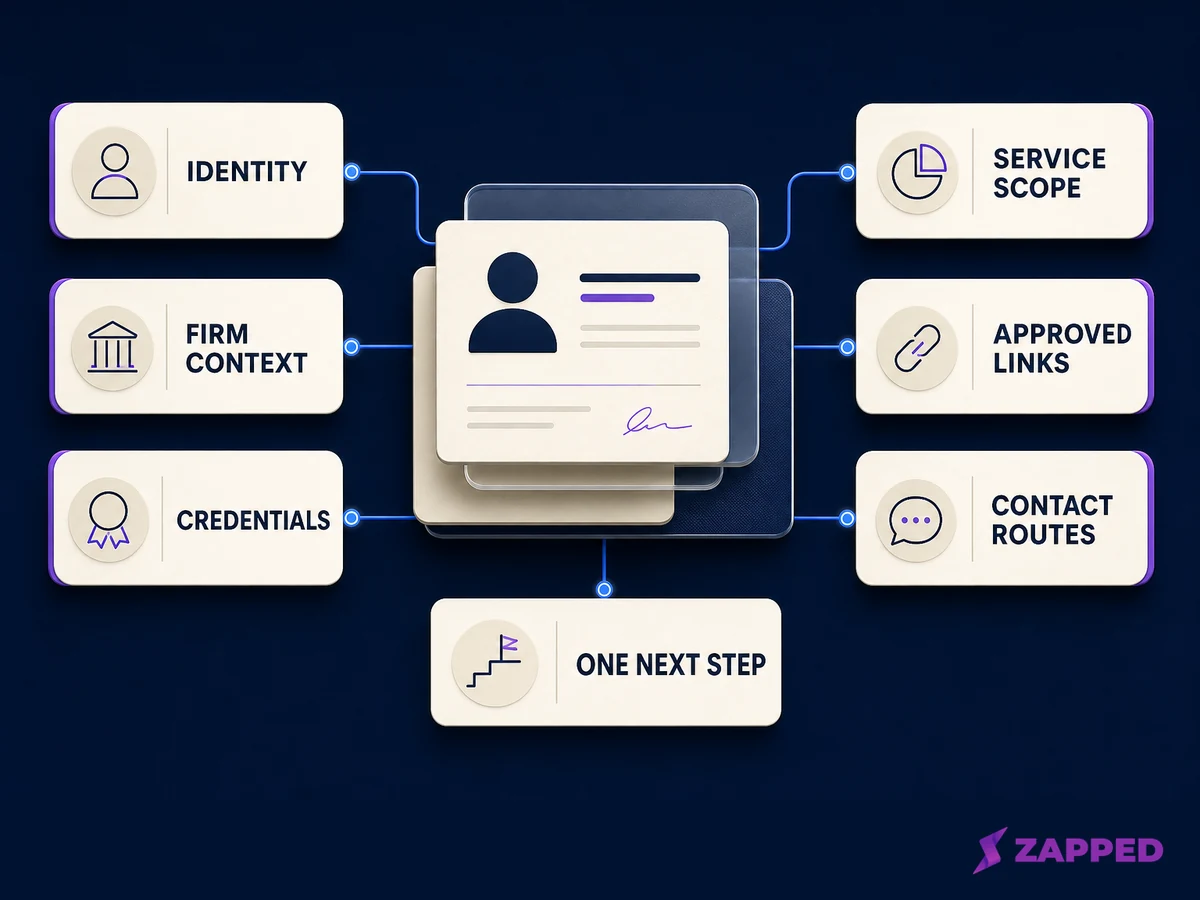
Conceptual information architecture. The categories are prompts for firm review, not a finished advisor profile.
Start with the advisor's name and role, firm identity, approved credentials, service scope, approved contact methods, directed legal or disclosure links, and one next action. The action might be a firm approved contact route or resource. It should not imply a result, promise a return, or offer specific advice before the appropriate review.
Keep a separate route for content that needs closer attention. Testimonials, endorsements, ratings, performance references, and specific investment advice should not be added because a template makes them easy to add. NASAA's investment adviser guide places websites, advertising, and seminar materials inside the adviser compliance context and notes that state requirements can vary.
The card should also have a recovery plan. If a firm name, title, credential, disclosure, or booking destination changes, identify who edits it, who reviews it, and how the change is recorded. A live profile is valuable only when its owner keeps it current.
The handoff from introduction to approved follow up
The cleanest workflow is visible from the first share:
-
The advisor shares a QR code, link, NFC tap, or another approved entry point.
-
The recipient opens the card and chooses whether to save or exchange contact details.
-
The advisor or approved system records the event source and consent context.
-
The approved follow up route creates the next task or message.
-
The responsible owner reviews the content and exception cases.
-
The firm's approved records system preserves what it needs to preserve.
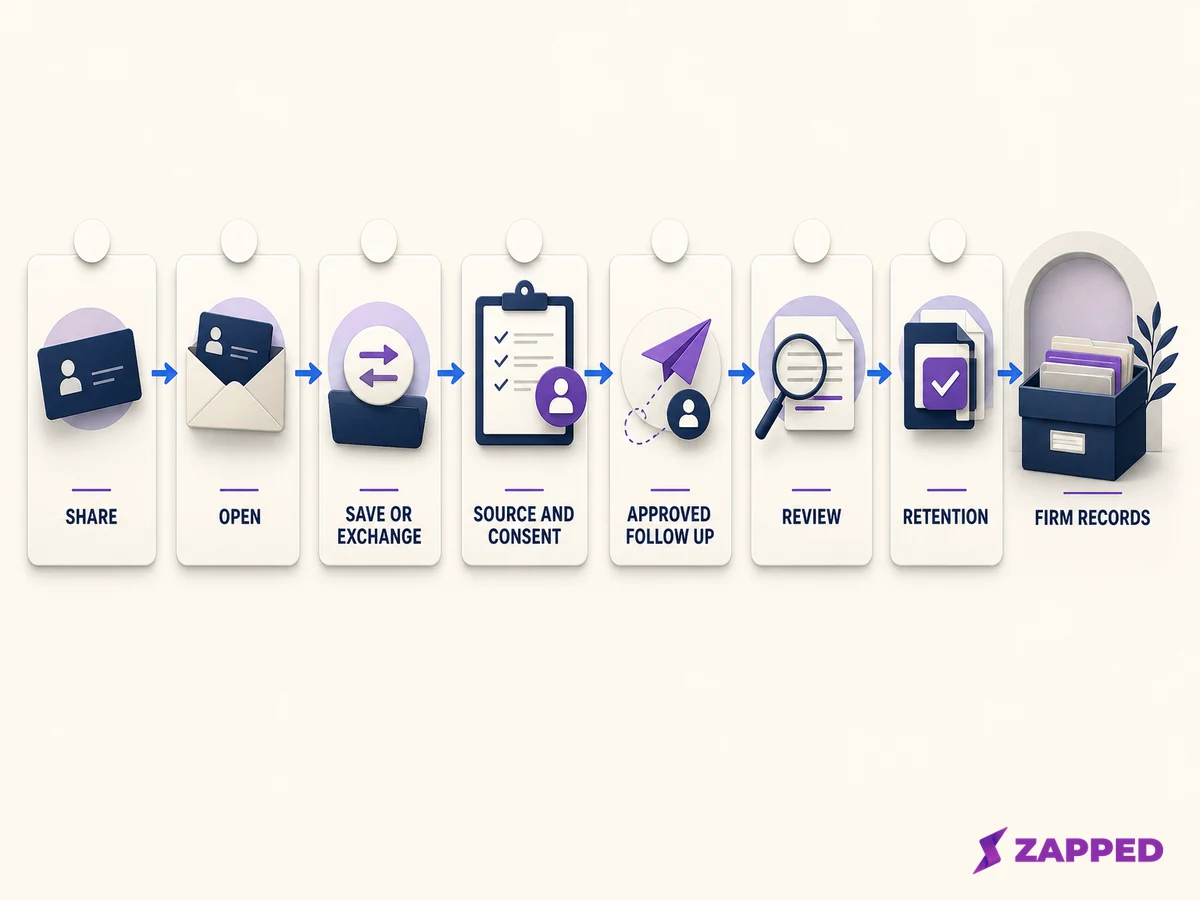
Conceptual handoff flow. The records system is shown as an abstract endpoint because a card platform does not establish the firm's retention or supervision design.
This sequence addresses a real friction point. Advisor communities often describe the need to collect the other person's details so a promising conversation does not disappear into a notebook. That is useful language for designing the workflow, not proof that any platform reliably performs contact exchange or follow up.
The card platform may document a view, a click, a submitted form, or an export. It cannot by itself establish that the firm's communication review, retention, retrieval, or supervision obligations are satisfied. FINRA Notice 11 39 leaves that technology determination to the firm.
One useful Zapped fit for recipient friction
If the decision is whether a recipient can reach the profile without installing an app, Zapped fits that specific workflow. Zapped cards open in a normal browser from a QR code, NFC tap, or link, so the recipient does not need to install an app.
A live card can also be edited after sharing while the shared link and printed QR continue to work. For a QR specific sharing review, see how digital business card QR codes work.
That makes Zapped worth evaluating when an advisor needs a browser first handoff and an editable destination. It does not establish compliance approval, CRM retention, supervision, or a firm's records design. Those questions remain with the firm's review process.
Compliance questions to settle before launch
Keep this review practical. Ask the firm's compliance or legal function to review the card content, linked materials, lead capture route, communication review, supervision, records retention, and any testimonials, endorsements, ratings, performance references, or specific investment advice.
The SEC's investment adviser marketing guidance is relevant to SEC registered or required to register investment advisers. The exact conditions depend on the communication and the use of testimonials or endorsements.
FINRA's communications guidance applies to member firm communications. NASAA's investment adviser guide covers a wider state adviser context, and state adoption or firm status may differ.
Do not call a vendor SEC approved, FINRA compliant, audit proof, or regulator accepted. A digital card does not replace Form CRS delivery, required disclosures, approved advertising review, supervision, or the firm's books and records system. It is one controlled handoff component inside that larger design.
A 30 day rollout baseline
Do not begin with a conversion promise. Begin with definitions.
For each referral meeting, seminar, or conference source, record the event label before sharing the card. Then define these measures with the person who owns the workflow:
- Share to view rate: card views divided by recorded shares.
- Save or contact exchange rate: completed saves or exchanges divided by card views.
- Qualified lead rate: leads that meet the firm's own qualification rule divided by completed exchanges.
- Median time to first approved follow up: the middle elapsed time between the recorded event and the approved follow up.
- Records completeness: the percentage of sampled events with the required source, consent context, review status, and retained record.
Review the measures weekly for thirty days. Look for broken links, missing source labels, unapproved copy, duplicate contacts, slow follow up, and records gaps. Set thresholds after the first baseline. The packet supports these metrics as a proposed measurement framework, not as observed advisor results.
The practical verdict
Choose a low friction, editable card when you are a solo advisor who needs a clear next step at a referral meeting. Choose a platform with documented team administration, approval ownership, and a firm approved records path when multiple advisors share a brand.
Choose documented capture and export features when events drive the work, but verify fields, consent context, ownership, and retention before treating a lead route as operational. Choose vendor features by fit, then let the firm's compliance and legal function decide what can be published and retained.
The best digital business card for a financial advisor is therefore not a permanent product ranking. It is the option that can support a governed introduction, a clear recipient path, an approved follow up, and a recoverable record without pretending to replace the systems around it.
Sources
Sources reviewed 2026-08-06. Vendor features and pricing can change, so recheck them before purchase.
- SEC, Investment Adviser Marketing
- SEC, Additional Observations Regarding Advisers' Compliance with the Advisers Act Marketing Rule
- FINRA Rule 2210
- FINRA, Communications with the Public
- FINRA, Social Media
- FINRA Regulatory Notice 11 39
- SEC, Form CRS Frequently Asked Questions
- NASAA, Investment Adviser Guide
- HiHello pricing
- Blinq for business
- Popl pricing and team documentation
- Zapped product page
- Zapped help, creating your first vCard