The event is over, the room is disappearing, and your phone is full of names you may or may not be able to place tomorrow. Follow up within a day or two, while the other person can still place your face. First decide who is worth continuing with, save the detail that makes each person recognizable, choose the channel that fits, and offer one useful next move.
The wording matters, but it's rarely where follow-up fails. People lose the context, message everyone the same way, or ask for a next step so vague that the recipient has to invent one. A good first note is smaller than that: it proves you remembered the conversation and makes replying easy, including an easy no.
Start with the people you can still place
Don't work through your contact list from top to bottom. Start with people whose work lines up with what you're trying to do and people who showed some openness to continuing the relationship. Someone who offered a useful introduction, suggested a resource, or stayed engaged deserves attention before a stack of cards collected during the last ten minutes of an event.
That's not a ranking of human worth. It's a way to spend limited attention where a second conversation has a reason to exist. The useful contact record is plain: where and when you met, the person's role and organization, what you learned, and the item you said you would follow up on.
Write that down before the details flatten into “interesting person from Thursday.” Add the contact's priority and the next reminder. A name without context is a filing cabinet, not a relationship system.
Your memory hook doesn't need to be profound. It might be the problem they were trying to solve, a book they mentioned, a hiring need, or the oddly specific example that made the conversation memorable. One accurate detail beats three flattering adjectives.
Pick the channel that matches the job
Email is the better home for a fuller thank-you, a relevant resource, or a request for an informational interview. LinkedIn fits when the professional connection itself is the next useful layer. The right channel depends on the person and purpose, not on whichever app you opened first.
Use the existing email thread when one already exists. It keeps the event, prior exchange, and your name in the same place. Use LinkedIn when that's where the professional relationship naturally lives, especially when a short connection note is all the situation calls for.
The channel should reduce work for the recipient. If your message needs room for a resource and a specific question, email gives it room. If you're simply making the connection findable and leaving the door open, LinkedIn may be enough.
Make the first note prove you remember
Send the first message within the warm window, ideally within 24 to 48 hours. Name the event, use one real conversation detail, and make the subject clear enough that the recipient knows why you're writing before opening the message. Networking guidance consistently points to a short, personalized note tied to a memorable detail and a concrete next step.
“Great meeting you at the event” is polite, but it gives the other person no handle. Try this shape instead:
Subject: Your transit map example at Thursday's meetup
Hi Maya, it was good speaking with you at Thursday's meetup. Your example about using a simple transit map to explain the customer journey stuck with me. I said I would send the accessibility checklist we use for first drafts, so here it is. If it would be useful, would you be open to a 20 minute call next week to compare notes? No problem if not.
The message identifies the setting, retrieves a specific moment, delivers the promised item, and offers a next step that can be accepted or declined. It gives the recipient a reason to answer beyond returning the courtesy.
Keep the subject short and tailored to the conversation. A customized subject with a clear purpose is more useful than a grand label such as “Following up on our meaningful discussion,” which sounds like it was assembled by a committee.
Choose one useful contribution or one small ask
Your first note can thank the person, share something relevant, offer help, request an informational interview, or explore collaboration. Pick one. A message that tries to do all five usually gives the recipient a paragraph to admire and no decision to make.
The contribution might be the resource you promised, a concise answer to a question, an introduction you can genuinely make, or a useful observation from the conversation. The ask might be a 20 minute call, permission to send two relevant examples, or a simple question they can answer in one line. One small next step is easier to evaluate than “let's stay in touch.”
If you have nothing useful to contribute and no clear reason to ask for time, send a short thank-you and leave it there. Following up is not a tax you collect from every person you meet. Sometimes the right next action is to record the contact and wait for a genuine reason to reconnect.
When the timing slips, write the honest version
Missed the first day or two? Send the note anyway. Name the event, say what you remember, and keep the next step optional and specific. “I meant to write sooner” is enough; there's no prize for inventing a dramatic explanation for a late email.
If there's no response, make one respectful recovery attempt. Reply in the original thread when possible so the context stays visible. A practical default is to try again after roughly a week. More conservative guidance recommends waiting at least 10 business days before another attempt, which can make sense when the request is substantial or the contact is especially busy.
Then stop the active sequence. Regular outreach should stop when someone remains unresponsive. Leave the record in your notes, but don't keep moving the same person to tomorrow's task list. A future reason to reconnect is different from repeated pressure with a new subject line.
Silence is information about timing, interest, capacity, or all three. It isn't an invitation to improve the message forever.
Keep the record smaller than the event
After the conversation, save six things:
- where and when you met
- the person's role and organization
- the memory hook
- what you promised or offered
- the next action, if there's one
- the date you will review the relationship again
Use a notes app or a spreadsheet if that's what you will actually open. A lightweight system described by one networking participant follows the same pattern: where they met someone, what the person does, one memorable detail, and a reminder for the contacts worth keeping in touch with.
The point is not to build a personal CRM with a dashboard full of empty fields. The point is to make the next message possible without asking your memory to recreate a crowded room.
Where a digital card helps, and where it stops
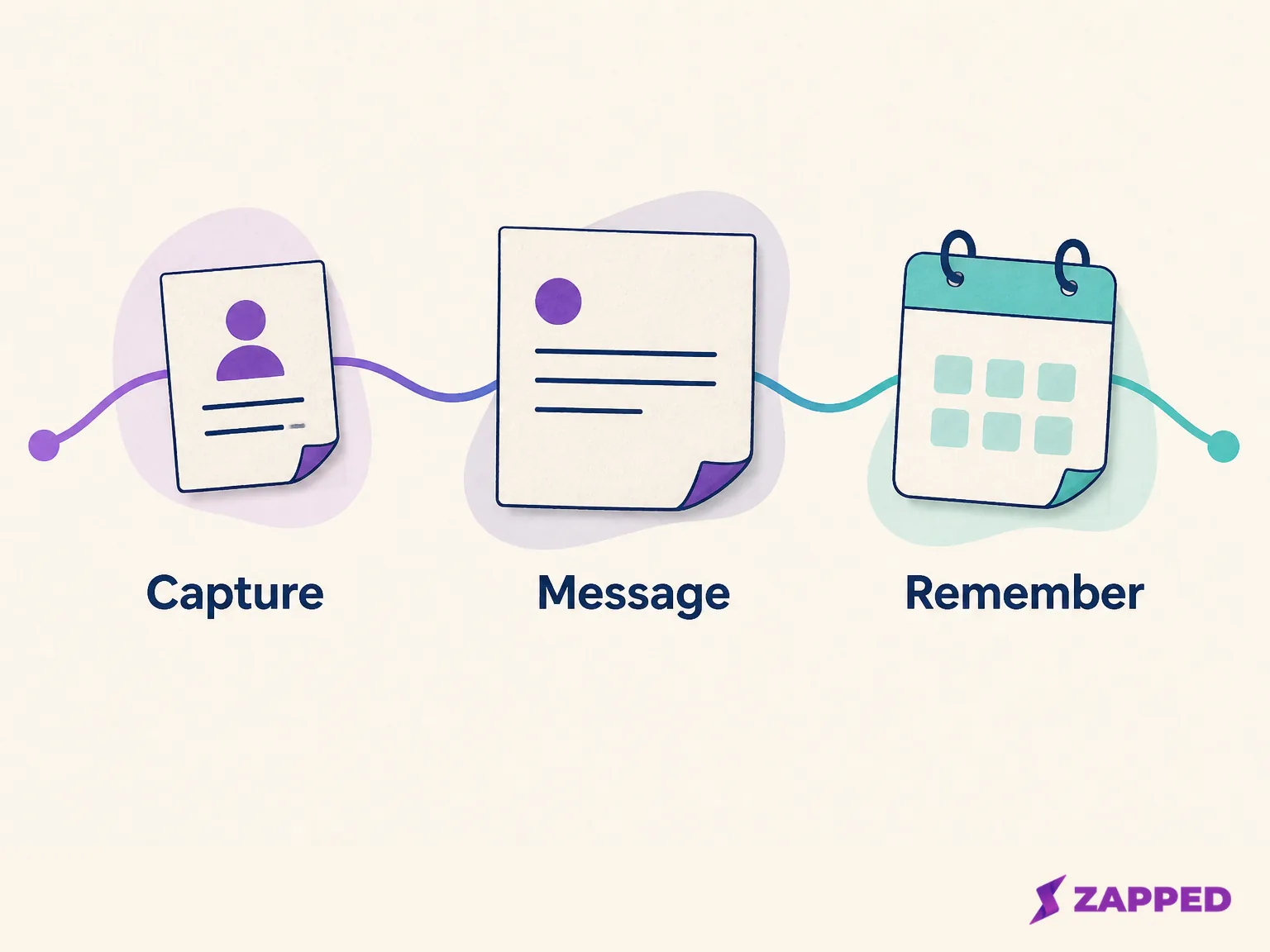
If you're collecting contacts at events, a Zapped digital vCard can be one part of the capture step. It can be shared through a QR code, NFC card, direct link, email signature, social bio, or event material, and the recipient can open it without installing an app. Its dashboard can show activity such as views, saves, clicks, scans, sources, and paths for following up around a shared card.
That helps answer “what did I share, and did anyone use it?” It doesn't answer “who should I email tonight?” Zapped doesn't replace the email or LinkedIn choice, the reminder in your notes, the useful contribution, or the decision to stop after a respectful second attempt. Those are still your system.
For a worked version, imagine leaving an event with three contacts. You save the place, date, roles, and memory hooks. You send a tailored email to the person aligned with your current goal, a LinkedIn connection to the person where a professional link is the natural next step, and no immediate message to the person with no clear reason to continue. You set one reminder for the first two. If one stays quiet after the second attempt, you remove the active chase but keep the record for a future reason.
That's the system worth keeping: capture enough context, send one message that carries its own reason, and remember only the next action worth taking.
The rule worth keeping
Follow up within a day or two when you can, but don't confuse speed with strategy. Prioritize the people and conversations that fit your goal, choose email or LinkedIn by purpose, write from one real memory hook, and make one useful contribution or small ask.
Then record what happened. If the person doesn't respond after one respectful second attempt, stop actively chasing them. The best message after networking is not the most polished template. It's the smallest note that proves you remember the conversation and gives the other person a clear, comfortable next move.