You sit down with a stranger, find one useful thread, and hear a bell before the conversation has time to sprawl. Speed networking is a timed rotation of short, focused conversations. People move to a new person or table, and the cycle repeats.
That structure creates access, not a relationship. It can help you meet more of the right people quickly. It can also leave you with a pocket full of names and no idea why any of them mattered. The format earns its keep when the next step preserves enough detail to be useful.
What a speed networking round feels like
You introduce yourself, ask one useful question, and listen for the part worth remembering. Then the bell cuts through the conversation and everyone moves. A typical round lasts about three to ten minutes, and an event can run from 30 minutes to two hours or more, depending on how many people need to meet.
That range is wide because the event can do two different jobs. A short round gives people broad exposure. A longer one leaves enough room to get past job titles and find a reason to continue talking. More rotation brings more chances, but it also makes the conversation shallower and the context easier to lose.
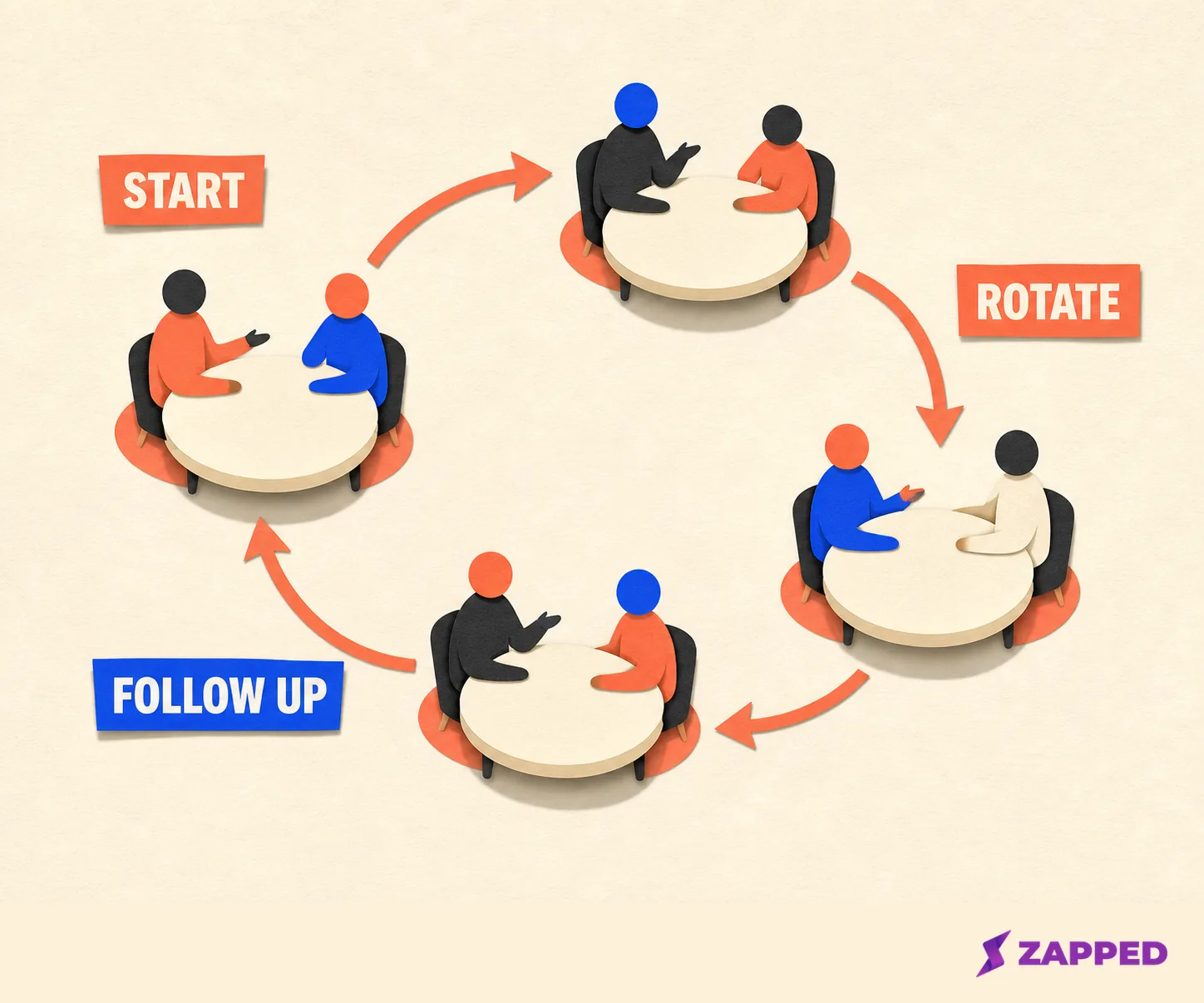
The format works in person or online. Either way, the useful sequence is the same: a clear start, a focused conversation, an obvious signal to stop, and a move everyone understands. Whova describes the cycle as a few minutes of conversation, a bell, and a move to the next person, then makes the sharper point that the introductions are only the beginning. The actual networking starts when you follow up with the people who matter. (Whova's conversation, bell, and move)
If an event needs many brief introductions, speed networking may fit. If its purpose is careful problem solving, private advice, or a small number of deep conversations, the timer will probably become the main character. Use one to one introductions or a small group conversation instead.
Choose the clock before you choose the chairs
Three to ten minutes is a useful design range, not a rule every event has to obey. Six minutes gives people time to exchange context without letting one conversation consume the room. Three minutes keeps things moving when broad exposure matters. Choose based on whether you want people to recognize a relevant connection or begin a substantial conversation.
The ACC Speed Networking Toolkit gives a concrete example: six minutes per session, a 60 to 90 minute event, and a group of 20 to 30 people. That is a workable starting shape for a planned event, not a law of networking. (the ACC toolkit's six minute example)
For a small group, fewer and slightly longer rounds can beat making everyone sprint through the same introduction. For a larger group, shorter rounds protect the schedule, but they make the prompt and the follow up note more important. Leave time at the end for open networking or a second conversation when the purpose calls for more depth.
The group shape matters, too. Cvent uses 16 to 30 people as a practical example and recommends an even number so nobody is left out. That example helps with planning, but it does not make every group of 16 workable. If attendance is uneven, late, or too small to support useful variety, change the format rather than pretending the room is balanced. (Cvent's practical group example)
The format decides who meets whom
Furniture isn't the decision. The rotation model decides whether people get broad exposure, targeted matches, or the energy of a small table.
Round robin is the predictable option. Participants follow a defined sequence and rotate through different people or seats. Choose it when fairness and simplicity matter more than matching specific interests. Everyone can see what happens next, and the organizer has fewer judgment calls to make during the event.
Station based networking is more deliberate. Meetings are pre-set using questionnaire answers and the people participants want to meet. Use it when the event has clear interests, industries, or goals that make a useful match more valuable than a random introduction. The preparation is heavier, but the conversations can start closer to the reason everyone showed up.
Group based networking moves people through tables rather than keeping every conversation one to one. Cvent describes tables with four to ten chairs as one example. Use this shape when a topic benefits from several perspectives or when the room is large enough that individual pairings would become difficult to manage. The tradeoff is airtime: a confident voice can take the table with it. (Cvent outlines the three common formats)
Broad exposure points to round robin. Targeted introductions point to station based. A social or discussion led room may be better served by group based networking. The right format is the one that matches what you want to see after the final bell.
Set the room up for a clean first round
Participants shouldn't have to solve the event while they're trying to meet people. Before the first round, make five things visible: what the event is for, how long the round lasts, where people move, what prompt they can use, and how they should record a useful contact detail.
The minimum kit is plain and effective: name tags, a sign in path, conversation starters, paper and pens for contact information, a timer, and a bell or chime. The ACC toolkit also tells participants to move when the bell rings and avoid sitting with people they've already met. (the ACC toolkit's room basics)
Give people the movement rule before the first conversation, not halfway through it. Say who moves, where they go, and what happens if someone is absent. Put the prompt where people can see it. A sign in path and attendee information help participants arrive with a reason to talk to someone, instead of spending the first round asking what everyone does.
The prompt should open a door, not produce a speech. “What are you hoping to find here?” is enough to reveal intent. So is “What are you working on that might benefit from another perspective?” Ask one question, hear one answer, then listen for the detail that earns a note.
When the conversation stalls
A shallow round isn't a crisis. Use one prompt or one specific follow up question, then move when the bell rings. The timer is there to prevent a stalled conversation from trapping both people, not to make you perform enthusiasm until the organizer rescues you.
If someone gives a job title and nothing else, ask what they're trying to solve or who they're hoping to meet. If the answer still goes nowhere, thank them and use the remaining seconds to write down the one detail you do have. You're allowed to leave a round with no next step.
The useful discipline is choosing once. Ask the question, listen, and decide whether the conversation has earned more time after the event. Trying to say everything before the bell is how a short introduction turns into a blur of credentials.
The last bell is the real test
The event has done its job when it makes a relevant next step easier, not when it produces the largest stack of contact details. A useful outcome might be a note to send an article, a second conversation, an introduction to someone else, or a reason to leave the connection alone for now.
Whova's distinction is the one worth keeping: the event creates introductions, while following up with the people who matter is where networking begins. Write down the context before you move on. “Met at speed networking” isn't context. “Works with small nonprofit teams and wants examples of volunteer recruitment tools” is enough to make a later message sound like it came from a human. (Whova's follow up distinction)
If you're organizing, send a short survey within 24 hours while the room is still fresh. Ask which conversations were relevant, whether the timing worked, and what should change next time. The ACC toolkit recommends an electronic survey within 24 hours, with feedback compiled and shared. (the ACC toolkit's 24 hour survey)
For a broader set of ways to carry a promising conversation forward, see our networking tips guide. The important part isn't collecting a perfect record of the room. It's preserving enough of the right conversation to make the next action obvious.
Make the handoff easy to remember
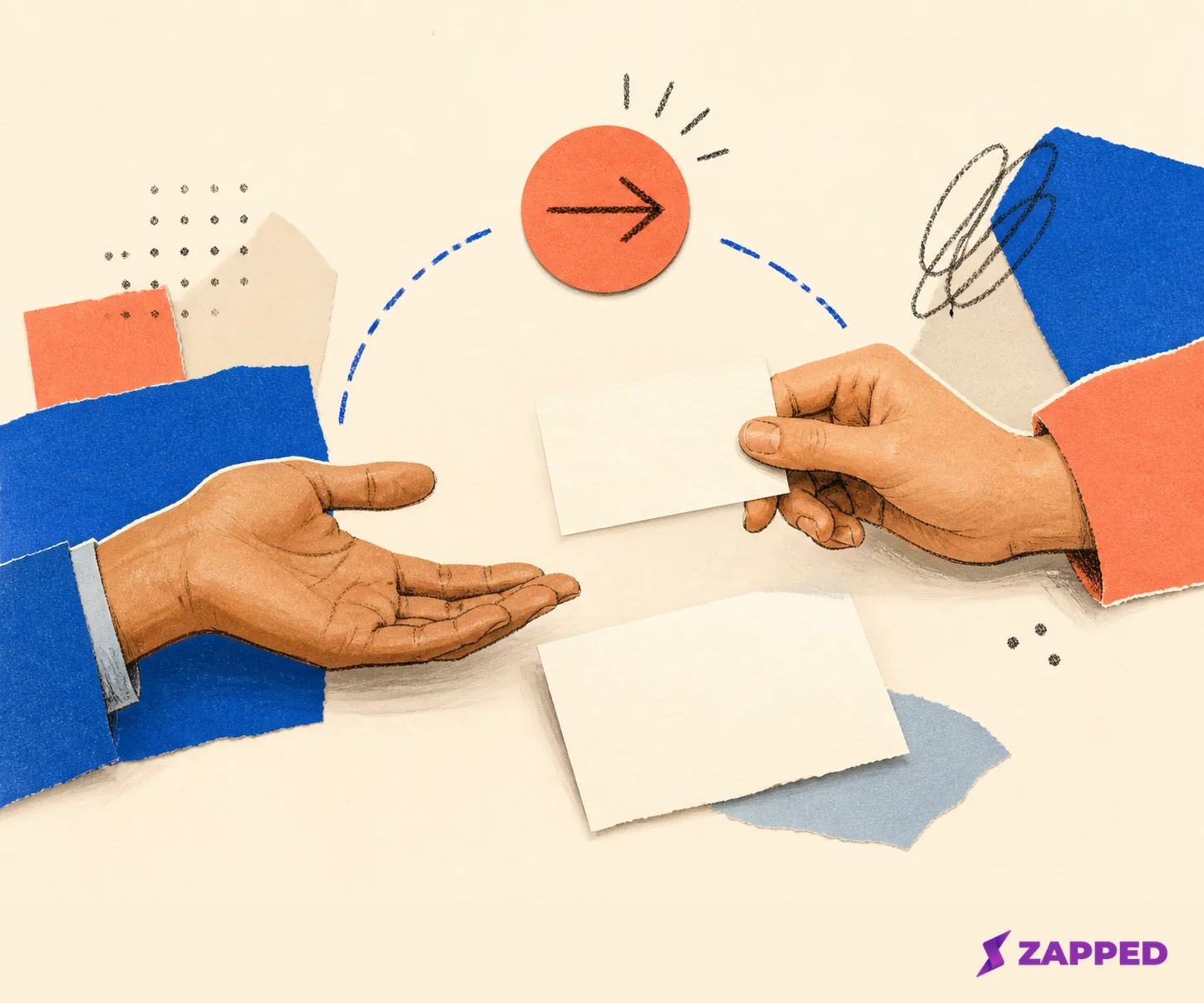
When a conversation earns a next step, Zapped can share a digital card through a QR code, NFC tap, or link. The recipient opens the card in a normal browser and can save the contact details without installing an app or creating an account. That removes a small but real piece of friction at the moment when two people are deciding whether to stay in touch. (Zapped digital card sharing)
The handoff should still carry context. Add a short note while the conversation is fresh, then share the card with the person who asked to continue. A fast link preserves the contact path. It can't decide whether the relationship is worth continuing.
Zapped also documents per card analytics, with the history length varying by plan. Treat that activity as a sharing signal, not proof of a relationship. If a card gets more visits, that can help you refine what you share at future events. The meaningful measure remains whether someone replies, accepts the next conversation, or takes the action you discussed. (Zapped's per card analytics)
When a timer is the wrong tool
Don't force the format onto a group that is too small, too uneven, too large for a fair rotation, or not ready to follow a timer and a clear movement rule. A room can be full and still lack enough relevant variety for repeated short conversations.
Use one to one introductions when the people matter more than the number of meetings. Use a small group conversation when one stated goal will create better energy than repeated table changes. For a virtual event, keep the short rounds and make each room change explicit, then offer a brief open networking block after the structured part.
Skipping the timer isn't a failed version of speed networking. It's a better fit decision when the room needs context more than throughput.
The useful definition of success
Speed networking suits an event that needs efficient access to several relevant people and can support a clear rhythm. It is a poor fit when the goal depends on uninterrupted depth, careful advice, or a group too uneven to rotate fairly.
If you attend, arrive with one question, listen for one specific detail, and decide which conversations deserve a next step. If you organize, choose the timing and rotation model around the purpose, make the movement rule impossible to miss, and leave room for follow up.
Judge the event by the few conversations people can still describe the next day, not by the number of names gathered before the final bell. More introductions are useful only when at least some of them remain connected to a clear reason to continue.