
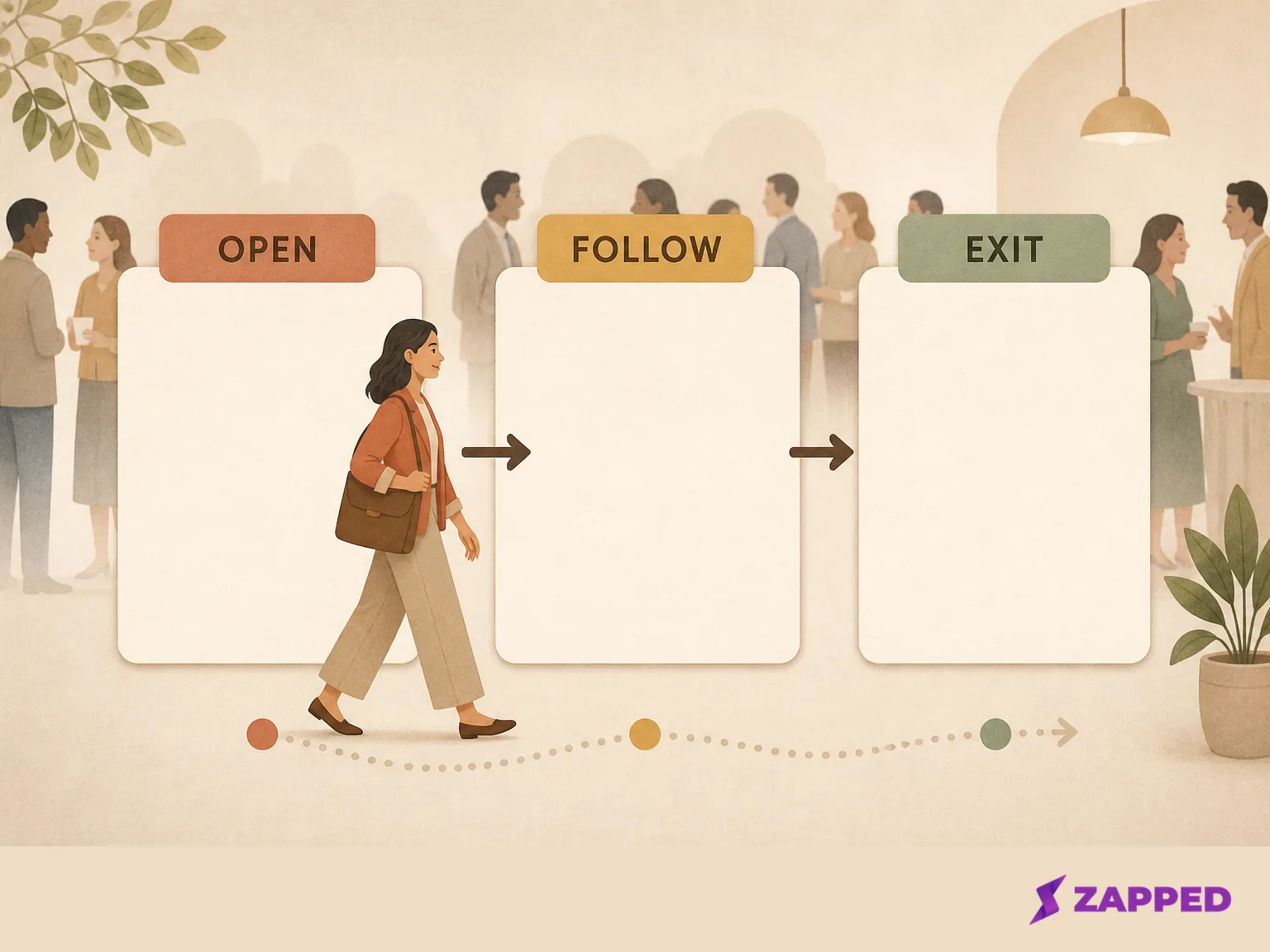
The room has already given you an opening: the event, the last session, the venue, or the reason you both showed up. Start there. Ask one open question, listen for a thread, and let that thread choose your follow-up.
If the exchange stays closed, try once more or leave kindly. The best starter isn’t the cleverest line. It’s the one that gives the other person an easy, genuine way to answer.
Start with the room, not the résumé
The event has already handed you a subject. Use it. Ask, “What brought you to this event?” or “What did you make of the last talk?” A question about the venue, session, or shared reason for being there gives the other person somewhere real to begin, and gives you something real to hear.
That’s more useful than opening with “What do you do?” The question can turn the first thirty seconds into a job title exchange, which is a strangely formal way to meet a human being. Conversation starters work better when they match the setting and situation, whether you’re at a conference, a career fair, a professional gathering, or a smaller business event. A contextual opener gives both people an immediate subject instead of asking one person to perform on command.
When you’re entering a group, refer to what’s already happening. “That example about hiring caught my attention” is enough. You don’t need to announce your value before anyone has asked. You’re making it easy for the next person to answer.
Ask for a story, not a label
Once the room gives you an opening, ask for an experience rather than a résumé label. What problem is the person working on? What brought them into the field? What project has been interesting lately? What did they hope to learn today? Each question leaves room for a real answer, and a real answer gives you somewhere to go.
Try one of these:
- “What kind of problem are you spending most of your time on right now?”
- “What brought you into this part of the industry?”
- “What has been the most interesting project on your plate lately?”
- “What did you hope to learn at this event?”
Career guides from Boston University’s question groups and Inc.’s professional prompts point toward useful territory: career experience, industry paths, professional development, and what someone actually likes about their work.
The question doesn’t need to sound profound. It needs to be answerable without a speech. If the person gives you a detail about a project, a move, or a challenge, that detail is more valuable than the next prepared line.
Let their answer choose your next sentence
The first answer is where networking either becomes a conversation or turns into an interview. Listen for one thread. Ask about it, then add a short related thought of your own so the exchange moves in both directions. FirstMove’s follow through advice makes the point: your follow-up should respond to what you actually heard.
If someone says, “I came because our team is changing how we handle customer research,” don’t jump to your next unrelated question. Try, “What part of that change has been hardest to get right?” Then offer a brief connection: “I’ve seen teams struggle when the research arrives too late to shape the work.” Now the other person has something to respond to, and you’ve shown that you heard them.
This is the useful sequence described by a practical networking rhythm: a line of context, a real question, a reflection, a small give, and a specific next step. It isn’t a script to recite. It’s a way to keep your attention on the answer instead of searching your memory for line number twelve.
You can also say that you’re new to the event or still finding your way around. A brief honest admission can create shared experience and invite guidance, especially when you pair it with a concrete question. “This is my first time here. Which session would you tell someone not to miss?” is better than pretending you’ve already mapped the whole room.
When the answer is short, test the door once
A one word answer is information. So is someone looking past you or failing to return any curiosity. Don’t treat a closed response as a challenge to overcome.
Try one recovery. Rephrase the question more specifically, or answer it yourself for a moment. If you ask what brought someone to the event and they say, “Work,” you might say, “Same here. I came for the session on hiring. Was there a talk you wanted to catch?” If the answer is still short, let the exchange end.
That retry matters because the first question may have been too broad. It’s also the limit. FirstMove’s recovery advice recommends offering a brief answer of your own, then moving on when the exchange isn’t developing.
Confidence isn’t the ability to keep someone trapped in a conversation. It’s the ability to notice the signal without making the other person manage your feelings about it.
Leave while the conversation is still good
An exit is part of the conversation, not proof that it failed. When the exchange reaches a natural pause, say, “I enjoyed talking with you,” or “Thanks, that gives me a useful angle to think about.” If there’s a genuine reason to continue, ask whether it would be welcome to keep in touch. If there isn’t, appreciation is enough.
The three stage networking guide treats starting, maintaining, and exiting as parts of the same skill. Respecting the other person’s time isn’t a polite extra. It tells them you were paying attention to the shape of the exchange.
If the event is moving and the conversation has been useful, name the reason for a later message: “Would it be all right if I sent you the report I mentioned?” That’s more considerate than asking vaguely to “connect sometime.” A thank you note or email after the meeting can carry the thread forward when you have a specific point to reference, as Wisconsin Green Bay recommends.
Then go meet someone else. A clean ending leaves both people with more room. That’s better than squeezing another question out of a conversation that has already said what it had to say.
Make the next step easy to accept
Only exchange details when the conversation has earned a next step. If you promised a useful detail, say what you’ll send. If you simply had a good exchange, ask permission to stay in touch and give the other person an easy way to save your details.
One option is Zapped. Its card can be shared through a QR code, NFC tap, or link, then opens in a normal browser so the recipient can save your contact without installing an app or creating an account. The card stays live after you edit it, so a printed QR code and a shared link keep working when your details change.
That solves the mechanics of exchanging contact details, not the reason to do it. You still need to remember the point you promised to send. A card is useful when it removes friction from a worthwhile next step, not when it’s used to collect every person in the room.
If you want to build the larger habit around these few seconds, continue with networking tips for the approach, preparation, and rhythm beyond the opening question.
At the next event, you need one question that fits the room, one follow-up that proves you listened, and enough confidence to leave when the exchange stays closed. If the conversation earns a next step, make it easy to accept. A useful connection begins with attention, not a performance.