The best elevator pitch examples answer the question behind “What do you do?” quickly. They tell the listener who you are, show the useful problem or work you bring, and leave room for a sensible next step. A first version can run 30 to 60 seconds, but you’ll want a shorter one when the moment is crowded or easy to interrupt.
An elevator pitch is a conversation opener, not a miniature resume. Give the other person a reason to respond. Don’t try to push your whole career through a very small door.
Give the moment only what it can hold
The setting decides how much your introduction can carry. A career fair may support a little context. A hallway introduction may support one clear sentence and a question. An interview gives you room to connect your direction to the role. A client conversation needs the problem you can help with before it needs your credentials.
The 30 to 60 second range is a useful boundary, not a stopwatch. If someone is already turning toward the next conversation, use the short version. If they ask a follow-up question, the conversation has earned more detail. A pitch that ends while the listener still wants to know more has done its job.
Before you write anything, decide what you want from this moment. Are you looking for advice, a contact exchange, a second conversation, an introduction, an interview, or a discovery call? That answer determines the final line. It also stops you from asking a stranger for a much bigger favor than the conversation can support.
If you’re still building the wider networking habit around your pitch, start with these networking tips before polishing every word.
Build the pitch around three choices
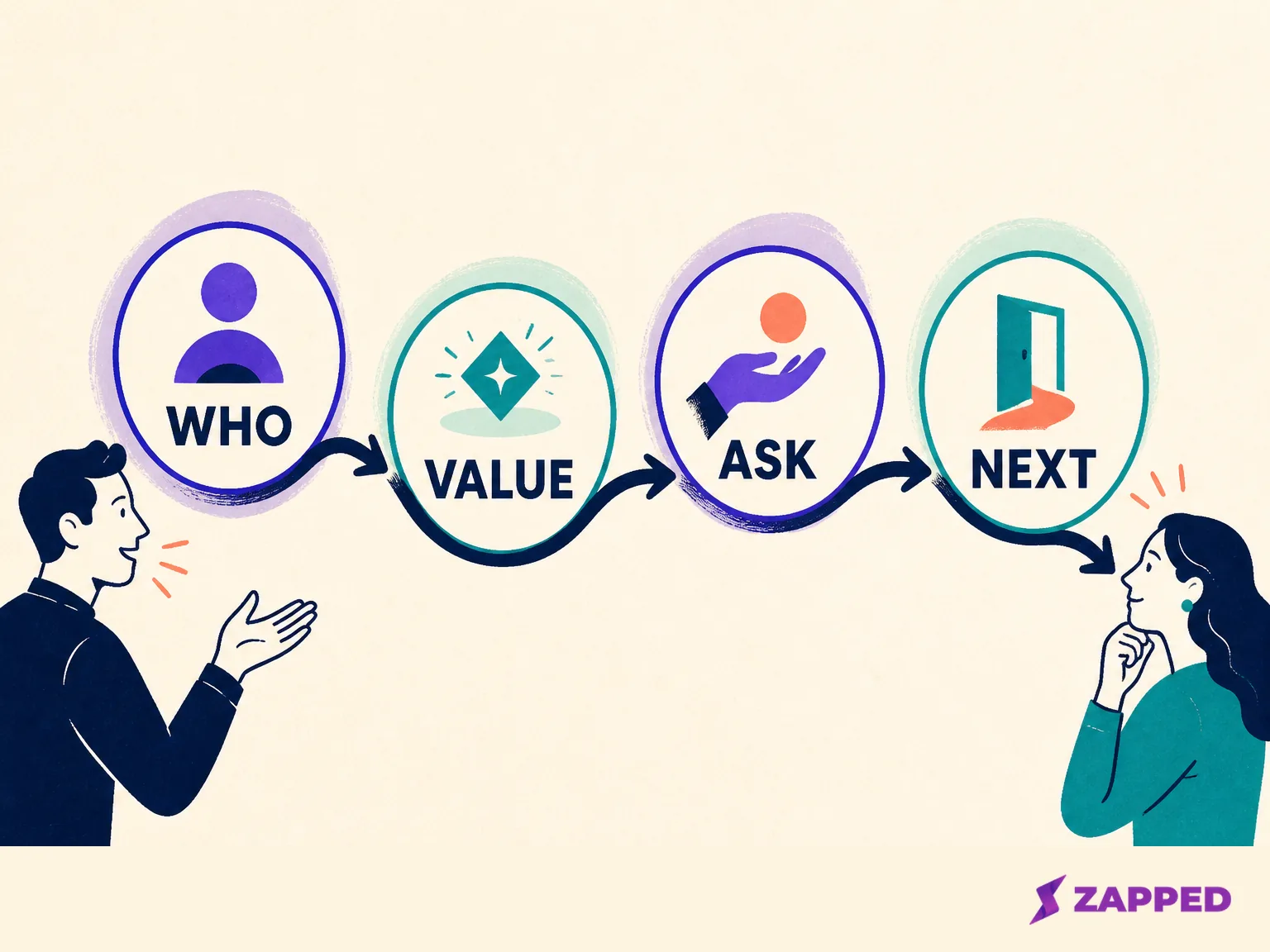
The usual four question structure is useful, but it’s easier to remember as three choices:
- Who are you, in language the listener can place?
- What useful problem, contribution, or direction should they remember?
- What small next step makes sense here?
The identity line and value sentence handle who you are and what you do. The ask handles what you want, and the next step makes the request concrete. Indeed’s four-part structure makes the same point: explain who you are, what you do, what you want, and what happens next.
Write the choices as flexible notes first. For example:
- Direction: product designer moving into service design
- Value: makes complicated customer journeys easier to use
- Proof: improved one confusing onboarding flow in a recent project
- Ask: wants advice on which service design skills to build next
That’s enough to speak from. A full paragraph is harder to adapt, and a memorized paragraph tends to sound like it’s waiting for applause.
Choose an identity line the listener can place
Your opening should name your role, field, or current direction in words that need no private context. “I’m exploring a move into operations” gives someone a place to start. “I’ve spent six years optimizing cross functional enablement systems” gives them a puzzle to solve before they can meet you.
Here’s the useful test: could someone outside your company repeat your opening accurately five minutes later? Think of the opening as a compact table of contents for the conversation. It tells the listener which page to ask about next instead of trying to print the whole book.
Try these shapes:
“I’m a data analyst who turns messy customer questions into decisions a team can act on.”
“I’m a front end developer focused on making public websites easier to use.”
“I’m moving from classroom research into roles where I can turn complex information into clear choices.”
These are illustrative openings, not lines to copy word for word. Keep the shape, then replace the role and direction with language you’d actually use. The UMass guidance describes this opening as an identification of the speaker and their role or direction, followed by work the listener can picture.
Spend one proof point, not your whole history
The proof point is where the pitch earns attention. Pick one experience, action, or result that demonstrates the capability relevant to this listener. Your career history may contain ten good stories. The pitch needs one useful thread for the listener to pull.
The connection between the proof and the value sentence should be visible. If you say you make complicated journeys easier to use, point to one project where you simplified a confusing process. If you say you turn customer questions into decisions, mention the project where you brought those questions into a form a team could use.
Use this pattern:
“In a recent project, I helped simplify a confusing onboarding flow, and that’s the kind of work I want to do more of.”
Or:
“In my last research project, I turned a large set of interviews into a short set of decisions, which is why I’m interested in insight roles.”
These examples stay credible because they don’t pretend the listener needs every tool, title, or credential. Princeton’s guidance recommends selecting one experience or result and tailoring it to the person in front of you. If a proof point doesn’t help this listener understand your direction, save it for another conversation.
Say the value in the listener’s language
Your value sentence isn’t a slogan about being passionate, results driven, or a people person. It answers the listener’s likely question: why is this relevant to me?
Translate your work into a problem or contribution the listener can recognize. A product person may care about a clearer customer journey. A hiring manager may care about someone who can turn ambiguous questions into a workable plan. A prospective client may care about what gets easier after you join the project.
For example:
“I help small teams find the confusing parts of a customer journey and turn them into simpler steps people can finish.”
“I bring research into product decisions when a team has plenty of feedback but no clear priority.”
“I help service businesses make it easier for a new contact to understand what happens next.”
These lines are deliberately plain. Harvard’s delivery guidance connects a useful pitch to the listener’s problem, clear language, a controlled pace, and practice from flexible notes. If the listener has to decode your vocabulary before they can understand your contribution, the sentence is doing too much.
Change the last line for the situation
The same person shouldn’t use the same ask everywhere. A career fair is often a good place to ask what a team looks for. A networking event may justify a follow-up conversation. An interview can support a direct question about the role. A client conversation should usually earn a discovery call by showing curiosity about the problem first.

Here are four elevator pitch examples with the final line changed to fit the moment.
At a career fair, ask for direction
“I’m a data analyst who turns messy customer questions into decisions a team can act on. In a recent project, I built a simple way to see which questions were slowing a customer journey. I’m exploring analyst roles where I can do that work at a larger scale. What skills do you look for in someone entering this field?”
The proof point supports the direction, and the ask is advice. It doesn’t jump straight to “Can you get me a job?” The listener can answer from experience, which is a reasonable first exchange.
At a networking event, ask for a second conversation
“I’m a front end developer focused on making public websites easier to use. I recently worked on a donation flow that had too many confusing steps, and I’m looking for teams that care about clear user journeys. Your work sounds close to that. Would you be open to a short follow-up conversation next week?”
This ask is specific enough to answer. It leaves room for a no, too, without turning the introduction into a negotiation.
In an interview, ask about the opportunity
“I’m moving from research into roles where I can turn complex information into clear product decisions. In my last project, I translated a large set of interviews into a short list of priorities. I’d like to bring that kind of structure to a product team. How does this team decide which customer questions deserve attention first?”
The question isn’t an escape hatch from the pitch. It shows that the speaker has connected their contribution to the work in front of them.
In a client conversation, ask about the problem
“I help service businesses make it easier for a new contact to understand what happens next. I’m interested in the points where a promising conversation loses momentum, especially when the information is scattered. What happens after someone meets your team today?”
The speaker doesn’t lead with a feature list or push for a full sales presentation. The question opens discovery. If the answer reveals a genuine fit, the next conversation can carry the detail.
The point isn’t to collect four scripts. Notice what changes: the identity and proof can stay close to your real direction, while the ask follows the relationship. Once you have a usable pitch, build the wider habit with this guide on how to network.
Practice until the words belong to you
Practice the choices, not a sacred paragraph. Keep three or four bullets in front of you: identity, value, proof, and ask. Say them aloud. Record a version or review it with someone you trust. Then remove the phrases you’d never say in a normal conversation.
Listen for three problems:
- The opening takes too long to reach a recognizable role or direction.
- The proof point sounds impressive but doesn’t connect to the listener’s problem.
- The final ask is so broad that the listener can’t tell what answering would involve.
Run the pitch again after each change. A conversational version won’t have identical wording every time. That’s a feature. You’re building a route through the conversation, not training yourself to recite a commercial.
When the conversation goes sideways
The listener may be busy. They may ask about a different part of your background. They may not be the person who can help with the original ask. Don’t force the planned route just because you prepared it.
If the listener is busy, stop after the value sentence and ask whether a follow-up would be useful. If your planned ask doesn’t fit, ask a genuine question about their work. If you don’t have a tidy title yet, use a short direction statement, one relevant project or transferable strength, and a question. Networking without a polished pitch makes the useful reminder that thoughtful comments and genuine questions can carry a networking exchange too.
A short recovery can sound like this:
“I’m still narrowing my direction, but I keep coming back to work that makes complicated information easier to use. I recently did that in a research project. What kind of problems are you working on?”
That isn’t a failed version of the longer pitch. It’s the right version for a conversation that has changed shape.
Make the follow-up easy, not mandatory
When contact exchange is the natural next step, Zapped can give the other person a browser openable destination through QR, NFC, or link. Our first vCard guide points to the setup path, and the recipient can open the card in a normal browser and save the contact without installing an app or creating an account.
The live card can be edited after sharing, so the link or printed QR code can keep working as your details change. Its analytics show card activity, not proof that the pitch worked. That makes it a useful follow-up destination when the other person wants your details, not a substitute for asking a good question or earning another conversation.
Let the next conversation carry the rest
Use the longer version when the setting gives you room, and keep a short version ready for an interruption. Give the listener an identity line they can place, one proof point that supports the value you offer, and an ask that fits the relationship. Then stop talking long enough for the other person to answer.
That’s the real test of an elevator pitch example. It should make the next sentence easier for both people. If it only makes your biography more compact, it’s still a resume wearing a smaller hat.