The show is over, the report says "we scanned 240 badges," and someone in the review asks what those conversations actually produced. The spreadsheet can't say. It doesn't show who owned each record, what happened next, or which opportunities closed. The honest fix is smaller than most KPI lists suggest: pick two or three measures that follow the event's written goal, and decide each measure's denominator, source, owner and review date before the doors open.
If you need the full ROI formula and cost inventory, that lives in our event ROI guide. This page is the dictionary underneath it, and the broader scorecard sits in the event lead capture hub.
Start with one goal, then pick two or three measures
Most guides list dozens of KPIs, and Cvent's event success guide is a fair example, running from attendance and revenue to surveys, networking and leads. What it doesn't do is tell you who owns each number or where it comes from. That part is yours to add.
Eventesia advises one primary objective and no more than two secondary ones, with a KPI, a target, a data source and a responsible person fixed for each, and the target written down before the event. Its reasoning is blunt: a target set after the results arrive only describes what happened. That is one vendor's recommendation, not a standard, but it is a sensible discipline.
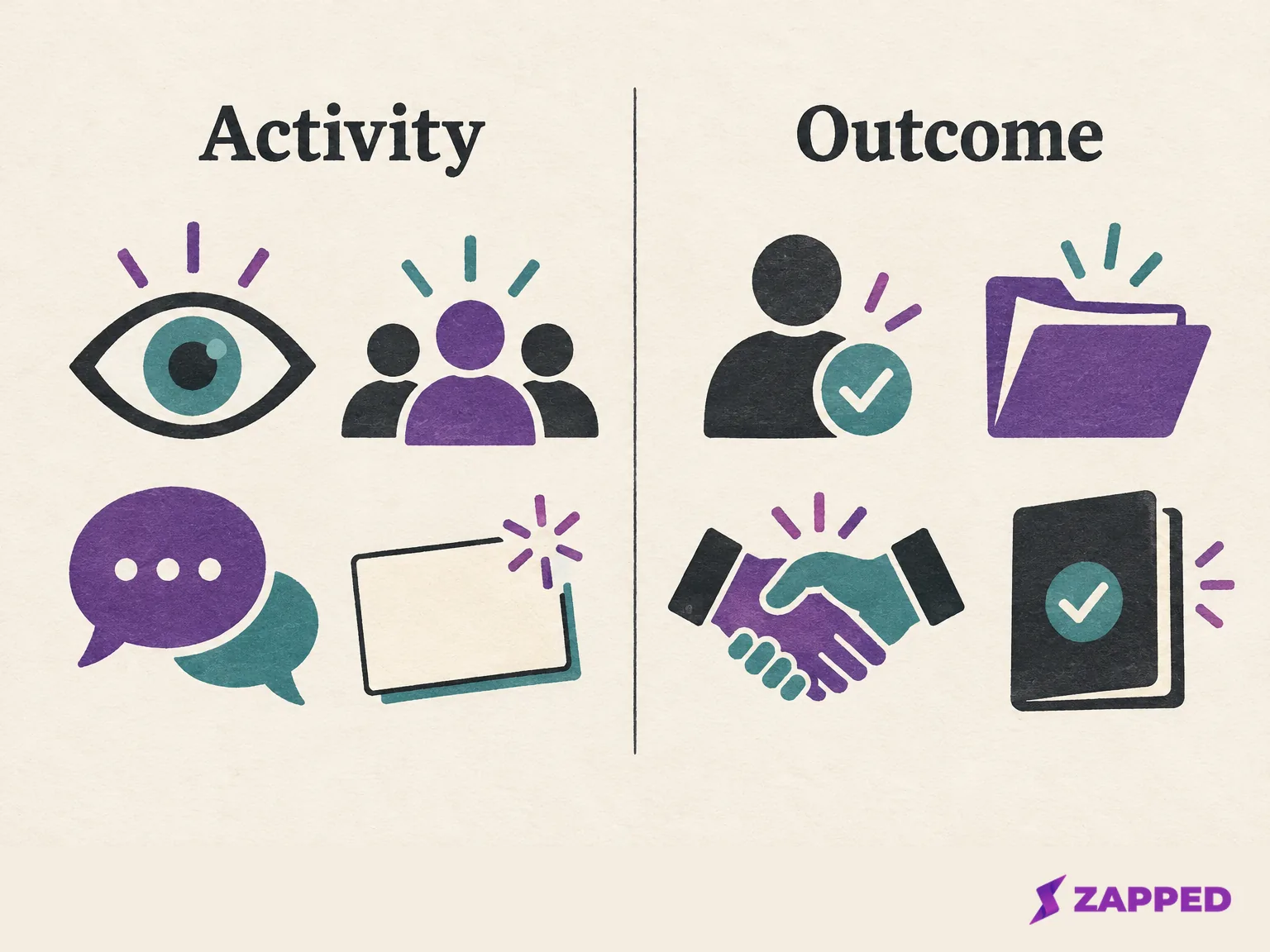
In practice, choose one activity signal and one downstream measure that match the goal. Add a cost measure only if it would change a decision. The table below is the dictionary to choose from. Every row names what the number can't prove, which matters more than the formula.
| Measure | Label | Working formula | Source | Owner | What it leaves unproven |
|---|---|---|---|---|---|
| Distinct accepted contacts | Activity | Deduplicated, usable contacts tied to the event | Badge or event platform records reconciled to event-tagged CRM campaign members | Event lead-capture owner | Qualification or intent |
| Handoff completeness | Activity or process | Accepted leads with a named owner and a recorded next action, divided by accepted leads | CRM ownership, campaign status and next-action records | Sales operations | That anyone was actually contacted |
| Engagement rate | Activity | Unique attendees who complete the chosen action, divided by actual attendees | Event platform or session records | Event producer | Lead quality or revenue |
| Event-sourced and influenced pipeline | Proxy or stage | Opportunities under the event source rule, shown apart from influenced ones | CRM campaign revenue and influence reports | Sales or revenue operations | That the event caused the revenue |
| Closed-won value | Outcome | Signed value linked to the event under the agreed rule | CRM | Sales or revenue operations | Which touch deserves credit |
| Cost per actual attendee | Efficiency | Approved event cost divided by actual attendance | Finance cost record and attendance system | Event producer or finance | That the right people came |
Count distinct contacts, not scans
A scan total is the easiest number in the building, and the least informative. The same person gets scanned twice, a colleague scans a friend, someone's badge gets tapped for a free pen. Count distinct, usable contacts tied to the event after deduplication instead, and label that count as activity.
You need a stable event identifier to do this. Take the badge or event platform export, reconcile it against the CRM records tagged to that event, and have one named person own the reconciliation. There is no universal definition of an "accepted" lead, so write yours down. A scan still doesn't prove qualification or intent. If you want a qualified lead rate, it's one line in the ROI guide and doesn't need repeating here.
Check whether anyone got a next step
This is where a busy booth with a full scan list quietly fails. Sales gets a file of names and nobody can say who is calling whom. A working handoff-completeness rate fixes that: accepted event leads with a named owner and a recorded next action, divided by all accepted event leads.
Ask sales operations to pull ownership, campaign status and next-action records from the CRM. Be careful what the result says. A lead with an owner has been assigned, not contacted, and a 100 percent rate can still sit beside zero follow-up. Treat it as a process measure. The lead retrieval guide has the step-by-step handoff test, so run it there rather than inventing a second one.
Keep open pipeline and closed revenue in separate columns
At the finance review, an open opportunity often lands in a list beside a signed deal, and the room reads both as money. Pull them apart before anyone presents.
Eventesia draws the lines clearly. Sourced pipeline is opportunities opened from leads who came from the event and weren't in your system before. Influenced pipeline is opportunities that already existed, where the client met your team at the event. Closed deals are signed contracts. Three different stages, three different levels of evidence.
Salesforce is a useful worked example of the same split, which no CRM-neutral guide spells out. Its campaign reports separate campaign members, responses, opportunities resulting from campaigns, and opportunities influenced by multiple campaigns. Closed value is its own field: Value Won Opportunities in Campaign counts closed or won opportunities where the campaign is the Primary Campaign Source. Influence works differently, and its default model gives 100 percent to the campaign named in that source field. If the standard influenced report omits records you expected, Salesforce documents a custom report type as the workaround.
Whatever tool you use, sales or revenue operations should own the attribution rule, and it should be agreed before the event. Eventesia suggests checking follow-up and meetings at 30 days, pipeline and deals at 90, and longer sales cycles at 180. Treat those as its advice for scheduling reviews, not a rule.
If the CRM campaign was never set up, don't try to reconstruct influence from a later opportunity. Use the event's existing attendee or lead export and one stable event identifier to count distinct records, then assign a person to reconcile the handoff. Report only through the last stage you can inspect, and agree the source rule with sales operations before the next event. Even one practitioner in an r/events thread described meetings, captured leads, sourced pipeline and influenced pipeline as separate numbers that stayed hard to combine. That's one person's account, not a survey, but it will sound familiar.
When the goal is learning, measure what people did
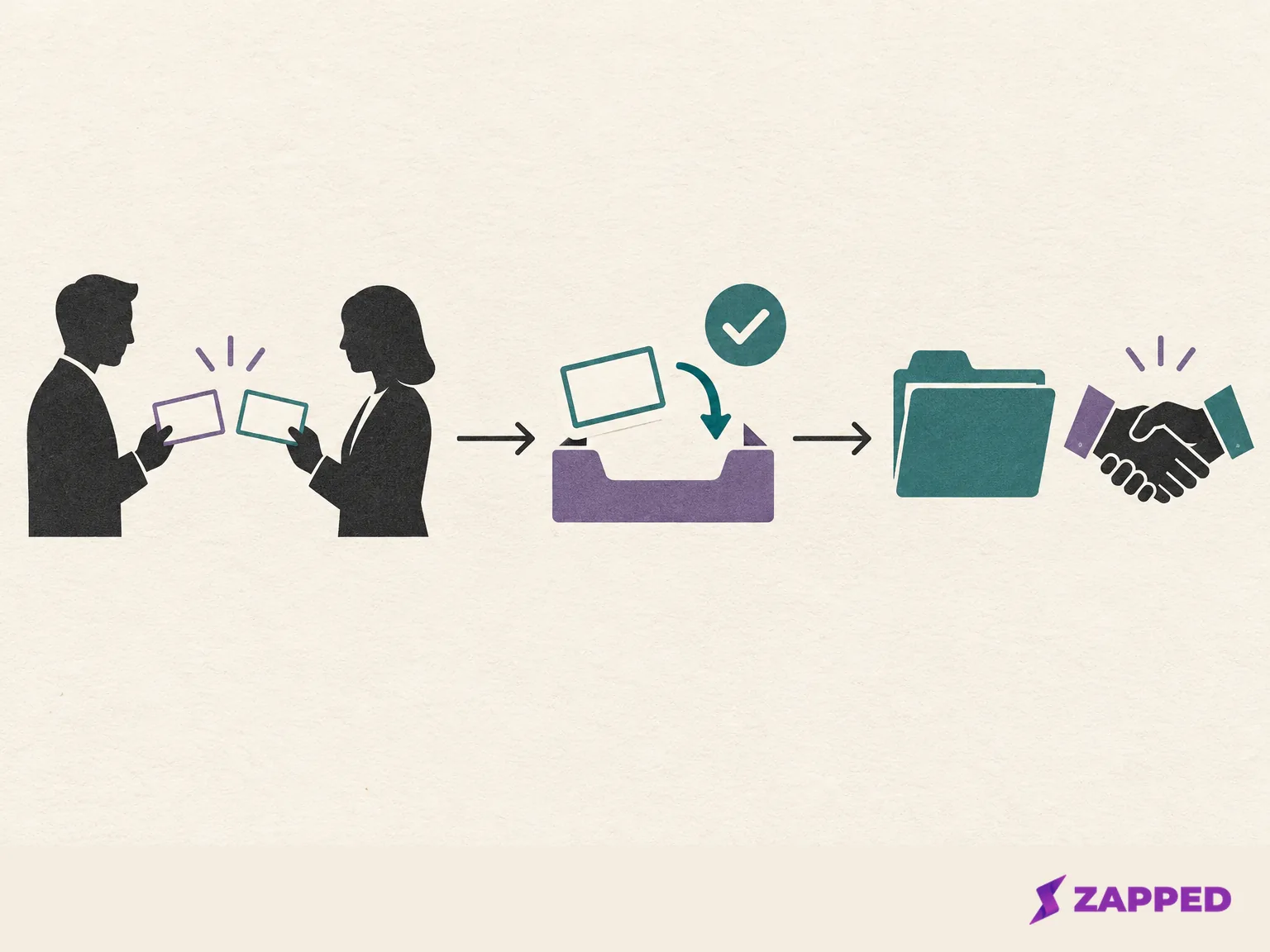
Not every event exists to fill a pipeline. If the goal was awareness or learning, forcing a pipeline number onto it just produces a weak one. Choose one behavior the event was meant to produce instead: a session actually attended, a meeting completed, an interaction after someone opened your card.
A working rate is unique attendees who complete that action divided by actual attendees, from event platform or session records. Short attendee surveys can add context, and Cvent suggests timing them close to the event so memories are fresh. Keep these as goal-specific signals. They aren't a second ROI formula.
If you hand out digital cards, a card-level signal can describe the exchange. Zapped isn't built as an event analytics or ROI platform. Zapped shows per-card views, visitors, interactions, and device or referrer detail when available (see our statistics help), and lead form submissions arrive in Inbox. Event-wide attribution and pipeline reporting sit outside that, and Zapped statistics describe activity, not intent. For the card-specific calculations, the NFC card CRM integration guide goes further.
Use cost per attendee as an explanation, not a verdict
Cost per actual attendee is the approved event cost divided by actual attendance. Cvent describes it as the average financial commitment per participant. Finance owns the cost record, the event producer owns the attendance count, and one of them should own the cost scope so it doesn't drift between events.
It helps explain efficiency. It can't stand in for the goal, because a cheaper attendee doesn't prove the event reached the right people. The full cost inventory is in the ROI guide.
Organizers comparing shows use a different set
If you run an exhibition rather than staff a booth, the useful comparison changes. IAEE and CEIR's Event Performance Analyzer compares attendee count, exhibitor count, paid exhibit space and organizer revenue against prior editions and a CEIR sector peer set. That's peer comparison for organizers. It isn't a target for an exhibitor's leads, and there's no universal benchmark to borrow. For a post-event report, the Events Industry Council's 2026 report template has the lead planner assemble it, each area's data come from whoever is responsible for that area, and fields with no applicable data marked NA instead of left blank, within 30 days.