You can copy or recreate some simple NFC tags, especially tags that store a public URL. Cards tied to access systems, payments, or changing credentials usually work differently, so the useful answer depends on what the NFC card stores.
Quick answer
You can usually copy or recreate a basic NFC tag when it stores a readable URL or contact link. You usually cannot turn building badges, payment cards, or other system credentials into a normal phone copy. For business cards, the practical move is to write a Zapped profile URL to a card you control.
Key takeaways
- Simple NFC tags can store public records such as URLs, contact links, or app actions.
- The thing to identify first is the payload: public URL, contact link, app action, or system credential.
- iPhone and Android can read many NFC tags, but Android is usually more flexible for writing tags.
- For networking, use an NFC business card that opens a digital profile URL you control.
- Dynamic profile URLs are easier to update than static contact details stored on a chip.
Can you copy an NFC card to your phone?
You can copy or recreate an NFC card only when the card stores simple, readable data such as an NDEF website link. You usually cannot copy cards that depend on encrypted credentials, backend authorization, changing keys, secure elements, or access control systems.
That difference matters. A basic NFC sticker that opens https://example.com is just storing a small public payload. A building badge or payment card is part of a managed system, so the phone usually needs an official mobile credential rather than a copied chip.
| Card or tag type | Can a phone copy it? | Better approach |
|---|---|---|
| NFC business card URL | Usually yes, if it is a simple writable tag | Write your own Zapped profile URL to the card |
| NFC sticker with website link | Usually yes | Read the URL, then write it to a new blank tag |
| Access badge or key fob | Usually no | Ask the building or system admin for mobile access |
| Hotel key card | Usually no | Use the hotel's official mobile key system if available |
| Payment card | No | Use Apple Pay, Google Wallet, or the issuer's approved wallet flow |
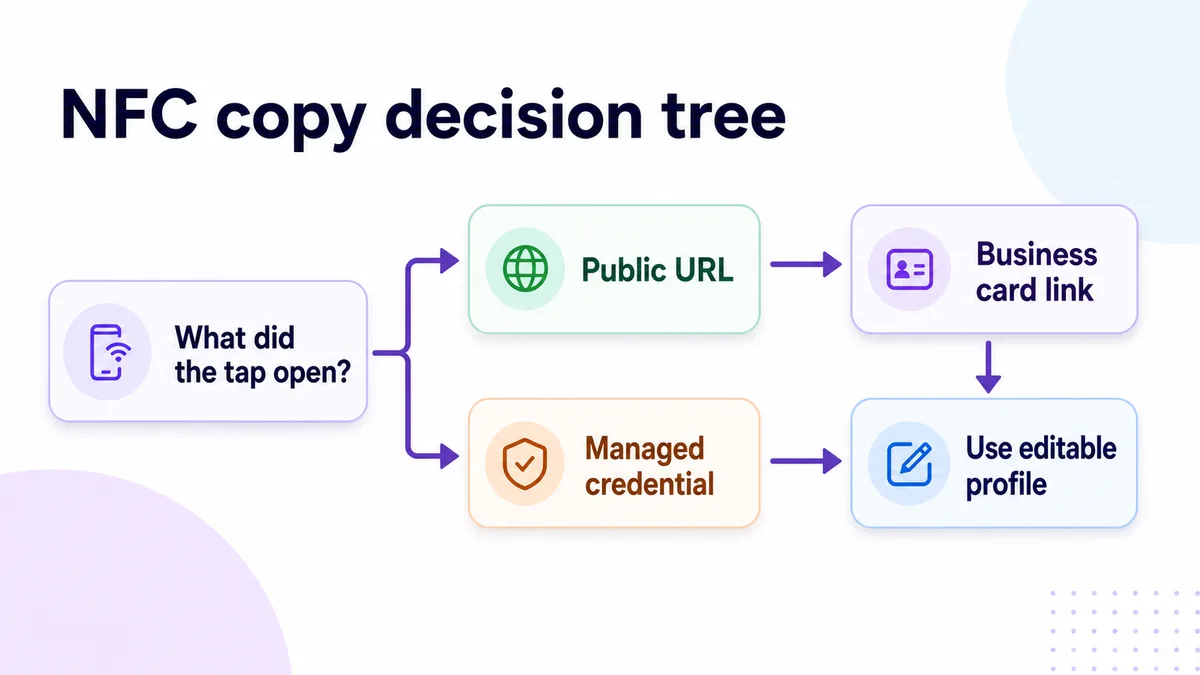
The decision tree below is the fastest way to think about the issue. If the tap opens a public URL, you are usually dealing with a simple link. If it represents access, payment, or another managed credential, the right path is the official mobile credential flow.
How NFC cards and tags store data
NFC is a short range wireless technology that lets compatible devices exchange small amounts of data when they are close together. Android's NFC overview describes NFC as typically working at about 4 cm or less, and the NFC Forum describes NFC Forum tags as contactless memory cards that can store an NDEF payload.
For business-card use, the most common payload is simple: a URL. When someone taps the card, the phone opens a link to a digital profile, contact page, lead form, or company card.
That is how a Zapped NFC business card should work. The physical card does not need to hold all of your contact details. It can hold a short Zapped URL, and Zapped can keep the destination current.
Can iPhone copy an NFC card?
An iPhone can read many NFC tags, including tags that contain NDEF data, but it is not a universal NFC card copier. Apple's Core NFC framework is designed for reading supported NFC tag types and working with tag data in apps, so it is best for links, app experiences, and official wallet flows.
For a simple business-card tag, an iPhone can usually read the link when you tap the card. If you want to create or edit NFC business cards, you normally use a supported NFC writing app, a card provider, or a service like Zapped that prepares the destination URL for the card.
What iPhone NFC is good for
- Reading NFC tags that contain public links.
- Opening digital business cards from an NFC tap.
- Launching supported app experiences from tags.
- Using approved wallet and payment flows.
Where iPhone uses official systems
- Payment cards through Apple Pay or an issuer supported wallet flow.
- Workplace, apartment, hotel, or gym access through the provider's mobile credential system.
- Transit cards through supported wallet or transit provider options.
- Managed cards where the app, issuer, or access provider controls the phone credential.
Can Android copy an NFC card?
Android phones can read NFC tags, write NDEF data to compatible blank tags, and support host based card emulation for certain app controlled card experiences. That still does not make Android a universal card cloning device.
Android's NFC documentation explains NFC tag reading and writing through NDEF messages. Android also supports host based card emulation, where an Android app can emulate a card for compatible readers. Those are developer features and platform capabilities, not a promise that any physical card can be copied.
For simple tags, Android is often flexible. For secure cards, the useful data is usually protected by the card technology and the access system behind it.
How to copy a simple NFC business-card link
If the original NFC card only opens a public business-card URL, you can recreate that experience with a new NFC tag or card.
- Tap the existing NFC card with your phone.
- Confirm that it opens a normal web link, such as a Zapped profile URL.
- Copy the URL from the browser.
- Use an NFC writing app, such as NFC Tools on Google Play or NFC Tools on the App Store, to write that URL to a compatible blank NFC tag.
- Tap the new tag with an iPhone and Android phone to confirm it opens the right page.
- If the card is for a business profile, make sure the destination page can be updated without reprinting the card.
The key screen in most NFC writing apps is the URL record screen. That is where you paste the public profile link you want the new tag to open.
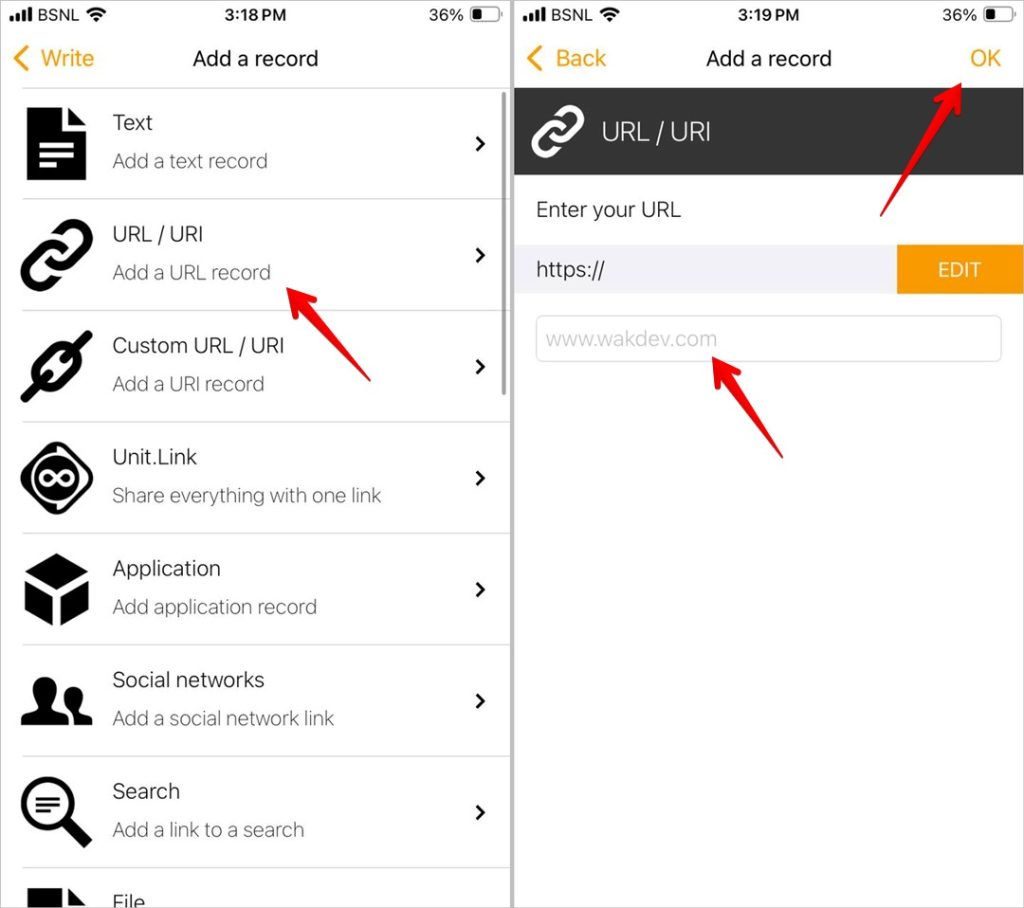 Visual reference: NFC Tools URL record screenshot from TechWiser's NFC tag programming walkthrough.
Use this workflow for NFC tags or cards you control, such as a business-card link. Access cards, payment cards, transit cards, and managed credentials need the official mobile flow from the provider.
Do this before buying blank tags
If you are copying a business-card link to new blank tags, test one tag before buying a pack or ordering printed cards.
- Scan the original card and write down the exact URL.
- Open the URL in a private browser window to make sure it works without your account logged in.
- Write that URL to one blank tag.
- Tap the new tag with an iPhone and Android phone.
- Confirm the profile opens without an app install prompt.
- Change one detail on the profile, then scan again to confirm the tag still opens the updated profile.
That last check proves you copied the right thing: a live profile URL, not a static contact record that will go stale.
Why a dynamic NFC business card is better than cloning
Copying an old NFC tag recreates whatever was on the tag at that moment. A dynamic NFC business card gives you a stable tap URL that you can update later.
With Zapped, the physical card can point to your digital profile while the profile itself can be edited from your account. That means you can update your phone number, job title, links, booking page, company page, or lead capture flow without replacing the physical NFC card.
| Approach | What happens when details change? | Best for |
|---|---|---|
| Static copied NFC tag | You may need to rewrite or replace the tag | Simple one time links |
| Printed paper business card | You need to reprint the card | Low tech handouts |
| Dynamic NFC business card | Update the online profile, keep the same card | Networking, teams, events, and sales |
Related guides:
- What are NFC business cards?
- Can NFC cards be rewritten?
- How to generate a vCard QR code
- Digital business cards for teams
Common mistakes to avoid
Treating every NFC card as the same is the first mistake. NFC is a communication technology, not a single card format. A simple URL tag and a managed access credential can both use NFC but behave very differently.
Be careful with apps that promise to clone every card. Some tools can read public tag data, but managed cards often cannot be copied in a useful way. Apps that ask for root access or promise universal card cloning can create reliability and account security problems.
For business cards, avoid putting permanent contact details directly on the chip if you expect them to change. A dynamic profile URL is usually more durable than writing a fixed phone number or email address to the tag.
Use Zapped instead of trying to clone the card
For business cards, the better question is not whether you can clone a tag. It is whether you control the destination behind the tap. Zapped lets the NFC card point to a profile you own, so the card can be recreated, shared, or updated without copying protected credentials or rebuilding the whole contact experience.
That is especially useful when a team member changes roles, a phone number changes, or you want the same profile to work from NFC, QR, email, and direct link sharing. The card becomes a pointer to a live profile, not a fragile copy of static data.
FAQs
Can I copy an NFC access card to my phone?
Usually no. Most access cards and key fobs are tied to an access control system, so the phone needs an official mobile credential from the property manager, employer, school, or access provider.
Can I copy an NFC tag to another NFC tag?
Yes, if the tag stores readable data and the new tag is compatible and writable. A simple website URL is usually easy to recreate. A locked tag, encrypted card, or system credential is not the same thing.
Can I copy an NFC card to an iPhone?
An iPhone can read many NFC tags, but it cannot clone every NFC card. It is best for reading supported tags, opening links, and using approved wallet features.
Can I copy an NFC card to Android?
Android is often more flexible for reading and writing simple NFC tags. Android also supports host based card emulation for app developers, but secure cards still cannot usually be cloned into a normal phone credential.
What should I put on an NFC business card?
For most business cards, write a dynamic profile URL. A Zapped digital card URL can show your contact details, links, QR code, booking page, team profile, and other details while letting you update the online profile later.
Sources
This guide uses current NFC platform documentation and official NFC standards resources to explain practical NFC tag behavior for business-card and URL workflows.
- Android NFC overview: Used for Android's NFC distance and data sharing overview.
- Android NFC basics: Used for Android NDEF reading and writing context.
- Android host based card emulation: Used for Android HCE context.
- Apple Core NFC: Used for iPhone NFC tag reading capabilities.
- Apple Pay: Used for official payment wallet context.
- Google Wallet: Used for official wallet context.
- NFC Tools on Google Play and NFC Tools on the App Store: Used as example NFC writing apps for simple writable tags.
- TechWiser, how to program NFC tags on iPhone and Android: Used for the NFC Tools URL-record screenshot reference.
- NFC Forum NFC technology: Used for NFC Forum tag and NDEF context.