To edit a vCard file safely, keep the original untouched, correct the contact in a contact app that can export a vCard, and check the exported copy before replacing anything. Use a text editor only when you can preserve the file's version, required fields, line endings, escaping, and repeated properties.
For an ordinary name, phone, or email correction, start with the contact record. A VCF can look perfectly readable while the saved contact has lost a photo, a note, or the second number you actually needed.
Start with a copy and one contact
Put the original file aside and give the working copy a distinct name. If you're correcting a larger export, start with one contact. The whole address book is too much to put on a first experiment. Before replacing a larger file, reopen or import the edited copy into its intended destination and inspect the corrected display name, phone, and email.
Google Contacts documents importing a VCF file through Import > Select file > Import. That gives you a concrete place to check the result if Google Contacts is your destination. Saving the file is only the midpoint.
Do you need a corrected file to send elsewhere, or just a corrected contact in your address book? For the file, establish the app's documented export route before editing. For the saved contact, its editing controls are enough.
Follow your app's save and export route
On a Mac, start with the protected VCF working copy. In Contacts, Apple's documented file import route is File > Import: select that .vcf file and click Add. Review any duplicate indication, then select the intended contact before editing so you're correcting the right record.
With that contact selected, choose Edit, change the fields, and click Done to finish editing. Keep the contact selected and choose File > Export > Export vCard to create the corrected file. Check the vCard settings for notes and photos before exporting: those settings can include or exclude both. Reopen or import a sample from the corrected file and compare the changed fields and the details you kept before replacing a larger file. This is a useful route when the deliverable is still a VCF file.
On Android, Google documents opening Contacts, selecting the contact, tapping Edit, choosing an account if asked, and saving the changes. Its separate export route is Contacts > Menu > Settings > Export, where you choose the accounts to export to a VCF. You're editing one contact, but choosing accounts for the export. Inspect what the resulting file contains before treating it as your single corrected card.
On iPhone, open Contacts, tap the contact, tap Edit, change the information, and tap Done to save. That completes the contact record correction. For an incoming VCF, Apple documents tapping its attachment in an email or message to import it. These controls give you an editing route and an import route; they aren't instructions for exporting a standalone VCF from iPhone.
In Outlook, go to People, open the contact, and change its information. Microsoft documents Save & Close or Save: Save & Close in classic Outlook, Save in new Outlook. For a vCard received by email, open the attachment, choose Add to Outlook Contacts, and save. If your next job is producing a file for another system, establish the export route separately. A saved Outlook contact and a corrected VCF are different deliverables.
A raw edit, with the whole record visible
Use raw text editing when you're comfortable preserving the format as well as changing the values. RFC 6350 defines the vCard 4.0 structure: BEGIN:VCARD opens the record, VERSION:4.0 follows it immediately, FN supplies the formatted name, and END:VCARD closes it. Changing a version label is not a version conversion.
Here is a fictional vCard 4.0 correction derived from that RFC. The example.com addresses and 202-555-01xx numbers are placeholders. These records illustrate syntax, not an app export or a compatibility test.
Before:
BEGIN:VCARD
VERSION:4.0
FN:Alex Rivera
N:Rivera;Alex;;;
TEL;VALUE=uri;TYPE=cell:tel:+1-202-555-0101
EMAIL;TYPE=work:[email protected]
TEL;VALUE=uri;TYPE=work:tel:+1-202-555-0103
EMAIL;TYPE=home:[email protected]
NOTE:Fictional contact for this illustration.
END:VCARD
After:
BEGIN:VCARD
VERSION:4.0
FN:Alex Rivers
N:Rivers;Alex;;;
TEL;VALUE=uri;TYPE=cell:tel:+1-202-555-0102
EMAIL;TYPE=work:[email protected]
TEL;VALUE=uri;TYPE=work:tel:+1-202-555-0103
EMAIL;TYPE=home:[email protected]
NOTE:Fictional contact for this illustration.
END:VCARD
Start from a working copy of your existing record. For this name correction, FN changes from Alex Rivera to Alex Rivers, and N changes alongside it. FN is the displayed name; N holds five components in order: family name, given name, additional names, prefixes, and suffixes. In N:Rivers;Alex;;;, the final three components are empty. All four structural semicolons remain unescaped. Don't escape the separators you need the importer to recognize.
Next, change only the intended telephone line. The cell number moves from tel:+1-202-555-0101 to tel:+1-202-555-0102, keeping VALUE=uri and TYPE=cell. The work email moves from [email protected] to [email protected], keeping TYPE=work. Those labels identify which instance you're correcting. Replacing every telephone or email line would erase the distinction.
Compare the rest before saving. The work telephone remains +1-202-555-0103, the home email remains [email protected], and the NOTE stays intact. BEGIN, VERSION, and END also remain unchanged. Repeated TEL and EMAIL lines are deliberate, not clutter.
The displayed blocks have real line breaks, but an actual vCard must use CRLF content line endings. Preserve folded lines too: a continuation follows CRLF with one space or tab. Text values use RFC escaping for literal commas, backslashes, embedded newlines, and literal semicolons inside a component. That last rule is different from N's four structural separators. Small punctuation changes can change the structure.
For the broader format question, our guide to vCard files explains what a VCF carries beyond this correction.
Decide what must survive the edit
Before choosing an editor, look beyond the three fields you're fixing. RFC 6350 describes photos, notes, and multiple numbers, along with email addresses, logos, and other contact properties. Inspect PHOTO and NOTE lines, repeated TEL and EMAIL lines, labels, and any custom X- properties in your source. If the app displays only one number, that isn't evidence that the others are disposable.
For Mac exports, Apple's notes and photos settings deserve a deliberate check. A correctly saved name doesn't tell you whether those settings excluded the photo from the exported file.
A nicer editing screen doesn't tell you what will survive the export. If your chosen editor doesn't state which fields it preserves, stop before replacing the original. Return to the source contact system and use its documented export, or choose a tool that explains its field preservation.
Reopen the copy before replacing the source
Now test the edited file in the destination you actually intend to use. On a computer, Google Contacts uses Import > Select file > Import for VCF files. On iPhone, Apple documents importing by tapping a VCF attachment in an email or message. Use one contact for this check before moving on to a larger replacement.
Open the resulting contact and compare it with the original and your intended edits. For the fictional record above, that means Alex Rivers, the cell number ending 0102, and [email protected]. Then check the work number ending 0103, the home email, and the note. For your real record, add its photo, labels, extra numbers, extra emails, and other details you decided must survive.
Google specifically recommends checking Notes when imported details are missing. If something vanished, inspect that field before deciding the data is gone or the copy is ready.
If the import creates a duplicate, keep both files and stop. Duplicate handling varies by destination; Apple's contact import documentation doesn't give you a universal rule for replacing existing records. Resolve the destination's duplicate behavior before scaling up or overwriting the address book.
For an incorrect change to a Google Account contact, Google documents Undo changes within 30 days on Android. Contacts stored outside that Google Account aren't recoverable through that path. Keep the file backup regardless.
Use CSV when conversion is the job
If you're moving many contacts into Outlook or reconciling fields between systems, CSV can be a deliberate route. Microsoft documents CSV import and export, and recommends UTF-8 for new Outlook CSV imports. Keep the VCF backup and inspect a small imported sample before applying the conversion to the full set. Check where each source field landed, not just whether the import reported success.
For Windows, Microsoft's specific iCloud VCF to CSV route imports the file through the Windows Contacts folder, confirms contacts individually, exports CSV, and then uses that CSV for Outlook. That's a documented route for that transfer. It isn't a generic instruction to edit every Windows VCF in CSV.
For Google Contacts, Google advises splitting imports above 3,000 contacts. Start with the sample even if you're below that threshold. Size and field preservation are separate decisions.
When the details will keep changing
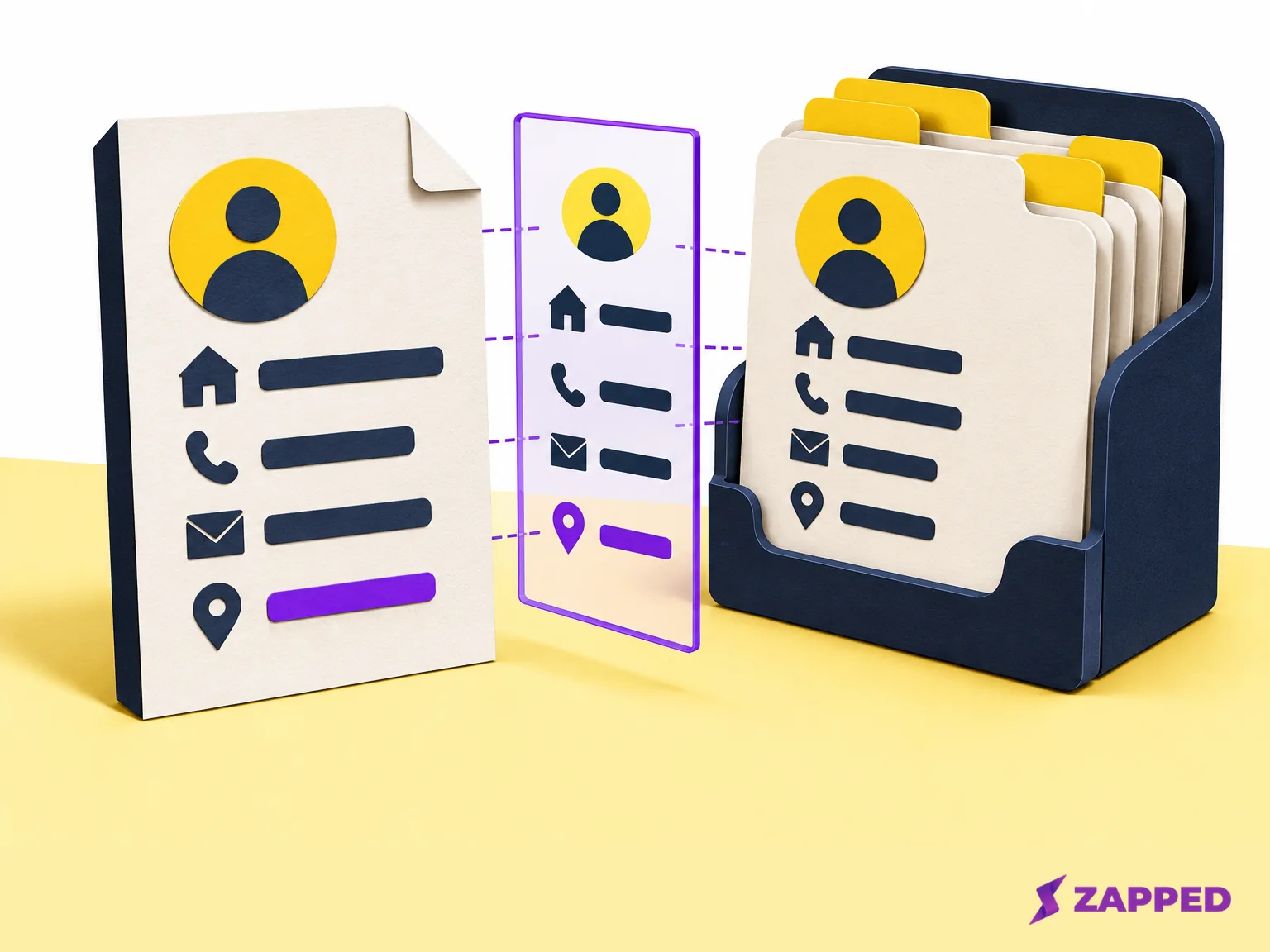
A corrected VCF solves today's file correction. If the real job is repeatedly updating the details behind a card you've already shared, Zapped's live digital card lets you edit after sharing while its printed QR code and shared links keep working. Use the live card for those future changes and the file workflow above to repair an existing contact export.
Replace the source only once the imported contact shows the corrected fields and every detail you chose to keep. Keep the original file as your way back.