To create a vCard file, export the contact from the address book that already holds it. If no contact exists, create a small record in a plain text editor, save it as a real .vcf file with UTF-8 encoding and CRLF line endings, then import a copy before sharing.
Start with the address book. It already knows more about the person than a blank editor does. A convincing filename isn't enough if the receiving app loses the phone number. For an introduction to the format, use the vCard file guide.
Start with the address book that holds the contact
Exporting saves you from rebuilding an existing record, but check who comes with it. Some exporters work on a selection; others work on a list or account. Choose the route for the app that holds the details, then confirm its scope before you send someone your whole list.
On iPhone, Apple's documented contact list export starts in Contacts > Lists. Touch and hold the intended list, tap Export, select the fields, tap Done, then choose a method to save or send the contact cards. You can create a list with Add List if needed. Export acts on that list, not on an individual contact. A person's Share Contact action is a separate route; don't look for this list Export flow on their contact card.
On a Mac, Apple documents exporting selected contacts as a vCard. Select the person in Contacts, choose File > Export > Export vCard, choose a location, and save. A selection of one is a useful starting point when the recipient needs one person's details.
iCloud Contacts also exports selected contacts as a vCard. Select the intended contacts and use Share > Export vCard. Several selected contacts become one vCard file. Before attaching it to a message, check that the selection contains everyone you intended, and nobody else.
On Android, Google's Contacts instructions describe exporting one or more accounts to a .VCF file. Choose the intended account or accounts through that export route. An account export shouldn't be mistaken for an instruction to save only the contact currently on screen.
Google Contacts on a computer needs a little care. Google's help names CSV and vCard as transfer formats, but its current detailed export steps specify Google CSV. They don't establish a stable desktop vCard button. If the contact is available on Android, the documented Android exporter gives you a VCF route; if your starting file is CSV, use the spreadsheet route below.
For classic Outlook, Microsoft documents File > Save As on an open contact to save a .vcf. The instructions cover classic Outlook for Microsoft 365 and Outlook 2024, 2021, 2019, and 2016. Use that route when Outlook holds the source record.
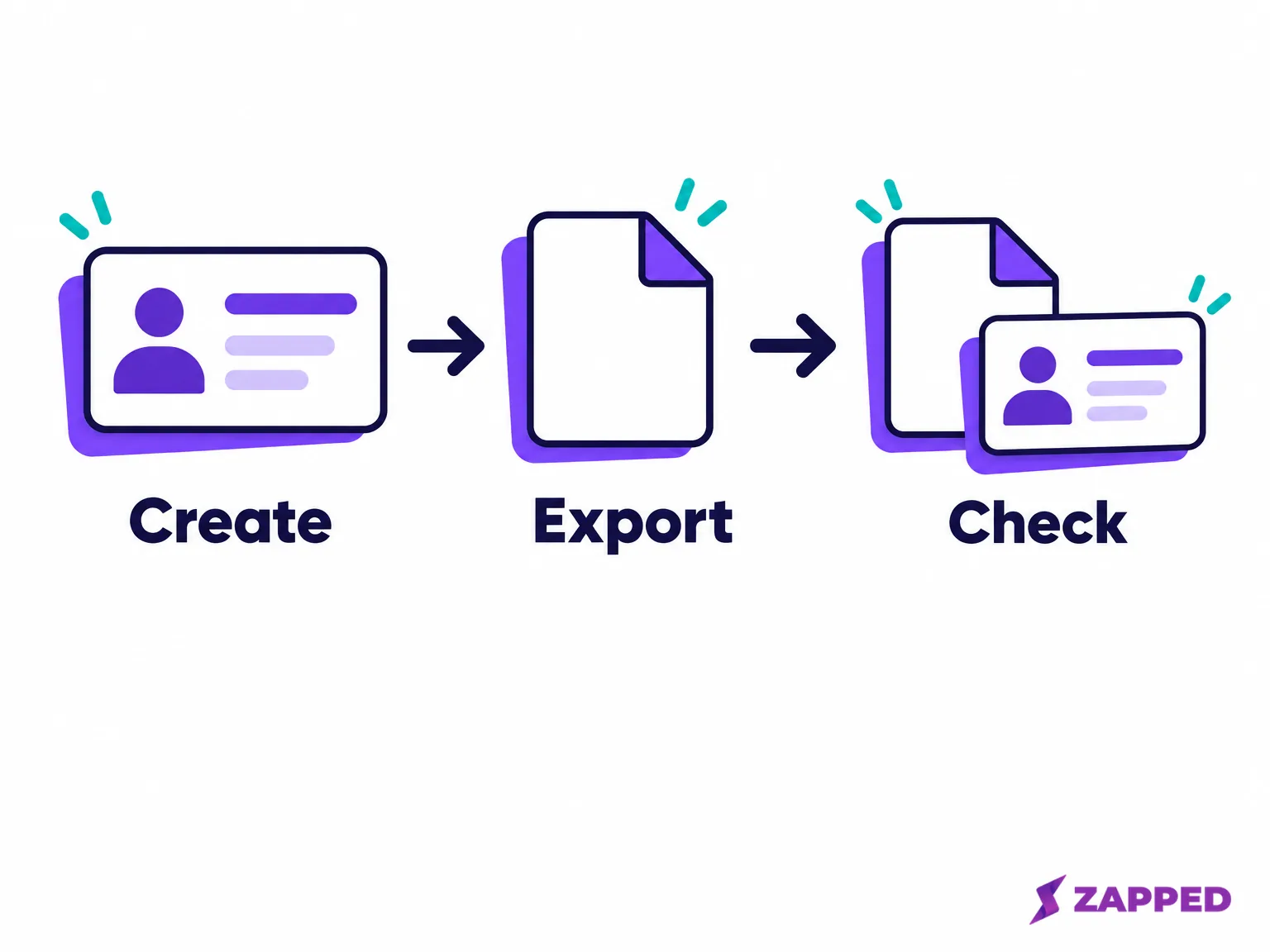
Choose the fields and version before typing
A name alone won't get someone very far. Start with the display name, phone, and email. Add a structured name, organization, and website when those details matter to the person receiving the contact.
The vCard 4.0 specification calls the display name FN, the formatted name. N holds five structured components in this order: family name, given name, additional name, prefix, and suffix. TEL carries the phone, EMAIL the email address, ORG the organization, and URL the web address. Choose the actual details you want to share before filling those fields.
The worked record below uses vCard 4.0. It starts with BEGIN:VCARD, puts VERSION:4.0 immediately next, includes FN, and ends with END:VCARD. N is optional in the 4.0 grammar, but belongs in a record whose name fits those structured components.
If the destination specifically requires vCard 3.0, use that profile's requirements instead. The older specification requires VERSION, FN, and N, with a version value of 3.0. Don't convert the example by changing its version line alone. The label must describe the record you've actually built.
If you're starting with a spreadsheet, map First Name and Last Name to FN and N, Organization to ORG, Phone to TEL, Email to EMAIL, and Website to URL. That explains where a row's values belong; it doesn't turn this single contact example into a batch converter. For a list of contacts, use the CSV to vCard conversion guide.
Build one contact without breaking its punctuation
For a contact that doesn't exist in an address book yet, desktop VS Code gives you a manual route you can inspect. Its documented file commands include New File and Save As. Create a new Plain Text file and paste this complete fictional record:
BEGIN:VCARD
VERSION:4.0
FN:Alex Rivera
N:Rivera;Alex;;;
ORG:Example\, Inc.
TEL:+1-202-555-0147
EMAIL:[email protected]
URL:https://example.com/alex
END:VCARD
The vCard 4.0 text rules give that punctuation a job. FN:Alex Rivera supplies the display name. N:Rivera;Alex;;; puts Rivera in the family name component and Alex in the given name component. The last three components, additional name, prefix, and suffix, are empty. All four semicolons stay unescaped because they separate the five components.
A literal semicolon inside one name component is different: escape that character with a backslash. For example, a family name containing a semicolon would put the backslash before that literal semicolon while retaining the four structural separators. Escape literal commas in text values, backslashes, and embedded newlines too. The distinction is the whole trick: punctuation inside a value needs escaping; punctuation that separates components must keep doing its job.
ORG:Example\, Inc. shows one literal backslash before the comma. It keeps the comma in the organization text. TEL, EMAIL, and URL hold the fictional phone, email, and website; replace those values with the details you chose. Keep BEGIN:VCARD, VERSION:4.0, and END:VCARD in place, and keep FN as the intended display name.
Before saving, clear out the fictional details. If there's no organization or website to share, remove the corresponding line rather than leaving Example, Inc. or example.com in a real person's file. Keep the structured name when it fits, and retain the phone and email you intend the recipient to save.
Save the active file, then reopen it
The vCard 4.0 specification requires UTF-8 and CRLF: the first is the text encoding, the second separates the individual lines. Set both on the file you're about to save. A default preference isn't proof that this file uses it.
With the file active in VS Code, inspect the status bar. The editor's status implementation exposes Select End of Line Sequence, with CRLF and LF choices. Click the end of line control and select CRLF for the current file.
Then check the encoding control. VS Code documents saving with a chosen encoding through that status bar control. Choose UTF-8 using Save with Encoding when needed. VS Code's file settings list UTF-8 as the default, but check the active file rather than relying on the default.
Use Save As, Close, and Open File to save the record as alex-rivera.vcf, close it, and reopen the saved file. That checks what reached disk. An unsaved tab can still look perfect.
Confirm the true filename ends in .vcf, not .vcf.txt. Fixing an accidental extra extension is a filename correction; it doesn't convert the text inside into a valid vCard. After reopening, confirm the status bar still shows UTF-8 and CRLF. Inspect BEGIN:VCARD, VERSION:4.0, the intended FN, the contact fields, and END:VCARD.
If your editor can't expose or confirm the active file's encoding and line endings, stop the manual route. Create the contact in an address book and use its documented exporter. Sending a file whose representation you can't check is a poor shortcut.
Check the person who arrives at the destination
Import a copy into the contact app that will receive the file. Google's documented VCF import steps are Import > select the file > Import. Apple's iCloud Contacts guide also supports importing a vCard. Microsoft says a received vCard opens a contact form displaying its information and can be added to Outlook contacts.
Now compare the imported contact with the saved text. Following the vCard record structure, confirm the wrapper, version, display name, and intended fields in the file, then inspect what arrived: contact count, name, phone, email, organization, and URL. If you intended one person, check for one person. If you included a website, look for that website.
An accepted import isn't the finish if the phone number is missing. Keep the original file and return to the source record or the syntax check; don't assume another app's acceptance proves this destination preserved everything. If the file won't open or imports incorrectly, use the vCard repair guide to tackle that failure before distributing more copies.
Use a live card when the details need to change
A saved VCF gives someone a contact file to import. If the job is instead to share a profile you can update later, Zapped offers a complementary digital vCard: its site documents sharing by link, QR code, or NFC tap and updating the card after sharing. That's useful when the shared destination needs to stay current as your details change.
For a requested .vcf attachment, the final check belongs in the receiving contact app: the intended person, with the details you meant to send. If a field is missing, keep the original and fix the handoff before distributing more copies.