To convert a vCard file to CSV, use Google Contacts on a computer, Microsoft's Windows Contacts route for an iCloud export, or Contacts and Numbers on a Mac. Keep the original VCF, compare the exported fields, and try a small destination import before sending the full set. A neat spreadsheet can still be missing the second phone number.
Before converting, check whether the receiving system accepts VCF directly. If it does and you don't need a table, you can skip the conversion.
First, decide whether you need a CSV
Google documents importing an existing VCF file, Apple lets Mac Contacts import a VCF, and iCloud Contacts can import a vCard. If one of those is your destination, you can use the original file directly. There's no prize for adding another conversion.
When you do need CSV, choose the receiving system before choosing the converter: its columns determine where the values must go. For the broader format decision, our guide to VCF files explains what you're starting with.
Give the second phone number somewhere to go
The vCard standard describes structured contact information, including names, delivery addresses, emails, multiple telephone numbers, and photos. A CSV has a different shape. RFC 4180 describes comma separated fields, with an optional header whose field count should match the records below it.
Now put two phone numbers through that conversion. In vCard 4.0, RFC 6350 allows repeated TEL and EMAIL properties, with TYPE parameters for labels such as cell or work. Here is a fictional record, not an export tested in an app:
BEGIN:VCARD
VERSION:4.0
FN:Alex Rivera
N:Rivera;Alex;;;
TEL;TYPE=cell;VALUE=uri:tel:+1-416-555-0142
TEL;TYPE=work;VALUE=uri:tel:+1-647-555-0198
EMAIL:[email protected]
END:VCARD
Google's contact template uses numbered label and value columns. It also allows extra columns for additional phone numbers or emails. This fictional row illustrates that template's shape; it is not observed app output:
First Name,Last Name,Phone 1 - Label,Phone 1 - Value,Phone 2 - Label,Phone 2 - Value,Email 1 - Label,Email 1 - Value
Alex,Rivera,Cell,+1-416-555-0142,Work,+1-647-555-0198,Work,[email protected]
Start with the name. N supplies the structured name: Rivera becomes Last Name and Alex becomes First Name. FN supplies the formatted display name, Alex Rivera. The illustrated row splits the name into two columns rather than adding a separate display name column.
The first TEL supplies Cell and +1-416-555-0142 to Phone 1. The second supplies Work and +1-647-555-0198 to Phone 2. Both numbers survive, and their labels remain attached to the right values. One generic Phone column would leave you deciding which number to sacrifice.
The email needs a closer look. EMAIL supplies [email protected] to Email 1, but the row assigns a Work label that the VCF's EMAIL property doesn't contain. There's no TYPE label on that property. Work is a mapping choice, not information recovered from the source. If an email label matters to your import, check where it came from.
These are Google template headers, not universal CSV columns. Use the destination's expected names and field mapping, while keeping separate places for repeated values.
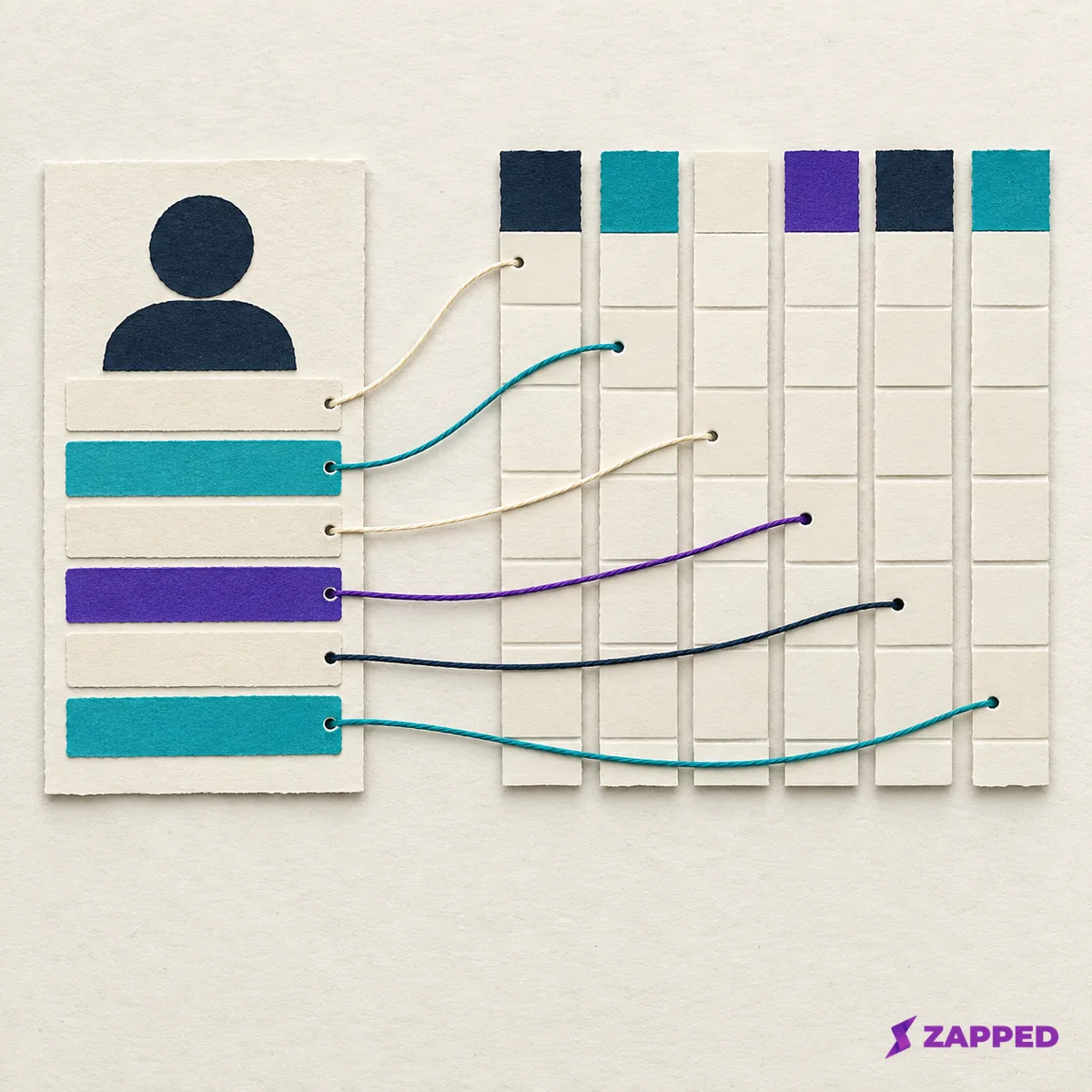
A converter also has to understand the vCard version, unfold folded lines, and decode escaped values. Renaming the file or replacing its punctuation with commas doesn't do that work.
Choose a route that fits your computer
Google Contacts: import, select, export
Start by confirming that the Google account is an acceptable place for these contacts. Google's documented VCF import sequence runs through Google Contacts on a computer:
- Open Google Contacts and choose Import.
- Choose Select file, select the VCF, and choose Import.
- Select only the intended imported contacts.
- Choose More actions, then Export.
- Choose Google CSV, then Export.
Steps four and five follow Google's Google CSV export instructions. Selecting the intended contacts matters: your conversion job is the file you brought in, not every contact already in the account.
Open the exported table and compare its headers and values with the original VCF. Then try a small import in the destination: a successful Google export doesn't settle how another system will map those columns.
Google identifies import problems when you try more than 3,000 contacts at once, reach its 25,000 contact limit, or use an unsupported format. If a detail seems missing after import, Google directs you to Notes. Check there before deciding the value disappeared.
Windows: Microsoft's iCloud bridge
For an iCloud VCF headed to Outlook, Microsoft documents a Windows Contacts bridge. Open the Contacts folder and follow this sequence:
- Choose Import, select vCard (VCF file), and choose Import.
- Select the VCF and confirm each contact with OK.
- Choose Close, then Export.
- Select CSV file, choose Export, choose the fields to include, and finish.
Don't click past the field selection. It's the point where you decide what the CSV will contain.
Microsoft also warns that an iCloud VCF can contain only one contact when you meant to export all of them. Apple says selecting several contacts in iCloud produces one vCard containing them all. One file is fine. One contact, when you expected a whole list, is a reason to return to the iCloud selection before converting again.
Mac: Contacts into Numbers
Apple documents three ways to import into Mac Contacts: open the VCF, drag it into Contacts, or choose File and Import. Once the contacts are there, Apple's Contacts and Numbers route is to select them, drag them into Numbers, then choose File, Export To, and CSV.
Apple notes that notes, photos, and choices about private cards can affect which fields are included. Decide whether you need those details before exporting, then inspect the result for them.
Starting on a phone? Make the VCF first
On iPhone, Apple documents exporting a Contacts list: select a list, choose Export, choose the fields, select Done, and save or send the exported contact cards. Choose the fields deliberately. A field left out here won't appear later by changing the spreadsheet header.
On Android, Google's documented route is Contacts, Menu, Settings, Export. Choose the account or accounts, then Export to .VCF file. The account selection determines which contacts you take with you.
These phone steps give you the source contact cards. When the receiving system requires CSV, continue with a computer route above.
Choose who gets to handle the contact file
For sensitive contacts, start with a local route that meets the destination's needs, or a platform account you're prepared to use for the data. An upload converter adds another decision: are you comfortable with its stated handling of the file? If it doesn't explain that handling or its field map, use a route you can assess and convert a small subset first.
Local execution alone doesn't promise complete conversion. The open source vcard2csv repository documents running locally, but says it preserves only some fields and does not implement vCard 4.0. It isn't a fit for the version 4.0 example above. Check the version and fields before adopting a script.
HowToCSV says its parser runs in the browser and joins multiple numbers or emails into one cell separated by semicolons. Those are the vendor's claims, not an independent test. The combined cell is also a different field choice from the numbered columns above: choose it only if the receiving system can use that arrangement.
A local converter can still drop a field. Assess where the file is processed and what survives as separate questions.
Check the result before the full import

Microsoft's guidance for preparing contact CSV files supports checking the table before import. Compare the intended contact count with the data rows, inspect the header and delimiter shape, and look at representative contacts with repeated fields, punctuation, and accented text. Then import a small set into the destination and inspect what actually lands there.
Choose contacts that will expose the loss you're worried about. Check a second phone or email, its label, and any notes, structured addresses, organization, title, URLs, custom fields, or photos you need to retain. Those details need a preservation decision; a CSV destination isn't obliged to have a useful column for each of them. Apple explicitly notes field choices in Mac exports, while Google recommends checking Notes for missing details.
If the trial import fails, the symptom tells you where to go next:
- The contact count is wrong. Return to the source selection. For an iCloud export, check Microsoft's documented single contact export problem. Adding spreadsheet rows won't recover contacts you never exported.
- Accented names look garbled. Microsoft recommends UTF-8 for Outlook CSV and says to cancel an unreadable import preview, correct the encoding, and restart. Stop at the preview.
- A value exists in the CSV but lands in the wrong field. Correct the destination's field mapping and retry the small import. The value is there; its assigned destination is wrong.
- A value is absent from the CSV. Return to the untouched VCF and export again with a route or field choice that retains it. A new column name can't restore a missing phone number.
- A note or address spills across columns. RFC 4180 requires appropriate double quote escaping for commas, quotes, and line breaks inside a field. Correct the quoting or use a route that handles the field before trying again.
Once the values are intact, our VCF to Excel guide is the next step for displaying or cleaning the table in Excel. Keep that work separate from recovering missing contact details. If you later need contact cards again, use the CSV to vCard guide for the reverse direction.
If your real goal is to keep a live, editable contact card available to people, Zapped offers link, QR, and NFC sharing with a browser experience for recipients. That complements a static export; the CSV serves the system that needs a table, while the live card serves the person you want to share with.
The small import is your last checkpoint. When its contacts land in the right fields, the full file's count matches, and the details you need have survived, send the full CSV. Keep the original VCF until the destination has proved it can use those details.