Practical networking tips for young entrepreneurs, including how to follow up, use digital contact cards, and build trust.
Quick answer
Young entrepreneurs network better when they treat each conversation as the start of a useful follow up, not as a pitch. Prepare a short introduction, ask better questions, share one easy contact path, and follow up with context while the conversation is still fresh.
Key takeaways
- Make the recipient journey clear before choosing the card format.
- Use QR or NFC as entry points, not as the whole strategy.
- Point scans and taps to an editable destination whenever details may change.
- Test the complete flow before printing or rolling it out.
What this means in practice
The point of networking is not collecting names. It is creating enough trust and context for the next conversation to happen naturally.
A refreshed business card should answer three questions quickly: who is this person, why should I care, and what should I do next? When the card points to a live profile, those answers can change as the business changes.
Networking workflow
| Moment | What to do |
|---|---|
| Before the event | Prepare a short intro and update your profile |
| During the talk | Ask useful questions before pitching |
| Contact exchange | Share one easy save path by QR, NFC, or link |
| After the event | Follow up with context from the conversation |
| Long term | Review contacts and look for useful introductions |
How to use this well
Start with the outcome. If the goal is a saved contact, make the save action obvious. If the goal is booking, put the booking link near the top. If the goal is local trust, include reviews, service area, and a clear way to call or request a quote.
Do not send every person to a generic homepage. A business card scan or tap should open a page made for that handoff. The page can still link to the full website, but it should not make the recipient hunt for the basic next step.
How young entrepreneurs should use the card
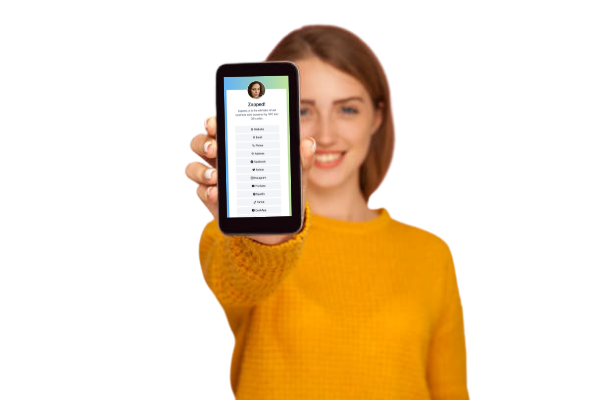
A digital contact card helps when your business is still changing. You can update your offer, portfolio, booking link, social proof, and contact details without reprinting every time the idea evolves. That matters for founders, freelancers, creators, and student entrepreneurs who are still testing markets.
Use the card as a follow-up tool, not just a digital replacement for paper. After a good conversation, send the profile link with a short note that reminds the person what you discussed.
Networking habits that make it work
Keep the profile focused on one clear outcome. If you want calls, make the call button obvious. If you want collaborations, show a portfolio and a booking link. If you want local customers, include service area and reviews. Then review the card monthly so old offers and inactive links do not undercut your credibility.
Make the card useful with Zapped
Zapped gives the card a live destination instead of locking every detail into print. The same profile can support QR codes, NFC taps, direct links, email signatures, social links, booking pages, and save contact actions.
That is the practical advantage of a digital card: people still get a simple handoff, but you can keep the profile accurate after the card is shared.
Examples by use case
A realtor can use the card to share listings, calendar booking, WhatsApp, and a saved contact. A consultant can point to a profile with case studies, a booking link, and a short service explanation. A restaurant or food business can link to menus, ordering, reviews, and loyalty signup. A creator can combine portfolio, store, social links, and email signup.
These examples work because the card is not trying to be everything. It is matching the recipient's next likely question. What do you do? Can I trust you? How do I contact you? What should I click first?
How to make the follow-up stronger
The card should support the conversation that just happened. After a networking event, sales call, local appointment, or customer interaction, the recipient should land on a page that reminds them who you are and why they should act. That means the first screen matters.
Use one primary action, then support it with proof. A buyer may need reviews, a portfolio, a service area, a booking button, or a short explanation of the offer. If the profile tries to serve every audience at once, it becomes less persuasive. Build the page around the next step that would make the relationship move forward.
FAQs
Do people need an app to open the card?
No. A strong recipient experience opens in a normal browser from a QR code, NFC tap, direct link, or message.
Should I use QR or NFC?
Use QR when visibility matters and NFC when fast close-range sharing matters. Many business cards should use both.
What should the profile include?
Include contact details, a save contact action, website or company link, and the most important next step for that audience.
How should I test the card?
Test the QR code, NFC tap, page speed, save contact action, and important links on both iPhone and Android before printing or sharing widely.
Sources
- NFC Forum technical overview for NFC tap behavior and common NFC use cases.
- IETF RFC 6350 for the vCard contact data format.
- Google Business Profile review guidance for review link and QR code workflows.